
12 min• 19.05.2026
The best league table creator in 2026
By Dawid Pątko

Football Mundial, the UK's largest FA-affiliated 5/6-a-side network, runs more than 30,000 players across 300+ leagues, and every one of those leagues needs a table that updates after every round. Multiply that by every corporate league, futsal night, school competition, and weekend six-a-side group out there, and you get a clear picture: thousands of organizers spend their Sunday evenings retyping standings into a spreadsheet or a free league table creator that breaks the moment a fixture moves.
The thing is, most tools sold as a league table creator – also called a league table generator or a league standings maker – are just calculators. They sort teams by points and goal difference, and that's it. A league table creator should do more than calculate points – it should keep your league running with zero spreadsheet work. Below is the league table creator we'd recommend to any organizer running an actual amateur league, plus five free alternatives that work fine if your needs stop at predictions or fantasy pools.
What makes a good league table creator?
Most people typing "league table creator" into Google are looking for a quick way to track standings. That's fair, and most free tools handle that part. The question is what happens when your league outgrows a calculator – when teams start asking about top scorers, players want fixtures published somewhere, and you start spending more time updating a spreadsheet than running matches.
The basics every league table creator must do
A league table creator is a tool that takes match results as input and produces a sorted standings table as output. Some platforms call it a league table generator or a league standings maker – same job. The minimum it should handle: number of teams, points awarded for wins and draws, goal difference, goals for and against, and at least one tiebreaker rule. Anything below that line isn't a league table creator – it's just a sortable spreadsheet.
For most amateur leagues, the standard 3-1-0 point system is the default (3 for a win, 1 for a draw, 0 for a loss). Futsal occasionally uses 3-2-1-0 to discourage draws. A creator worth using lets you pick.

What separates a calculator from a real creator
The line between a calculator and a real league table creator is whether the tool understands what comes before and after a match. A calculator takes results you typed in and shows the table. A real creator generates the fixtures, lets a referee record results from the pitch, updates the table automatically, tracks individual player stats, and gives you a public page to share with teams.
If you're running a real league, the calculator approach falls apart fast. You spend more time syncing data between tools than organizing actual football.
How we ranked the tools below?
The criteria below sort the field cleanly:
- Live updates from match results – does the table update itself, or do you type in scores manually after every game?
- Fixture generation – can it schedule rounds, or just track results from fixtures you built elsewhere?
- Player and team stats – top scorers, assists, cards, clean sheets, anything beyond the table itself
- Public website – can teams and players see the table without a login?
- Team capacity – does the tool break above 12 or 20 teams?
- Cost and access – free tier, signup wall, mobile app, or web only
A tool can rank well even if it only ticks one or two of these – as long as it's honest about what it's for. The best league table creator is the one that fits the league you run, not the one with the most features on paper.
The best league table creators in 2026
These six tools come up consistently when you research the league table creator category. We've ranked them by how well they serve a real amateur league organizer.
1. FLM System – the best league table creator for amateur leagues
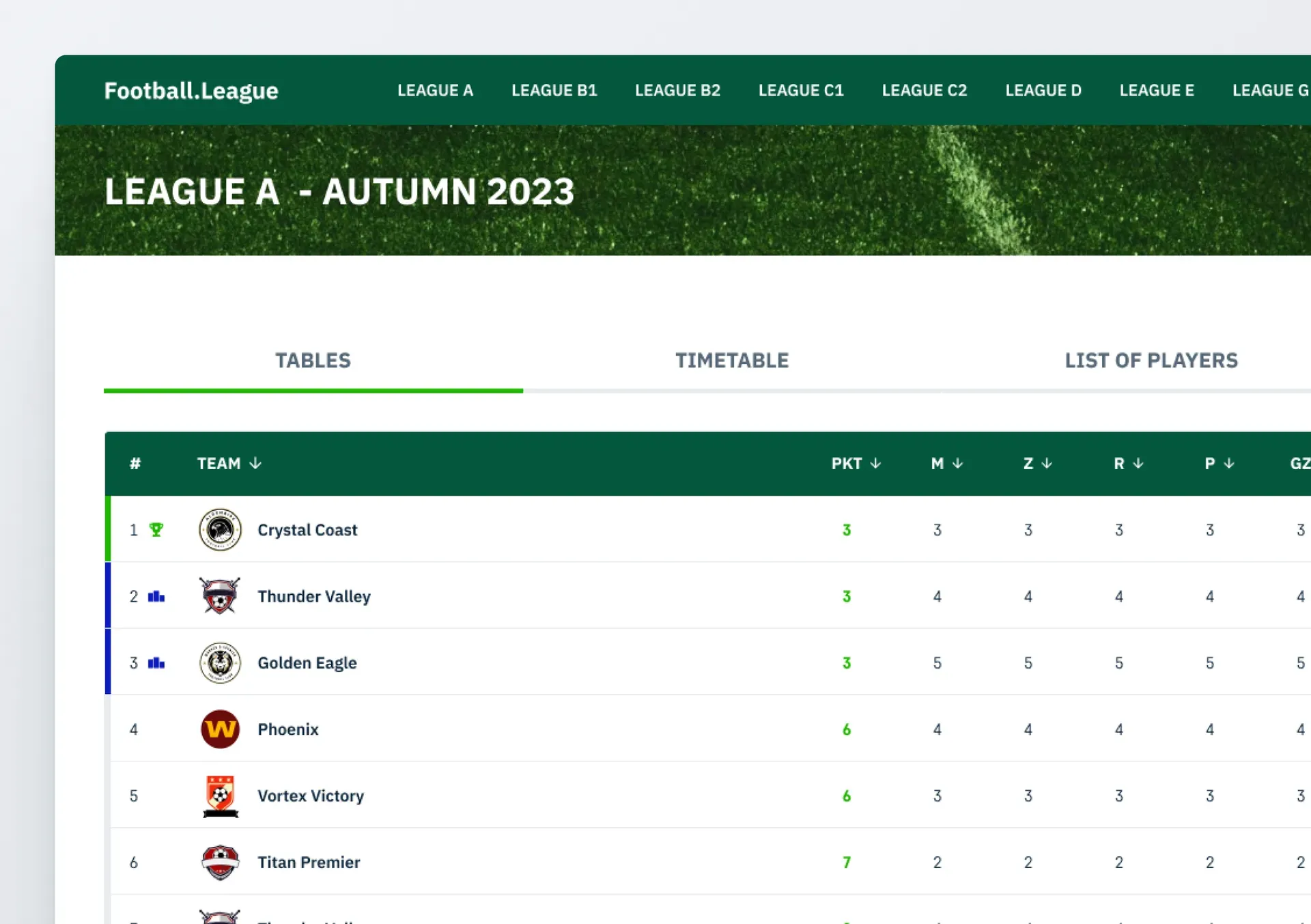
FLM System is the best league table creator on this list because it doesn't stop at the table. It runs the league. The platform was built for organizers of small-sided football – six-a-side, futsal, indoor, corporate – and the league table is one piece of a system that also handles fixtures, results, players, referees, and a public website.
What sets FLM apart is the data flow. A referee records goals, cards live from the referee app on the pitch, and the league table updates the moment the match ends. Top scorers, assists, and disciplinary records all populate from the same input. You don't retype anything.
- Live tables – auto-updated from match events, no manual entry
- Fixtures – built-in scheduler, supports round-robin, multi-leg, divisions
- Player stats – top scorers, assists, cards, clean sheets, season history
- Public site – every league gets a public page teams can share
- Team capacity – scales to leagues of any size
- Pricing – $1 per team per month, all features included
Best for: organizers running an actual amateur league with real fixtures, players, and referees – not a fantasy pool or office prediction game.
2. Kickly League Table Creator – free web tool with a 20-team cap
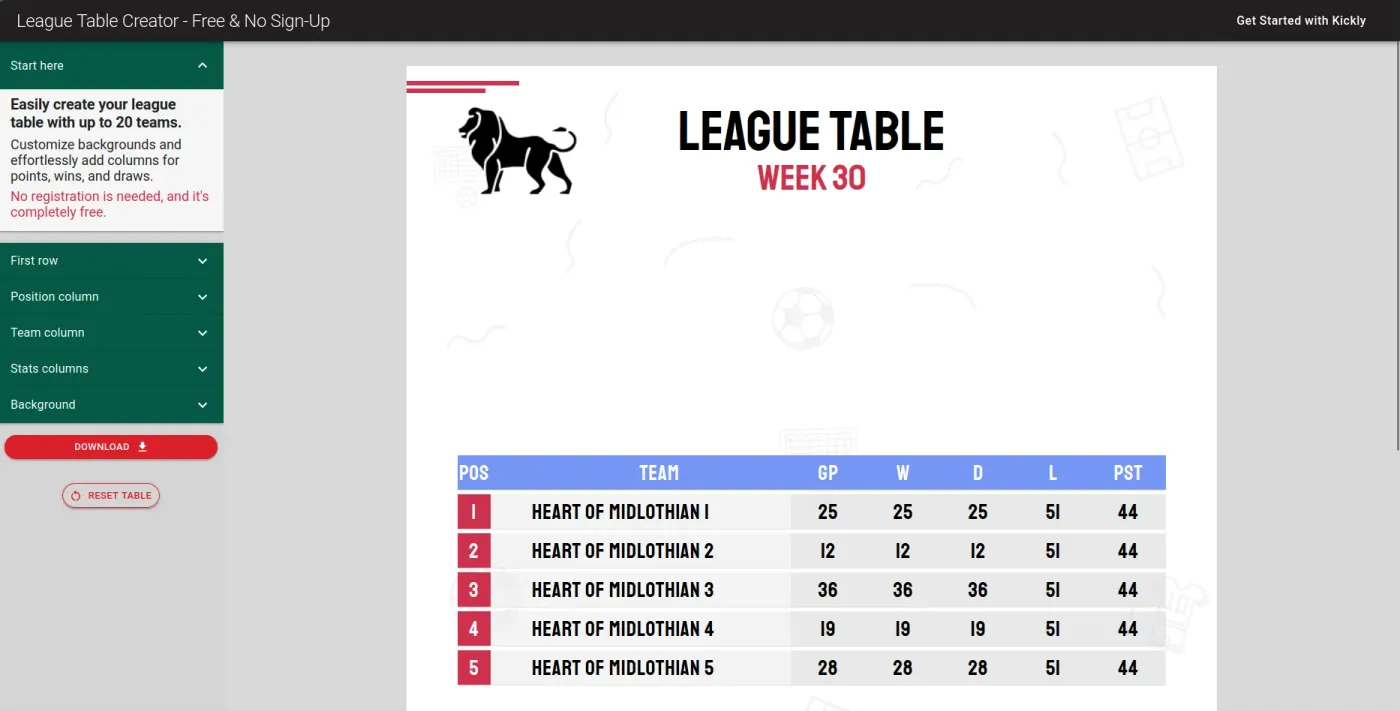
Kickly's League Table Creator is a free web app with no signup, capped at 20 teams. You enter team names, type in match results, and the tool sorts the standings. There's no fixture generator, no player tracking, and nothing is saved server-side once you close the tab.
- Live tables – manual entry, the page sorts as you type
- Fixtures – none
- Player stats – none
- Public site – no, results live in your browser session
- Team capacity – 20 teams maximum
- Pricing – free, no signup
Fits: weekend prediction pools, FIFA mini-leagues among friends, classroom exercises – cases where the league has a fixed end date and you don't care about persistence.
3. AthletePath Soccer League Table Maker – simple interactive standings tool
AthletePath's tool is a web-based standings calculator that auto-sorts as you log results. It handles leagues of any size, from a 4-team office tournament up to a 20-team division. The page does the math the moment you enter a score. Beyond that, there's no fixture management and no player roster.
- Live tables – manual entry, sorts on the fly as you log scores
- Fixtures – none
- Player stats – none
- Public site – limited, the page can be shared but isn't a real league hub
- Team capacity – flexible, no hard limit
- Pricing – free
Fits: small group leagues, training session tournaments, anything where typing in 6 results is faster than learning a real platform.
4. iCalculator Advanced League Table Creator – calculator with custom point systems
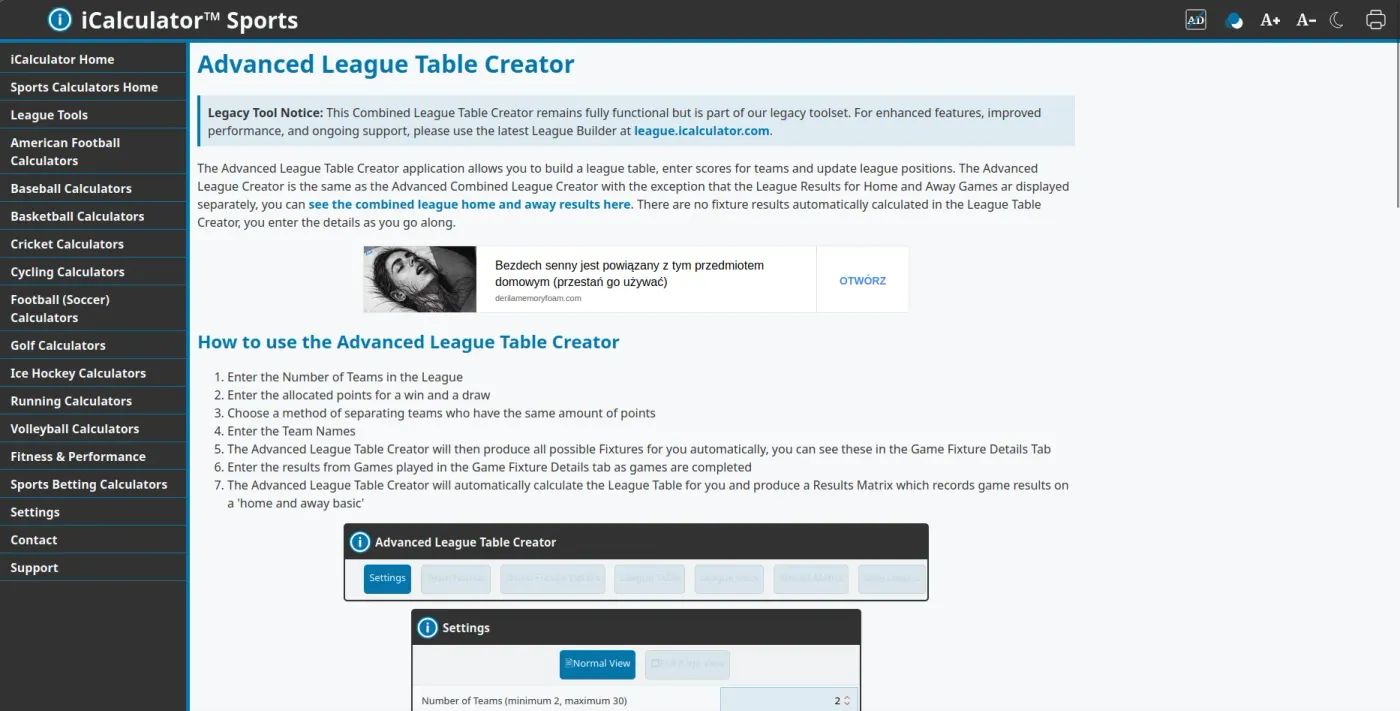
iCalculator's Advanced League Table Creator lets you set the number of teams, custom points for wins and draws, and how many times teams play each other. It also generates a sharing link so other people can see results as you update them. It's still a calculator – no fixtures, no player stats, no app – but the customization is unusual for the category.
- Live tables – manual entry, recalculates on input
- Fixtures – none, you decide who plays whom
- Player stats – none
- Public site – sharing link only, no real league page
- Team capacity – flexible
- Pricing – free
Fits: non-standard formats like racing leagues, F1 fan groups, or futsal pools that use a 3-2-1-0 system. Useful when the standard 3-1-0 doesn't apply.
5. Good Calculators League Table Creator – minimalist web calculator
Good Calculators offers a stripped-down league table creator with the basics: input team count, set point values for victories and draws, log results, and the page sorts positions. Save and load functionality means you can come back to a league later. The interface is dated and there's no fixture or player support.
- Live tables – manual entry, page sorts on input
- Fixtures – none
- Player stats – none
- Public site – no
- Team capacity – flexible
- Pricing – free
Fits: organizers who want a basic tool without learning a new app, and don't mind the look of a 2010-era calculator page.
6. Excel or Google Sheets – the DIY spreadsheet route
A spreadsheet template is still the most common league table creator in amateur football, mostly because every organizer has Excel or Google Sheets installed. You build the table, the formulas, the tiebreakers, and the fixtures by hand. You own everything and customize anything.
- Live tables – only if you build the formulas yourself
- Fixtures – manual, sometimes via templates
- Player stats – possible, but it's a second sheet you maintain
- Public site – none, unless you publish the sheet read-only
- Team capacity – unlimited, but performance degrades with complex formulas
- Pricing – free
Fits: organizers who genuinely enjoy spreadsheet work, or have a one-off league small enough that building the formulas costs less than learning a platform.
Quick comparison
For a side-by-side view:
- FLM System: auto-updated tables from referee input, full fixtures, full player stats, public site, $1/team/month
- Kickly: manual table only, no fixtures, no stats, no public site, 20-team cap, free
- AthletePath: manual table only, no fixtures, no stats, free
- iCalculator: manual table with custom point systems, no fixtures, no stats, free
- Good Calculators: manual table only, no fixtures, no stats, free
- Excel or Google Sheets: spreadsheet you build yourself, full control, free
The five free tools all do the same job slightly differently – calculate a table from results you typed in by hand. FLM is the only entry that runs the league around the table.
-1-900x502.webp?2026-07-08T14%3A18%3A43.124Z)
How to choose the right league table creator?
Six tools, one keyword, three different jobs. The choice depends on what you're tracking.
If you're tracking predictions or fantasy
A free web creator is enough. Kickly, AthletePath, iCalculator, and Good Calculators all handle the basic math, and the limitations don't matter when the "league" is a prediction pool that ends in 90 minutes. Pick whichever interface you like and move on.
If you run an actual league with fixtures
You need more than a calculator. The moment you have to schedule 12 teams across 22 rounds, track top scorers, or publish the table somewhere players can find it, you've outgrown the calculator category. The FORZA State of Grassroots Football 2025 report found that 81% of grassroots clubs cite a lack of funding and sponsorship as one of the biggest challenges they face in 2025 – meaning the last thing organizers need is to spend their week retyping scores into a free web app that can't even save them between sessions.
If you want one tool that handles everything
FLM System. It's the only league table creator on this list that owns the full data flow from referee input to public table. If you're new to running a league, the guide to setting up a league management system from scratch walks through the setup, and the comparison of soccer league management systems puts FLM in the wider context.
A league table creator is only as good as the workflow it fits. Pick the one that matches the league you run.

FAQ - League Table Creator
What is the best free league table creator?
For pure calculator use, Kickly is the easiest free option – web-based, no signup, sorts standings instantly, capped at 20 teams. AthletePath and Good Calculators do the same job with slightly different interfaces. None of them handle fixtures, player stats, or a public site, so they fit prediction pools and small one-off leagues, not a real season.
Can FLM System work as a league table creator?
Yes, that's the core of what FLM does, and the table comes from real match data, not manual input. Specifically:
- The referee app records goals, cards, and substitutions live during matches
- The league table recalculates the moment the match ends
- Top scorers, assists, and clean sheets populate from the same input
- The public league page updates without any extra step
Unlike a calculator, you never type a score into FLM – the data comes from the pitch.
How does a league table creator calculate tiebreakers?
A soccer league table creator applies tiebreakers in a fixed order when two teams finish on equal points. The standard sequence in amateur football is: head-to-head result, then goal difference, then goals scored, then goals conceded. Some leagues add fair play (yellow and red cards) as a final tiebreaker. The free creators usually default to goal difference and goals scored only, while a real platform like FLM lets you configure the full chain.
Can I create a league table in Excel?
Yes, and many amateur organizers still do. You set up columns for played, won, drawn, lost, goals for, goals against, goal difference, and points. Then you write formulas for points (wins × 3 + draws × 1) and goal difference, and use SORT or RANK to order the table. The work is in tiebreakers and fixtures – Excel handles them, but you build every formula yourself, and there's no public site to share with teams.
Does a league table creator generate fixtures too?
Most don't. The five free league table creators reviewed above only sort standings from results you've typed in – fixtures are something you arrange separately, often in a spreadsheet or a messaging group. FLM System is the exception on this list: it generates round-robin fixtures, supports multi-leg formats and divisions, and ties them to the table automatically.
Is FLM System free for small leagues?
FLM uses a per-team monthly model rather than a free tier. Pricing starts at $1 per team per month, which makes a 10-team six-a-side league $10 a month. For comparison, the free creators on this list cost nothing but also don't handle fixtures, players, referees, or a public site. If your "league" is a four-team office pool, a free tool fits. If you're running a real amateur league, the math usually works in FLM's favor once you count the hours saved.