
11 min• 28.04.2026
Top 5 soccer league website tools in 2026
By Dawid Pątko

In 2024, 16.7 million Americans played outdoor soccer and another 6.6 million played indoor soccer, figures that have climbed nearly 20% since 2018 according to the SFIA's 2026 participation report. The fastest-growing slice of that number isn't pro academies or college programs – it's the small-sided weekend leagues run by volunteers and independent organizers. Most of those players open the same page every week: their league's website.
For an organizer, that page is the first impression players, fans, and sponsors get of the whole competition. A fast, real-time site signals a serious league. A half-updated page tells everyone you're still figuring it out. The right soccer league website turns weekend matches into a recognizable, sponsor-ready competition. This guide breaks down what separates a good soccer league website from an amateur-looking one, ranks the five best soccer league website tools available in 2026, and helps you pick the one that fits your league. If you want a head start, FLM System is a purpose-built soccer league website platform that covers every point below in a single product.
What makes a great soccer league website?
Before comparing tools, it helps to define what "great" looks like in practice. The four pillars below are what separate a site that players check daily from one they visit once and forget.
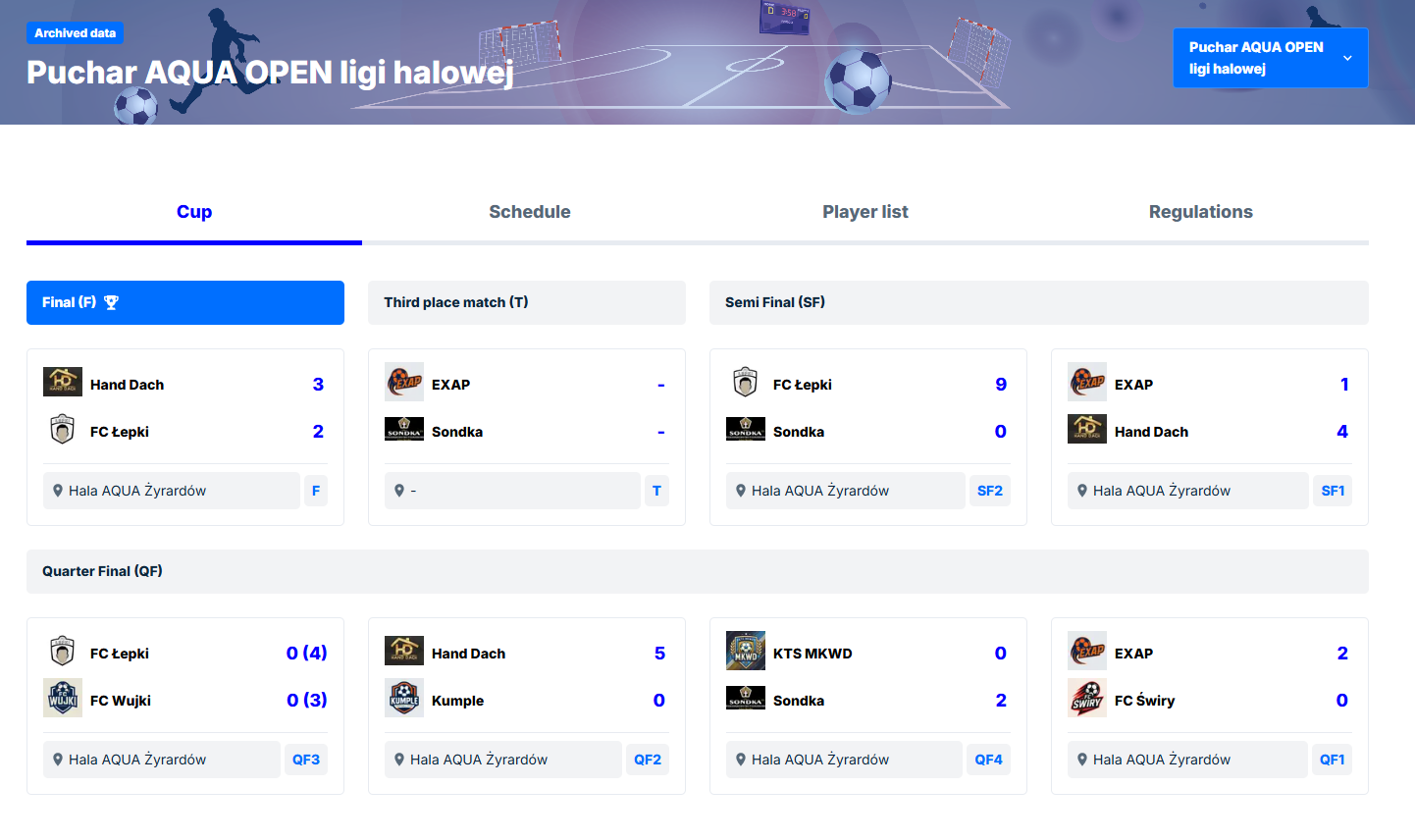
Real-time match data and standings
Players want to know the result the moment the final whistle blows. If someone has to log into an admin panel and type the score by hand on Sunday night, you've already lost the engagement window. The best soccer league website tools take referee or organizer input and push it to the public site within seconds.
Look for these specifics:
- Live score entry – ideally through a referee app, not a desktop form
- Auto-updating standings – tables, top scorers, cards, and form recalculate after each match
- Match event timelines – goals, assists, cards shown per minute
- Historical archives – previous seasons stay accessible, not deleted
Anything less means your "automated" website is just a manual website with extra steps. For a wider perspective, see this breakdown of automated league software and why automation changes the player experience.
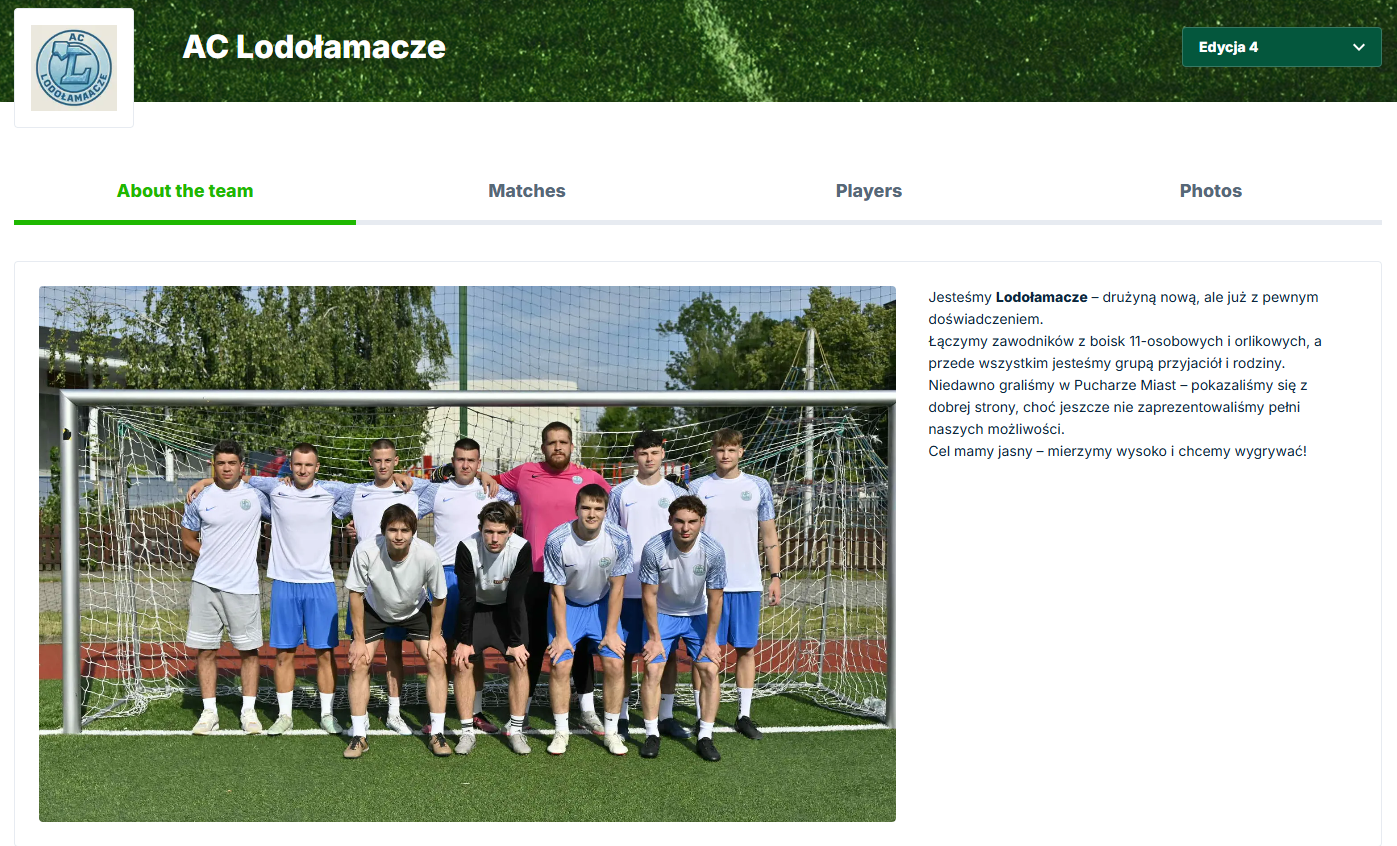
Player and team profiles with stats
Players treat amateur football the way pros treat their careers. They check their goal tally, their assists, their card history. A soccer league website that surfaces individual stats keeps people coming back well beyond match day.
Profile pages also help retention: when a player can send a recruiter, employer, or friend a link to their own season stats, the league becomes part of their identity, not just a Sunday hobby.
Mobile-friendly design
Most league traffic is mobile. People check fixtures on the way to the pitch and standings on the bus home. If the website looks like a desktop spreadsheet shrunk down, you're losing readers.
A mobile-first soccer league website should load in under two seconds, scale text without horizontal scrolling, and make the schedule and standings the first things visible above the fold.
Branding and sponsor visibility
Sponsors don't pay for invisible logos. A professional-looking soccer league website creates a placement they can point to – a banner above the standings, a logo on team pages, a sponsor section on every match recap.
The platforms covered below differ widely on this. Some let you swap colors, fonts, and logos in minutes; others lock you into a generic template that screams "free tier."
These four pillars separate a hobby site from a league worth sponsoring. For a deeper feature checklist for league websites, we cover each requirement in detail in a separate post.
The 5 best soccer league website tools in 2026
We evaluated platforms on the four pillars above, plus pricing transparency, ease of setup, and how the public-facing site looks once content goes in. The list focuses on tools where the website matters as much as the admin panel – not pure scheduling software with a basic page tacked on. For a broader view, see our ranking of league management systems which cover the back-office side in more depth.
1. FLM System – the most automated soccer league website on the market
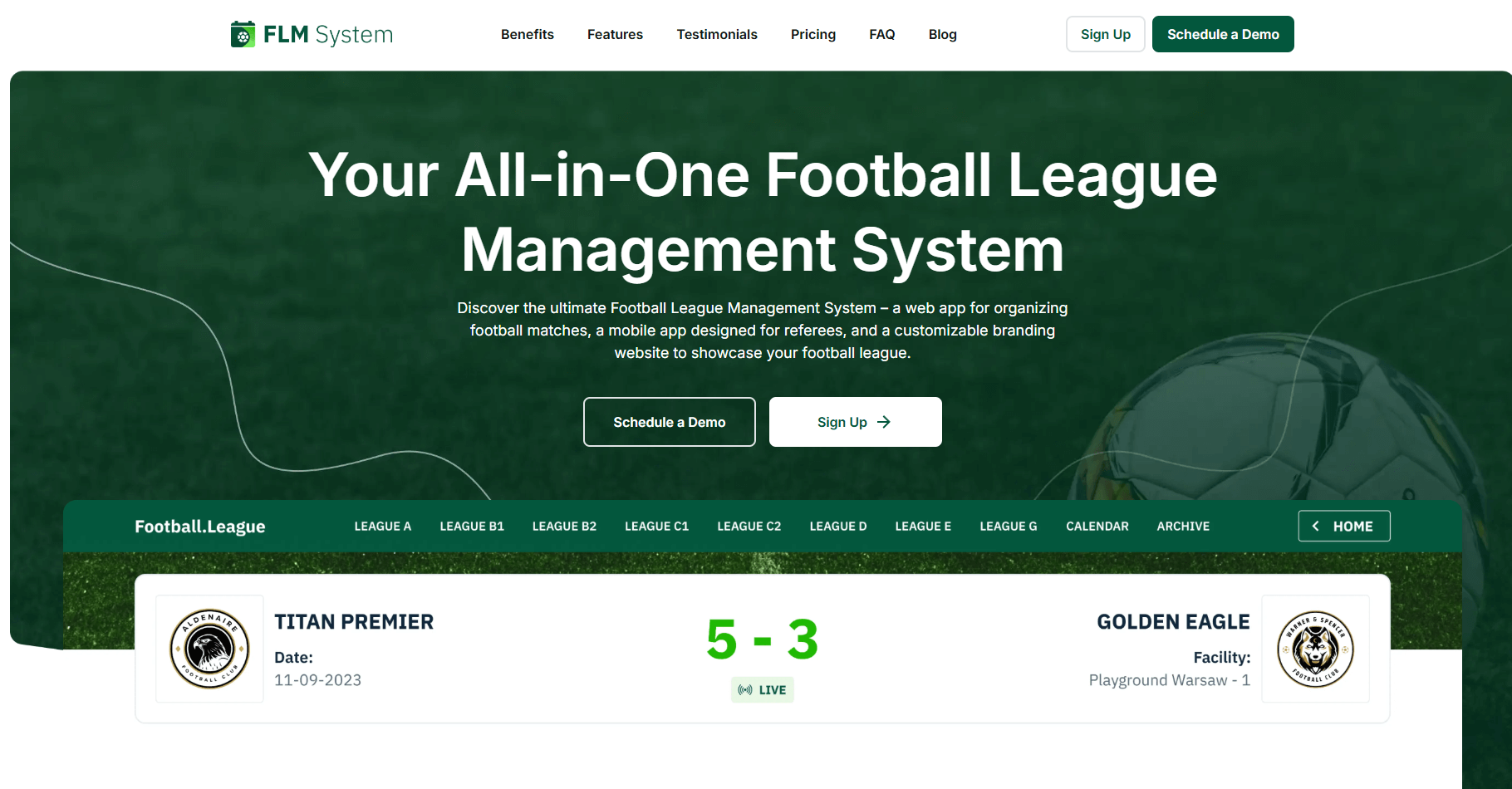
FLM System is built specifically for organizers running small-sided football leagues: 6-a-side (szóstki), futsal, 5-a-side, socca, and corporate competitions. It pairs a referee mobile app with a public-facing league website, so a goal entered on the touchline appears on the standings within seconds, with no manual sync.
The standout is exactly that automation gap. While other tools require an organizer to log into an admin and type results, FLM treats the referee as the data source. That means players see live scores during matches, top scorers update automatically, and the league table is correct before the organizer has even left the venue.
Design-wise, the public site is sponsor-ready out of the box: clean typography, mobile-first layout, configurable team and league branding, and dedicated sponsor placements. Pricing is straightforward at $1 per team per month, with no setup fees and no per-match charges. For a full picture of what a soccer league platform should include, this article on what a full league management system should include covers FLM's feature set in detail.
What you get with FLM:
- Referee app with live data entry – goals, cards, assists, substitutions in real time
- Auto-generated standings, top scorer, card, and form tables
- Player profiles with full season stats and history
- Match detail pages with minute-by-minute event timelines
- Branded public site – your logo, colors, sponsor placements
- Predictable pricing – $1 per team per month, no hidden fees
If automation and a clean public site are your priorities, FLM System is the most direct answer on this list.
2. Jersey Watch
Jersey Watch is a US-focused platform that bundles a soccer league website builder with registration and payments. It's built for volunteer organizers who want something live in an afternoon, not a week, and the soccer league website template library is the strongest in this category.
Key strengths and limits:
- Templates designed for US youth and amateur leagues – familiar layouts for parents and players
- Built-in registration and payment collection – useful if you handle fees through the same tool
- Drag-and-drop editor – no developer needed
- Limited live-data automation – standings and stats often need manual updates
- Pricing scales with features – the cheapest plans don't include the full website builder
If your league runs on volunteer time and you need to launch fast, Jersey Watch removes friction. If you want match-day data flowing automatically, you'll find it lighter than FLM.
3. LeagueRepublic
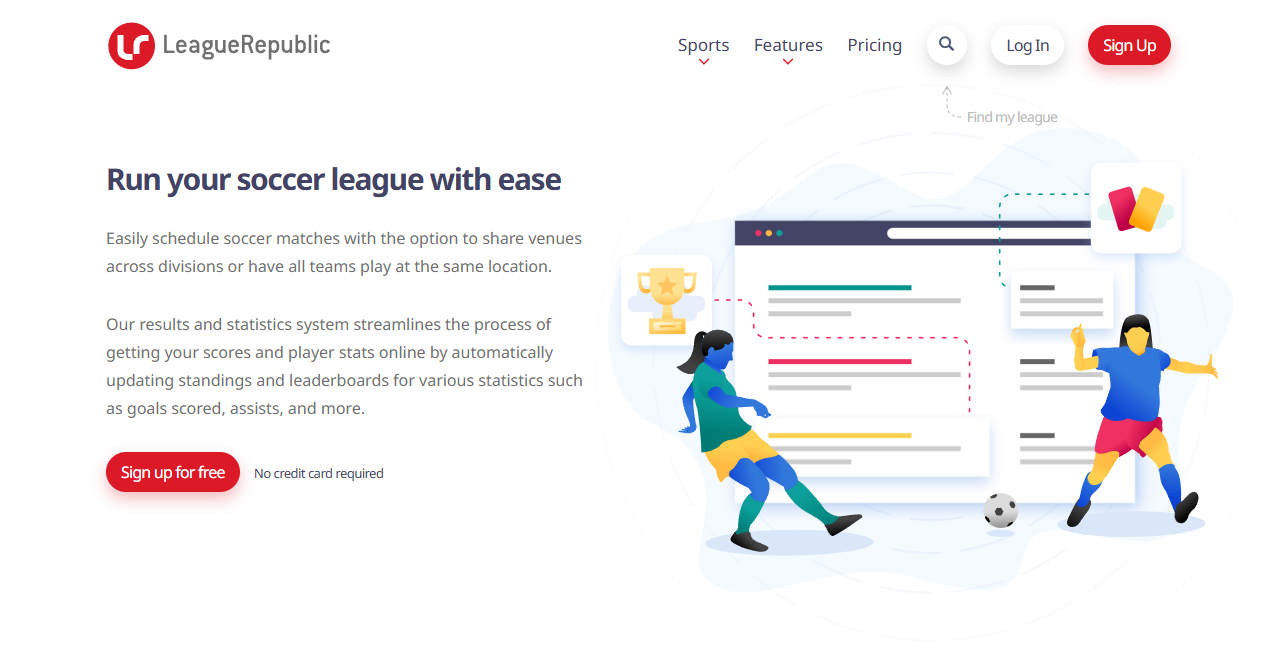
LeagueRepublic has been around for years and is widely used by small UK, Australian, and Irish amateur leagues. The hook is simple: the basic plan is free, and any change you make in the admin appears on the public soccer league website automatically.
Where it fits and where it doesn't:
- Free plan with auto-updating standings and fixtures
- Long track record – stable, used by hundreds of small leagues
- Generic site design – functional, not visually distinctive
- No referee mobile app – results are entered through the admin panel
- Sponsor placements are basic – limited customization on the free tier
LeagueRepublic is the safest choice if you have zero budget and just need fixtures, results, and a table online. The trade-off is a site that looks like every other LeagueRepublic site.
4. Pitchero
Pitchero leans heavily on visual quality. The platform sits at the club level more than the league level, but several leagues use its site builder for a polished public face. Templates are mobile-responsive and customizable without code.
What it does well, and where it falls short:
- Strong template design – arguably the best-looking out of the box
- Mobile-responsive by default – every theme adapts cleanly
- Club-first model – better fit if your league has affiliated clubs running their own sites
- Less suited to small-sided formats – no native referee app for live entry
- Pricing tiers can add up – advanced features are paywalled
Pitchero is worth a serious look if presentation and brand feel matter more than backend automation. For pure small-sided league operations, it's a heavier setup than necessary.
5. SportsPlus
SportsPlus is a sports-management platform with a built-in website builder. It targets organizations that want one tool for everything: registrations, scheduling, payments, communication, and a public site.
What stands out and what doesn't:
- All-in-one approach – website, scheduling, payments, communication on one login
- Multi-sport support – useful if your organization runs more than soccer
- Decent built-in templates – not as polished as Pitchero, but workable
- Heavier setup – more configuration than purpose-built league tools
- Pricing reflects the breadth – higher than single-purpose alternatives
If you run a multi-sport club with a soccer league inside it, SportsPlus is a sensible single-vendor choice. For a soccer-only league, the breadth becomes overhead.
.png?2025-12-12T12%3A47%3A08.690Z)
How to choose the right soccer league website tool?
The five tools above all build a soccer league website, but they're built for different organizers. These three checks will narrow the list to one or two real candidates.
Match the platform to your league's size and format
A 12-team weekend 6-a-side league has different needs than a 40-team multi-division youth competition. Small-sided organizers benefit from purpose-built tools like FLM System where the admin layer is light. Larger, multi-division operations may need the breadth of SportsPlus or Pitchero.
The mistake to avoid is over-buying. A volunteer running a single 8-team season doesn't need an enterprise sports-management suite – they need a clean public site and reliable standings.

Prioritize automation over manual updates
Think of your league website like a scoreboard at a stadium: if a person has to walk over and update it every minute, it stops being a scoreboard. Apply the same logic to the website. The platform you pick should remove the Sunday-night data-entry shift, not move it from one tool to another.
In practice, that means looking for live entry from the referee or organizer device, automatic recalculation of tables, and stats updates that don't require any second action.
Test the public-facing site, not just the admin panel
Most demos show off the dashboard. That's the wrong angle. Players, fans, and sponsors never see the admin – they see the public soccer league website.
Before you commit, walk through this short checklist on the live demo of each tool:
- Open the public site on a phone – does the schedule fit the screen cleanly?
- Click into a match detail page – are events shown clearly with times?
- Find the standings – do they include form, top scorer, and cards in one view?
- Check sponsor placements – is there room for real branding, or just a footer logo?
If any answer is "no" or "you have to upgrade," that's your decision-making data.
The cleanest path is to pick the tool where the public site looks the way you want without paid add-ons – and see FLM System in action if you want a working reference for a fully automated soccer league website.

FAQ - Soccer League Website
Do I need a separate website for my soccer league?
Yes, if you want the league to feel like a real competition rather than a private group chat. A dedicated soccer league website gives players, fans, and sponsors a single source of truth for fixtures, results, and standings, and it makes the league shareable outside your existing players.
How much does a soccer league website cost?
Costs vary widely depending on the platform and how much you want it to do. A rough breakdown:
- Free tools – LeagueRepublic basic plan, generic Wix templates: $0 but limited design and no automation
- Per-team pricing – FLM System at $1 per team per month, predictable as your league grows
- Tiered subscriptions – Jersey Watch, Pitchero, SportsPlus typically $30 to $200+ per month depending on features
For most small-sided leagues, per-team pricing scales the most predictably as you add or drop teams between seasons.
Can I build a soccer league website without coding skills?
All five tools in this guide are built for non-developers. None of them require HTML, CSS, or hosting setup – you sign up, configure your league, and the public site goes live. The differences are in design quality and how much manual updating the platform asks of you afterward.
What features should a soccer league website include?
The non-negotiables for a credible soccer league website are:
- Live or near-live match results
- Automatic standings, top scorer, and card tables
- Player and team profiles with season stats
- Mobile-responsive design
- Visible sponsor placements
Anything missing from this list will be obvious to players within the first few weeks of a season.
Is a free soccer league website builder worth it?
For a one-season trial or a tight pilot, free tiers are a reasonable starting point. The catch is that free plans usually skip live-data automation, look identical to every other free site on the same platform, and limit sponsor placements. If you're running a league for more than one season or trying to attract sponsors, the cost of an entry-level paid tool is recovered quickly.
How long does it take to launch a soccer league website?
With a purpose-built platform like FLM System, an organizer can have a basic public site live in an afternoon and a full season configured within a few days. Generic builders like Wix can take longer because you're designing the layout from scratch instead of starting from a soccer-shaped template.