
8 min• 03.07.2026
Indoor soccer explained: rules, players, and field size
By Dawid Pątko

Indoor soccer just had its best year on record. In 2025, 6.6 million Americans played the indoor game, an all-time high, as leagues filled turf arenas through the winter and right across the calendar. It is faster, smaller, and far higher-scoring than the outdoor game, and for a lot of players it has quietly become the main way they get on the ball each week.
Ask ten people what indoor soccer is and you will get ten slightly different answers, because the rules genuinely change from one venue to the next. This guide lays out what indoor soccer is, how many players are on a team, the field size, the core rules, and how the indoor game differs from both outdoor soccer and futsal. Only futsal is a standardized code; everything else people call "indoor soccer" is shaped by the facility and whoever runs the league. If that person is you, the last section is about turning it into a season.
What is indoor soccer?
The term covers a few variants, so it helps to start with a clear definition before getting into the rules.
Indoor soccer, defined
Indoor soccer is a fast, small-sided version of soccer played indoors, usually five or six players a side including the goalkeeper, on an artificial-turf field enclosed by walls or boards. The boards keep the ball in play, so the game flows almost without stopping. Most versions run two short halves and produce far more goals than a standard outdoor match.
Turf, walls, and the arena format
Indoor soccer is played on a turf field roughly the size of a hockey rink, around 165 by 90 feet, though the dimensions vary from one facility to another. The defining feature is the perimeter. Most arenas ring the field with solid walls or dasher boards, so a ball hit into them rebounds and stays live instead of going out for a throw-in. That walled version is often called arena soccer, and it is what most Americans mean by the term.
Not every venue has walls. Some use a smaller court with sidelines and no boards, closer to futsal, which is part of why "indoor soccer" is such a slippery label. The surface, the walls, and the court size all depend on where you play.

Indoor soccer rules and format
The rules follow from the space. A small field, a perimeter wall, and only a handful of players on each side add up to a quicker, more relentless game than the outdoor version.
Players and game length
Most indoor soccer is played five or six a side, including the goalkeeper, though youth and coed formats range from four to seven. Games are short. The usual format is two halves of about 20 minutes on a running clock, sometimes split into quarters. A full match wraps up in under an hour, which is exactly how a single arena can run league games back to back all evening.
The rules that make indoor soccer different
A handful of rules separate the indoor game from what you see on a Saturday-morning pitch:
- The ball stays in play off the walls – in the arena format, boards replace touchlines, so play rarely stops and the tempo barely drops
- No offside – most indoor and arena codes drop the offside rule entirely, which keeps attackers high and games open
- Rolling substitutions – players swap on the fly, hockey-style, so nobody stands still for long
- Fast restarts – kick-ins or plays off the wall replace throw-ins, and many venues run a short shot clock or a no-slide-tackle rule to protect players on the hard surface
- Smaller goals and a crease – goals are smaller than outdoor nets, and a marked goalkeeper area limits how defenders and keepers can play near them
Indoor soccer rules vary by venue
There is no single global rulebook for indoor soccer. Only futsal, governed by FIFA, is fully standardized. The walled arena game that most Americans play runs on rules written by the facility, the league operator, or a national body such as US Indoor. Field size, roster limits, whether the walls are in play, how fouls and penalties are handled, all of it can shift from one venue to the next. That puts the organizer in charge of setting a consistent rulebook, which starts to matter the moment you are running more than a few teams.
Indoor soccer vs outdoor soccer
If you are coming from the 11-a-side game, almost everything scales down and speeds up. Here is how the two compare on the points players notice first.
Indoor soccer:
- Field around 165 by 90 feet, artificial turf, usually walled
- Five or six players a side, including the keeper
- Two halves of roughly 20 minutes, running clock
- Walls keep the ball in play; no throw-ins in the arena format
- High-scoring and fast, played year-round
Outdoor soccer:
- Field up to about 115 by 75 yards, grass, open touchlines
- Eleven players a side
- Two halves of 45 minutes
- Ball leaves play for throw-ins, goal kicks, and corners
- Lower-scoring, tied to the season and the weather
Tactics in a smaller space
The smaller space rewards quick, one-touch passing and constant movement. There is no room to dribble past three players or hit a 40-yard diagonal, so the ball has to move faster than the legs. The walls become an extra teammate, letting you play a one-two off the boards to beat a defender. And with five outfielders at most, the old split between attackers and defenders blurs: everyone does both, every shift.
Indoor soccer vs futsal
People use the two words interchangeably. They are not the same game. Futsal is the standardized indoor code: five a side on a hard court with marked lines, no walls, and a smaller ball with less bounce that stays low and rewards close control. When the ball crosses the line in futsal, it goes out, just like outdoor soccer.
Arena indoor soccer is played on turf, inside walls that keep the ball live, usually with a regular ball. It is faster and more transition-heavy, where futsal leans on technique and tight passing. If you want the full breakdown of the standardized game, we covered futsal rules and formats separately.
Running an indoor soccer league
Someone has to turn all of this into a season, and because indoor rules are not fixed, part of the job is deciding your own. You settle on a format, a roster size, a set of house rules, and how many teams share the arena each night. From there it is the same work as any league, only faster-moving, and doing it by hand across an arena of back-to-back matches gets old fast.
The first job is the calendar. You build a schedule around your court slots and publish the fixtures so nobody shows up on the wrong night. FLM System generates the whole fixture list for you, the same way we cover in our guide to building a season of fixtures.

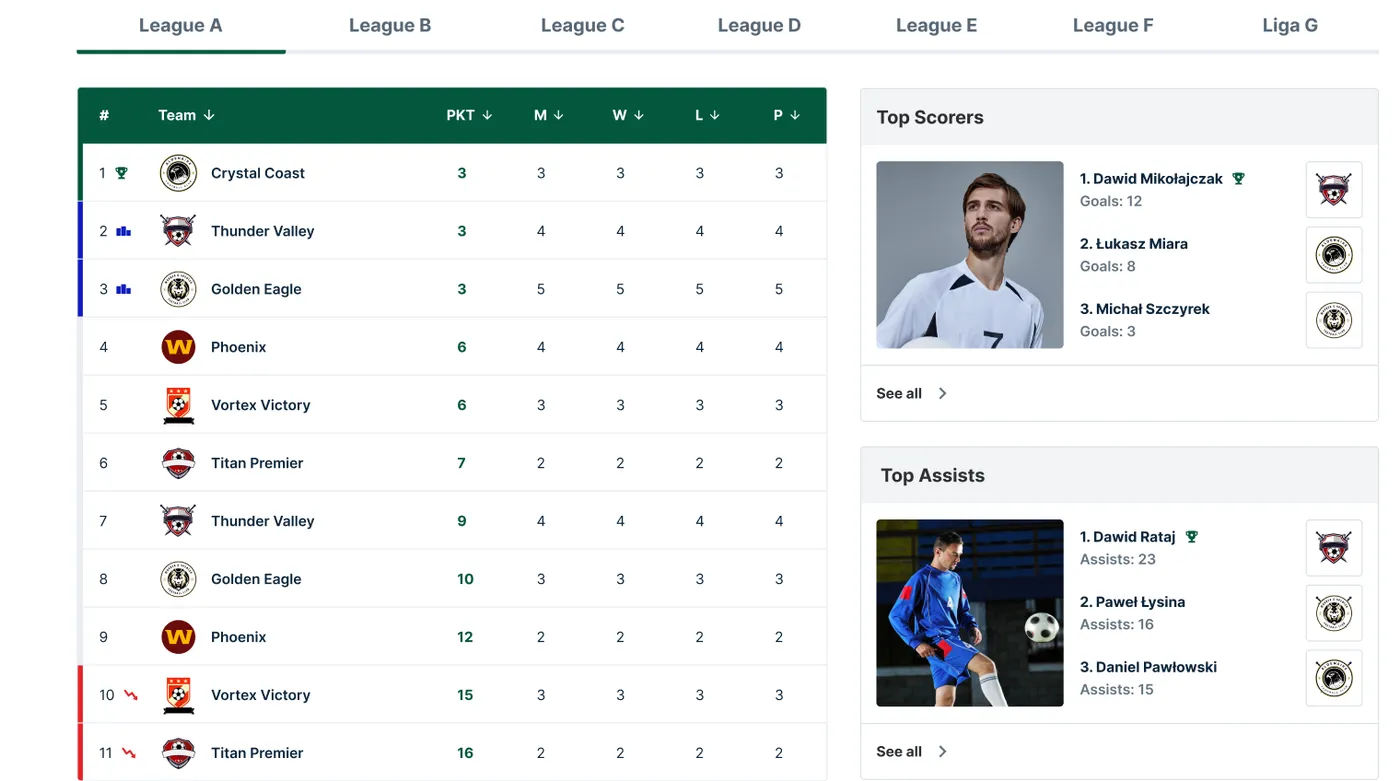
With matches running back to back, results need to land the moment the final whistle goes, not on Monday morning. Referees post live scores from the sideline on their phone, and the standings and top-scorer charts recalculate on their own.

Players also want somewhere to look between games. A public league page puts the table, fixtures, and results on every phone, which is a big part of what makes an indoor league feel like a real competition. If you are starting from scratch, our walkthroughs on running an amateur league and organizing small-sided competitions are good next reads.
Set your rules once, let the software keep the season straight, and you can spend match night watching soccer instead of updating a spreadsheet.

FAQ
How many players are on an indoor soccer team?
Most indoor soccer is played with five or six players on the field per team, including the goalkeeper. Youth and coed leagues sometimes go as low as four or as high as seven. Rosters are usually larger than the on-field number so teams can rotate through rolling substitutions.
What is the difference between indoor soccer and futsal?
The short version comes down to the surface and the walls:
- Futsal – hard court, marked lines, no walls, a smaller low-bounce ball, and fully standardized by FIFA
- Arena indoor soccer – artificial turf, walls that keep the ball in play, usually a regular ball, and rules that vary by venue
Futsal rewards close control and passing; walled indoor soccer is faster and built on quick transitions.
How long is an indoor soccer game?
Most indoor soccer games last under an hour, typically two halves of around 20 minutes on a running clock, sometimes divided into quarters. The exact timing is set by the facility or league, so it varies from one venue to the next.
What shoes do you wear for indoor soccer?
Indoor soccer is played in flat-soled indoor shoes or turf shoes, not the studded cleats used on grass. On a hard court you want a flat gum rubber sole for grip; on artificial turf, short rubber turf studs work best. Regular outdoor cleats are usually not allowed, both for grip and to protect the surface.
What size is an indoor soccer field?
A typical indoor soccer field is around 165 by 90 feet, roughly the footprint of a hockey rink, but there is no fixed standard and sizes vary widely by facility. It is far smaller than a full outdoor field, which is part of why the indoor game is so much quicker.