
19 min• 09.10.2026
Football tournament format by number of teams: how to set up 4 to 16 teams
By Dawid Pątko

Grassroots football in England has never had more teams: over 124,500 of them, with more than 1.6 million affiliated players, according to The FA's grassroots mid-strategy review. When the league season winds down, plenty of those teams head off to a tournament: a summer festival at the junior club down the road, a charity six-a-side, a one-day cup to close a five-a-side league. Most of them run at weekends, organised by a club volunteer, a leisure-centre manager or a league secretary who picks the tournament format, builds the fixtures in a spreadsheet and works around a pitch booking that ends at 1pm.
Say you have eight teams confirmed, two pitches and four hours. A round robin needs 28 matches. A straight knockout sends four teams home after one game, and they paid the same entry fee as the finalists. The right tournament format sits somewhere between the two, and this guide gives it to you for every team count from 4 to 16: the recommended setup, the number of matches, the matches each team is guaranteed, and the pitch time on one, two or three pitches. Pick the tournament format from three numbers – teams, pitches and hours on the booking – and the match count, the guarantee and your finishing time all follow from them. FLM System can generate every format on this page, so the fixture list is the easy part once you have chosen.

Football tournament format basics: the building blocks
Every tournament format below is built from the same handful of parts. Learn them once, and the recommendations for each team count read like recipes.
Round robin, straight knockout, and group stage plus knockout
A tournament format is the set of rules that decides who plays whom, how many matches each team gets and how the winner is found. Three formats cover almost every amateur football event:
- Round robin – every team plays every other team once, like a mini league. It is the fairest format and the hungriest for pitch time, because the match count grows fast: n × (n − 1) ÷ 2. Six teams need 15 matches, eight need 28. The maths, the byes and the circle method are in our round robin scheduling guide.
- Straight knockout – lose once and you are out. With n teams it takes n − 1 matches, which makes it the cheapest option and the harshest: half the teams play once.
- Group stage plus knockout – small round robins inside groups, then the top teams move into a knockout. The default for one-day football tournaments.
Group stage plus knockout wins most of the time because it does two jobs at once. Every team gets two or three matches before anyone is knocked out, and the day still ends with a final that people stay to watch. If you want a knockout where one bad game does not end anyone's day, double elimination is the fourth option, at roughly twice the matches of a straight knockout.
Cup and Plate: knockout football for every team
Many grassroots tournaments in the UK add one more layer to the tournament format after the groups. The top teams go into the Cup, the main knockout, and the rest go into the Plate, a second knockout played alongside it on the same pitches. Bigger festivals sometimes add a third tier, usually called the Shield or the Bowl. Nobody is finished after the group stage, and the sides that came third and fourth get knockout football against opponents at their own level.
With two groups of four, it runs in three steps:
- Group stage. Each team plays the other three in its group, and the tables decide the split.
- Crossover. The winner of one group meets the runner-up of the other, A1 v B2 and B1 v A2, so two teams from the same group can only meet again in the final.
- Cup and Plate. The top two from each group play that crossover in the Cup semi-finals. The bottom two follow the same pattern in the Plate (A3 v B4, B3 v A4), and each competition ends with its own final.
American schedules call the group stage "pool play", so "Pool A" on a US tournament page is your Group A. The Plate itself is the British name for what US guides call a consolation bracket, and with two groups of four it gives each of the bottom four teams two more matches.
The Champions League format for small tournaments
Since the 2024/25 season, the UEFA Champions League has run without groups. Its league phase puts all 36 clubs in a single table, each club plays eight different opponents, the top eight go straight into the last 16, and the sides from 9th to 24th play off for the remaining places.
Scaled down, the league phase makes a tidy tournament format for amateur events. Ten teams each play three different opponents, everyone sits in one table, and the top four go into the semi-finals. There is no group of death, every match counts towards the same table, and the format copes with team counts that refuse to split into equal groups. The fiddly part is the fixture list, because each team needs opponents it has not already met. Doing that by hand takes a long evening; the cup brackets, groups and league phase module in FLM System builds it automatically in seconds, or lets you set the pairings manually if you would rather balance each team's opponents yourself.
-1920x1280.webp?2026-08-07T10%3A18%3A24.731Z)
Three numbers behind every tournament format
The recommendations further down rest on the same three numbers. Change any of them and the right answer can shift.
- The match slot. All times assume a 20-minute slot: a 15-minute match plus five minutes to clear the pitch and get the next teams on. If you play two halves of 12 minutes with half-time, your slot is closer to 30 minutes, so multiply every time on this page by 1.5.
- The guarantee. The number of matches the earliest-eliminated team plays. Two is the floor for an event that charges an entry fee. Three is comfortable, and families who drove an hour to get there notice the difference.
- The number of pitches. Pitch times below are the minimum, with matches running back to back. Add a 10-minute break between rounds, a buffer of 10 to 15% for injuries and late arrivals, and time for the presentation.
One trap catches first-time organisers. In a group of three, one team plays two matches in a row unless you alternate between groups. On a single pitch, run Group A, then Group B, then Group A again, and nobody plays consecutive slots. On two pitches the back-to-back match is unavoidable, so give those teams a few extra minutes before their second kick-off.
Tournament format for 4 to 6 teams
With six teams or fewer, a full round robin still fits into one day, so the choice is between fairness and time. For the rest of the preparation, from rules and budget to referees on the day, see our step-by-step tournament guide.
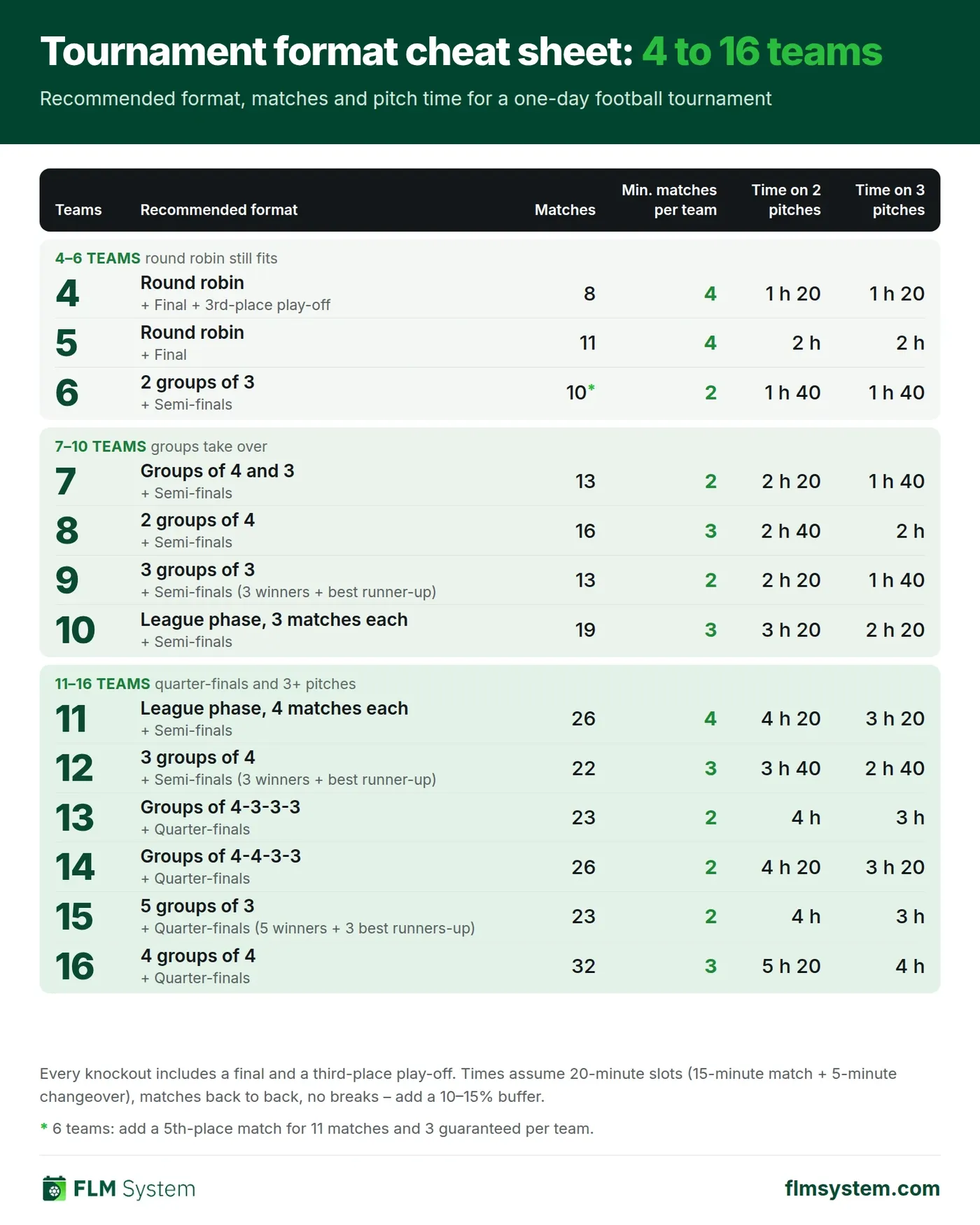
4 teams: round robin plus a final
Four teams is too few for groups and too few for a knockout. A straight knockout would give you three matches, and two of the four teams would go home after their first one.
Play a round robin instead, then finish with a final between the top two and a third-place play-off between the other two:
- Format: round robin, then 1st v 2nd and 3rd v 4th
- Matches: 8
- Guaranteed matches per team: 4
- Pitch time: 2 h 40 min on one pitch, 1 h 20 min on two
On two pitches, every team plays four slots in a row, so put a 10-minute break after each round. If you want to save 40 minutes, drop the two closing matches and let the round robin table decide the places.
5 teams: round robin with one bye per round
Five teams cannot form groups worth having. A group of two and a group of three would leave one pair with a single match against each other and nothing else.
A round robin is the obvious tournament format here: 10 matches over five rounds, with one team sitting out each round, so every team gets a built-in rest. Add a final between the top two and you have 11 matches, four guaranteed per team, finished in 3 h 40 min on one pitch or 2 hours on two. A third pitch adds nothing, because five teams can only fill two games per round.
6 teams: two groups of three or a full round robin
The 6 team tournament format most organisers settle on is two groups of three. Each group plays a three-match round robin. The two group winners and two runners-up go into crossed semi-finals (A1 v B2, B1 v A2), followed by a final and a third-place play-off.
- Format: two groups of three, semi-finals, final, third-place play-off
- Matches: 10
- Guaranteed matches per team: 2
- Pitch time: 3 h 20 min on one pitch, 1 h 40 min on two
The two teams that finish third in their groups play only twice in that setup, so add a fifth-place match between them. For one extra match (11 in total, 2 hours on two pitches) every team leaves with three games played. We would add it every time.
If you have the whole day, a full round robin gives six teams 15 matches, five per team, with no knockout at all: 5 hours on one pitch, 2 h 40 min on two, 1 h 40 min on three. Nothing is fairer, and on two pitches the full round robin runs an hour longer than the groups.
Tournament format for 7 to 10 teams
From seven teams up, a round robin stops fitting into a Saturday. An 8 team round robin needs 28 matches, seven per team, which is closer to a short league season than a day's football. Groups take over here, and the decision shifts to how many teams go through to the knockout.
7 teams: groups of four and three
The tournament format that works for seven teams is Group A of four and Group B of three, with the top two from each group going into crossed semi-finals.
Group A teams play three matches and Group B teams play two. The difference looks unfair on paper and changes nothing in practice: the top two from each group go through, and nobody is ranked against a team from the other group. The whole event runs to 13 matches with a guarantee of two, which takes 4 h 20 min on one pitch, 2 h 20 min on two and 1 h 40 min on three.
A full round robin for seven teams runs to 21 matches and 7 hours on one pitch. Use it only if the tournament spreads across two days.
8 teams: two groups of four and semi-finals
Two groups of four into semi-finals is the most common amateur football tournament format, and the one from the opening example. Each group plays six matches, the top two go through, and the knockout runs exactly as with six teams.
- Format: two groups of four, semi-finals, final, third-place play-off
- Matches: 16
- Guaranteed matches per team: 3
- Pitch time: 5 h 20 min on one pitch, 2 h 40 min on two, 2 h on three
Two pitches and a four-hour booking leave you 80 minutes for breaks, warm-ups and the trophy. Seed the groups in a snake pattern so the strongest teams do not land together: rank the teams 1 to 8 on last season's results, then put 1, 4, 5 and 8 in Group A and 2, 3, 6 and 7 in Group B.
For a bigger guarantee, run a Plate for the bottom four: A3 v B4 and B3 v A4, then a Plate final for fifth place and a match for seventh. The total rises to 20 matches and 3 h 20 min on two pitches, and every team plays five times.

9 teams: three groups of three and the best runner-up
Nine teams split cleanly into three groups of three. The three group winners go into the semi-finals, and the last semi-final spot goes to the best runner-up.
- Format: three groups of three, semi-finals (three winners plus the best runner-up), final, third-place play-off
- Matches: 13
- Guaranteed matches per team: 2
- Pitch time: 4 h 20 min on one pitch, 2 h 20 min on two, 1 h 40 min on three
Because the groups are the same size, comparing runners-up is fair: points first, then goal difference, then goals scored. The 2026 World Cup picked its eight best third-placed teams with exactly that sequence. Publish the rule before the first kick-off, because the argument at 11.40am with parents lined up along the touchline is the one you want to avoid. Our guide to tie-breakers in football league tables covers the criteria and their order.
If two matches feels thin, switch to a league phase. Each team plays four different opponents in one table, the top four go into the semi-finals, and the event grows to 22 matches and 3 h 40 min on two pitches.
10 teams: two groups of five or a league phase
Ten teams give you two reasonable tournament formats, and they differ mainly in pitch time.
Two groups of five produce 20 group matches plus four in the knockout. Every team plays at least four, and each group round has a bye, so teams get regular rest. The cost is the clock: 24 matches take 4 hours on two pitches and 3 hours on three.
A league phase has each team play three different opponents in one table, with the top four going into the semi-finals: 19 matches and three guaranteed per team, done in 3 h 20 min on two pitches or 2 h 20 min on three.
On a single day with two pitches, take the league phase. With three pitches and a longer booking, the groups of five buy every team a fourth game for 40 extra minutes.
Tournament format for 11 to 16 teams
Past ten teams, two pitches stretch the day to four hours or more, and the knockout grows a quarter-final round. You also run into the "best third-placed team" problem that the 2026 World Cup solved at scale: 48 teams in 12 groups of four, with the top two and the eight best thirds going into the last 32. The same logic shrinks well to a 12- or 16-team Saturday.
12 teams: four groups of three or three groups of four
Twelve teams can go two ways, and the second one is the better deal.
Four groups of three send the top two from each group into the quarter-finals, then semi-finals, a final and a third-place play-off: 20 matches with a guarantee of two, in 3 h 20 min on two pitches or 2 h 40 min on three.
Three groups of four send the three winners and the best runner-up straight into the semi-finals. The event grows to 22 matches, but every team plays three, and on three pitches it finishes in the same 2 h 40 min.
Two extra matches in total buy every team a third game, and on three pitches they cost you no extra time. Four groups of three only make sense when you have two pitches and a hard stop.

16 teams: four groups of four into quarter-finals
Sixteen teams is exactly the shape of Euro 96 in England, and of every European Championship from 1996 to 2012: four groups of four, the top two into the quarter-finals, then semi-finals and the final. Those Euros had no third-place play-off, but at an amateur tournament it is worth adding one.
- Format: four groups of four, quarter-finals, semi-finals, final, third-place play-off
- Matches: 32
- Guaranteed matches per team: 3
- Pitch time: 10 h 40 min on one pitch, 5 h 20 min on two, 4 h on three, 3 h on four
One pitch cannot hold a 16-team day. Book three or four pitches, or move to a straight knockout (15 matches plus a third-place play-off), which finishes in 2 h 40 min on two pitches at the price of sending eight teams home after one match.
11, 13, 14 and 15 teams: uneven groups and the league phase
Odd and awkward team counts follow one rule: never rank a team against a rival from another group that played a different number of matches. Keep groups at three or four teams and take the top two from each, or, when the groups are the same size, fill the knockout with the best runners-up.
- 11 teams – use a league phase. Each team plays four different opponents in one table, and the top four go into the semi-finals: 26 matches, four per team, 4 h 20 min on two pitches, 3 h 20 min on three. An odd number of teams works here because 11 teams × 4 matches gives 44 team appearances, which pair up into 22 matches.
- 13 teams – groups of 4, 3, 3 and 3, top two into the quarter-finals: 23 matches, a guarantee of two, 4 h on two pitches, 3 h on three.
- 14 teams – groups of 4, 4, 3 and 3, top two into the quarter-finals: 26 matches, 4 h 20 min on two pitches, 3 h 20 min on three.
- 15 teams – five groups of three. The five winners and the three best runners-up make eight quarter-finalists: 23 matches, 4 h on two pitches, 3 h on three.
When you cannot avoid comparing teams across groups of different sizes, rank them on points per game. Ranking them on total points hands an advantage to whoever happened to land in the bigger group.
Setting up your tournament format in FLM System
Choosing a tournament format takes an evening. Running it on the day is where spreadsheets fall over: a group of three that has to alternate with another group, a best-runner-up comparison while the semi-finalists are already warming up, a knockout that needs the group results before anyone can print it.
Groups, knockouts and league phase from one setup
FLM System runs group stage plus knockout, league plus cup, and the Champions League-style league phase. You choose the tournament format, add the teams, and the system generates the fixtures. The order of tie-breakers is configurable, so the table ranks teams in the order your rules set out.
Several pitches, live results and a public tournament page
A tournament in FLM System can run across several pitches at once. Referees or a match coordinator enter scores in the referee app on their phones, using accounts you create for them, and the group tables update the moment a match ends. Parents and players follow the scores on the public tournament page, so nobody crowds around a sheet taped to the clubhouse door.

$1 per team for a one-off tournament
A one-off tournament costs $1 per team: $12 for twelve teams, $16 for sixteen. For context, our comparison of nine tournament tools by real cost prices one 24-team event across all nine. Pick the format from this guide, set it up in FLM System, and spend tournament day on the touchline instead of recalculating tables.
FAQ – tournament format
Most questions about a tournament format come down to two numbers: how many matches it needs, and how many the first team out gets to play.
How many games does it take for 6 teams to all play each other?
Fifteen. Everyone meets everyone once in 15 games, because 6 × 5 ÷ 2 = 15, which works out as five rounds of three games with each team playing five. A double round robin, home and away in league terms, doubles that to 30 games and suits a short summer league better than a one-day tournament.
What is the format of an 8-team tournament?
The default tournament format is two groups of four, then semi-finals, a final and a third-place play-off: 16 matches, three per team. The alternatives sit either side of it. A straight knockout needs only seven matches but sends four teams home after one, while double elimination, at 14 or 15 matches, suits an event spread over two days.
What is a Plate competition in a football tournament?
A Plate is a second knockout for the teams that miss out on the Cup, usually the sides that finish third and fourth in their groups. It runs at the same time as the Cup on another pitch, so nobody stands around for an hour while the top four play. Plenty of tournaments give the Plate winners a trophy and medals of their own, and for an under-10s side that lost every group match, lifting the Plate can make their whole day. On a tight booking, play the Plate final just before the Cup final, so the day ends with the biggest match and everyone still there to watch it.
How should you seed an 8-team knockout?
Seed so that the two strongest teams can only meet in the final. Rank the teams 1 to 8, then pair them so each first-round tie adds up to nine:
- 1 v 8
- 4 v 5
- 2 v 7
- 3 v 6
The winners of the first two ties meet in one semi-final and the winners of the last two in the other, which keeps seeds 1 and 2 apart until the final. At a friendly festival, an open draw out of a hat does the job. For a competitive cup, seeding stops the two best sides knocking each other out in the first round.
How do you run a tournament with an odd number of teams?
Odd numbers are easier than they look. In a round robin, one team sits out each round with a bye, so five teams play five rounds of two matches. In groups, mix sizes of three and four and take the top two from each. A league phase also works, as long as the number of teams multiplied by the matches per team comes out even. The harder case is the side that pulls out on the morning of the tournament and turns eight teams into seven: cancel its matches so the table recalculates for everyone else, then decide whether its opponents get a rest or a friendly.
How long does a 6-team tournament take?
Longer than the match count suggests. With the usual 6 team tournament format of two groups of three on two pitches, the matches themselves take 1 h 40 min. Registration and warm-ups take about 30 minutes, three 10-minute breaks between rounds add another 30, and the presentation takes 15. A 6-team event on two pitches fills about three hours, and closer to four and a half on one pitch.