
7 min• 27.07.2026
Football league standings: how goal difference and tiebreakers decide the table
By Dawid Pątko

In May 2012, Manchester City and Manchester United both finished the Premier League season on exactly 89 points. City took the title on goal difference alone, plus 64 against United's plus 56. Level points happen far more often than most organisers plan for, and when they do, the order in the football league standings is settled by rules written long before kick-off.
For anyone running an amateur or small-sided league, the football league standings are the scoreboard everyone trusts, right up until two teams finish level and nobody agrees on who sits higher. This guide covers how a football league standings table is built, how goal difference and the other tiebreakers separate level teams, and how to handle the case that starts the most arguments: a three-way tie. Decide your tiebreaker order before the season starts, write it into your rules, and the table resolves every deadlock for you instead of the group chat.

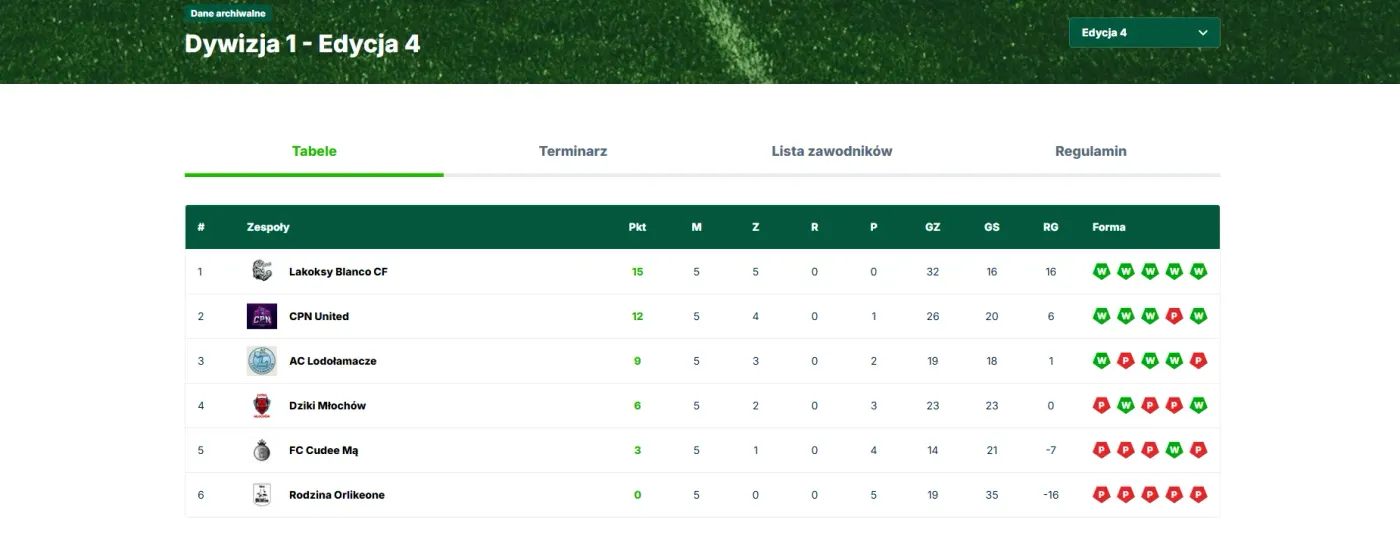
Reading a football league standings table
Every football league standings table starts in the same place, match results turned into points, and only needs tiebreakers once teams end up level. You can build one by hand, in a spreadsheet, or with a league table creator, but the logic underneath is always the same.
Almost every league in the world scores matches the same way:
- Win – 3 points
- Draw – 1 point
- Loss – 0 points
A handful of grassroots leagues add wrinkles, like a bonus point for scoring three goals or a point for winning a shootout after a drawn game. Those are fine, as long as the rule lives in writing before the season.
The columns across a standings row are shorthand:
- P – games played
- W / D / L – won, drawn, lost
- GF / GA – goals for, goals against
- GD – goal difference, which is GF minus GA
- Pts – total points
Goal difference is the single number that settles most ties: a team's goals scored across the season minus the goals it conceded, so a side that wins 4-0 and loses 2-1 sits at plus 1. Scoring by a margin helps, while one heavy result cannot count for more than a single win or loss.
When points are level, most leagues rank teams by a ladder that looks roughly like this:
- Goal difference
- Goals scored
- Head-to-head record between the tied teams
- A play-off or a drawing of lots if nothing else separates them
The catch is that leagues put those steps in different orders, and the order decides who goes up and who goes down.

Breaking a tie: goal difference or the head-to-head mini-league
The biggest leagues in the world openly disagree here, and the disagreement is worth understanding before you copy one into your own rulebook. Two models cover almost every competition you will watch.
Goal difference first: the Premier League model
The Premier League separates level teams by overall goal difference, then by goals scored. The 2011-12 season is the textbook case: City and United tied on 89 points, and the trophy came down to those eight extra goals of difference. Every result across all 38 games fed into that number, which is what makes the model feel fair to most people. Score more and concede less than your rival over the year, and you finish above them.
Head-to-head first: the La Liga model
La Liga starts somewhere else. It looks first at how the tied teams did against each other, and only falls back to overall goal difference later. In 2006-07, Real Madrid and Barcelona both finished on 76 points, and Madrid were champions because they held the better record in the two matches between them. Same points, different rule, different trophy.
Three-way ties and the mini-league
Head-to-head is simple with two teams, just their matches against each other. With three or more teams level on points, it becomes a mini-league: a fresh, small table built only from the games those tied teams played among themselves. You rank them on points inside that mini-table, then on goal difference inside it.
Picture three teams all finishing on 30 points. Set the rest of the season aside and count only the games they played against each other:
- Team A – 4 points in the mini-league, so first of the three
- Team B – 3 points, goal difference plus 1
- Team C – 3 points, goal difference minus 2
Team A takes top spot, and Team B edges Team C on goal difference within those matches. Now try doing that by hand on a Sunday night with three captains reading over your shoulder. This is the moment tables get contested.
Set your rules and keep the table correct
The order you pick matters less than spelling it out and applying it the same way every week. Two teams will finish level eventually, usually with promotion or the title on the line, and a rule you improvise in that moment is a rule someone will fight.
Write the order into your league rules
- Publish one order up front – overall goal difference first is the easiest to explain to teams; head-to-head first rewards beating your direct rivals.
- Lock it before the season – changing tiebreakers once results are in is one of the classic mistakes that cost a league its credibility.
- Define the deepest tie – state what happens when two records are identical, whether that means a play-off, a drawing of lots, or a shared position.
Let the system settle it
This is where FLM System does the counting for you. You set your tiebreaker order once, and the standings engine applies it automatically after every result, including building the head-to-head mini-league when three or more teams are level. Referees enter scores from the referee app and the football league standings on your public league page update in real time, so there is a single source of truth instead of a spreadsheet that drifts every time someone edits the wrong cell. A table nobody trusts is one of the quicker ways to lose teams between seasons, and organisers running several leagues at once can hold every division to the same rules from one panel. You can run your own league on it without a card at $1 per team per month, and watch your first standings table build itself.

FAQ
What is goal difference?
Goal difference is a team's total goals scored minus its total goals conceded over a season. A team that has scored 30 and conceded 20 carries a goal difference of plus 10. Goal difference is the most common first tiebreaker in football league standings because it rewards both scoring and defending across every game played.
How is goal difference calculated?
Take a team's goals for and subtract its goals against. In practice:
- Goals for (GF) – every goal the team has scored
- Goals against (GA) – every goal it has conceded
- GD = GF − GA – the result, shown as a plus or minus number
A side with 25 scored and 18 conceded sits at plus 7.
How is a three-way tie broken in a league table?
When three or more teams finish level on points, most rulebooks build a mini-league from only the matches those teams played against each other. They are ranked on points within that mini-table first, then on goal difference inside it. Overall season goal difference comes into play only if the mini-league still leaves them level.
Is head-to-head or goal difference the better tiebreaker?
Both are valid, they just reward different things. Goal difference favours teams that win by big margins against everyone, while head-to-head favours teams that beat their direct rivals. Pick the one that matches the spirit of your league, then keep it consistent from one season to the next so your football league standings stay predictable.
How are standings decided in a round-robin league?
In a round-robin league where every team plays every other team, the football league standings come down to total points first. Any teams left level are separated by your published tiebreaker order, usually goal difference or head-to-head, and finally by a play-off or drawn lots if they still cannot be split.