
9 min• 09.06.2026
How to organize a minifootball league: a complete guide for organizers
By Dawid Pątko
-1-1920x1440.webp?2026-07-08T14%3A18%3A55.140Z)
Minifootball has quietly become one of the fastest-growing team sports in the world. The format is now played in close to 100 countries across five continents, and in Europe alone the European Minifootball Federation has grown to 34 national associations since it was founded in 2012. Behind the international tournaments sits a much larger base of everyday competition: weekly games organized by people who wanted a proper league in their town.
Starting a minifootball league and keeping it running, though, are two different challenges. Most organizers handle fixtures, results, and standings by hand, and the admin tends to grow faster than the fun. This guide covers the whole process, from defining the format to running match days week after week. Organizing a minifootball league comes down to a series of small, repeatable decisions, and once you set them up properly, the league mostly runs itself. If you would rather skip the spreadsheets from day one, a dedicated league management platform can take care of the routine for you.
What is a minifootball league?
Before you organize anything, it helps to be precise about what minifootball is, because the name gets confused with a few similar formats.
A minifootball league is a recurring competition built around minifootball, a small-sided version of the game played by two teams of six players each (a goalkeeper plus five outfield players) on a compact artificial pitch. Matches are shorter and higher-scoring than eleven-a-side football, and a league runs them on a fixed schedule across a season, ranking teams in a table by points. This is the format governed internationally by the World Minifootball Federation and, in Europe, by the EMF.

Minifootball vs futsal, five-a-side, and six-a-side
People use these names loosely, and the differences matter when you set your rules. Here is how the main small-sided formats compare:
- Minifootball – six players a side on an outdoor artificial pitch around 50 by 30 metres, no offside and no slide tackling. This is the WMF and EMF competition format.
- Futsal – five players a side on a hard indoor court, with a smaller low-bounce ball and stricter touchline play. It is its own sport with its own governing rules. Our guide to futsal explains where it differs.
- Six-a-side – often used interchangeably with minifootball in the UK, since both put six players on each team.
- Mini-soccer – the English FA's name for children's 5v5 and 7v7 football, a youth development format rather than an adult league.
For an adult competition, minifootball and six-a-side point to the same thing. Decide early which rule set you are following, because it shapes everything from pitch hire to the laws your referees enforce.
The basic rules and pitch setup
Minifootball rules are simpler than the full game, which is part of the appeal. The core points most leagues adopt:
- Teams – six players on the pitch, with rolling substitutions from a bench of three to five.
- Pitch – an artificial surface of roughly 50 by 30 metres, with smaller goals than eleven-a-side.
- Match length – two halves of about 20 to 25 minutes, depending on how many games you fit into an evening.
- Key laws – no offside, no slide tackles, and kick-ins or throw-ins instead of the full restart rules.
You can publish your own version, but anchoring it to the EMF international minifootball rules saves arguments and gives your league credibility. Clear, written rules are the single best defence against disputes once results start to matter.

How to set up a minifootball league: the key decisions
The format you choose in the first week determines how much work you create for yourself across the whole season. Three decisions do most of the heavy lifting.
Choosing your format and season structure
Start with the number of teams you can realistically attract, then pick a structure that fits:
- Single round-robin – every team plays every other once. Simple and short, good for a first season of six to eight teams.
- Double round-robin – home and away fixtures, which doubles the games and rewards consistency over a longer season.
- Divisions with promotion and relegation – once you pass ten or twelve teams, split them into tiers so games stay competitive.
- League plus playoffs – a regular season to seed teams, then a knockout to crown a champion and add a finale.
Match the structure to your venue slots and the calendar. A league that promises 20 games but can only book a pitch for 12 weeks will collapse under its own schedule.
Setting the rules and competition format
Beyond the laws of the game, your competition needs its own house rules. Define the points system (three for a win, one for a draw is standard), the tie-breakers (head-to-head, then goal difference, then goals scored), and the disciplinary policy for cards and no-shows. Write down how forfeits are scored and what happens when a team withdraws mid-season, because both will happen eventually.
Venue, equipment, and timing
A minifootball league is only as reliable as its pitch booking. Lock in a recurring slot before you announce anything, and confirm the basics: goal size, ball type, lighting for evening games, and changing facilities. Keep a short equipment checklist (bibs, spare balls, a first-aid kit, a stopwatch or match clock) so match nights run without scrambling. Settle format, rules, and venue before you recruit a single team, and the rest of the setup falls into place.
Registering teams and building the schedule
With the framework decided, the league becomes a logistics exercise: get teams signed up, then turn them into a fair fixture list.
Team and player registration
A clean registration process protects you later. Collect what you need up front:
- Team details – name, captain, contact number, and a backup contact.
- Player rosters – full squad lists so you can check eligibility and avoid ringers.
- Fees – entry fees or per-match payments, with clear deadlines and a refund policy.
- Consent and rules – a signed acceptance of the league rules and any insurance or waiver requirements.
If you have run a competition before, the same principles from our guide on how to start and manage an amateur football league apply directly to minifootball.
Creating a fair fixture list
Fixtures are where manual organizing starts to hurt. A balanced schedule has to spread home and away games evenly, avoid clashing pitch slots, and account for teams that can only play on certain nights. To build one by hand:

- List every team and confirm their availability.
- Use a round-robin grid to pair teams so nobody plays twice before everyone has played once.
- Slot the pairings into your booked pitch times.
- Publish the full season schedule so teams can plan ahead.
The same scheduling discipline carries over to one-off events, which our step-by-step tournament guide covers in detail. A fixture list that is fair and published in advance is the clearest signal that your league is run seriously.
Running your minifootball league week to week
Setup is finite; running the league is not. This is the part that quietly eats an organizer's evenings, and it is where most leagues either professionalize or burn out.
Standings, results, and player stats
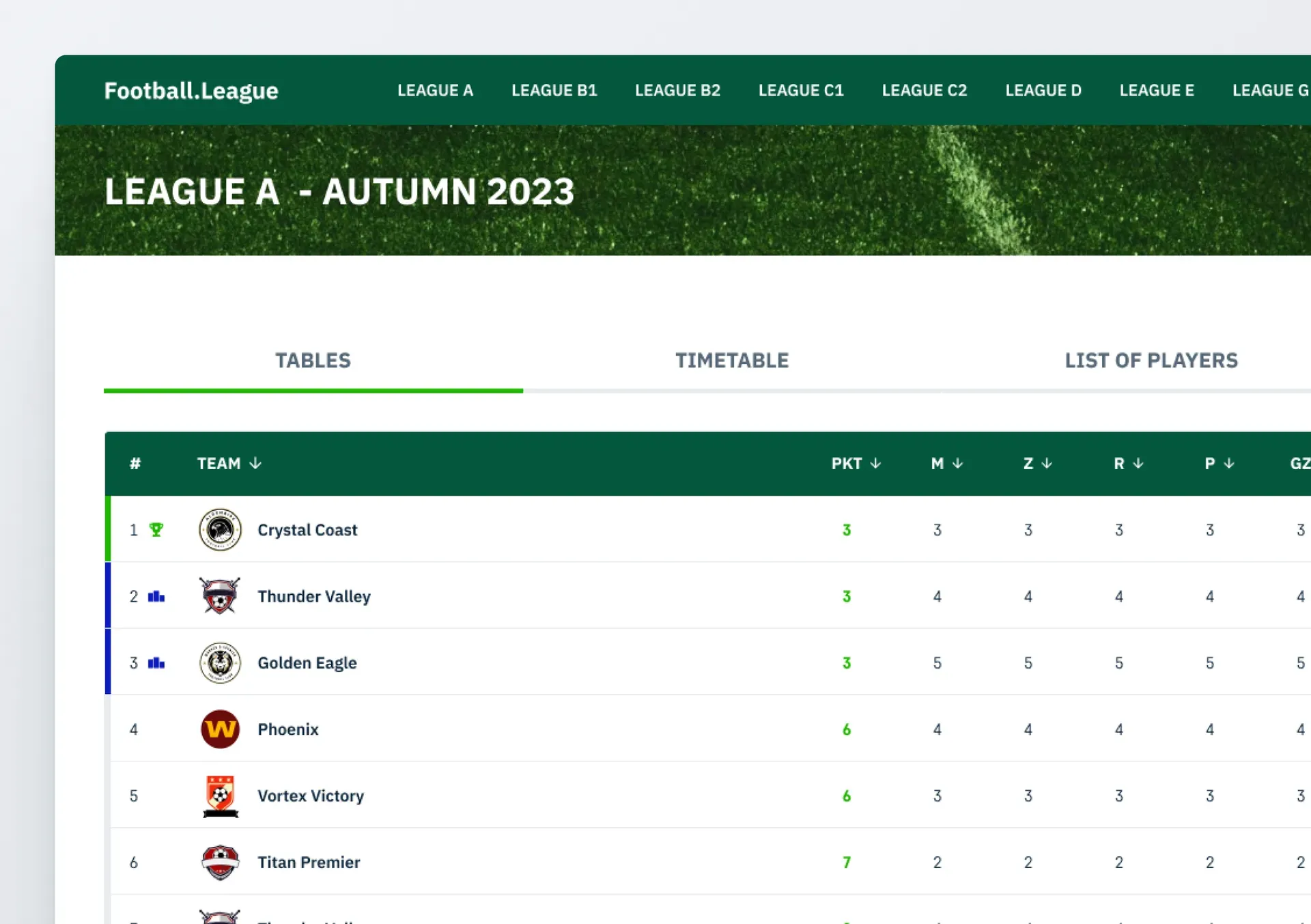
After every round, results have to turn into an updated table, top-scorer charts, and any disciplinary records. Done by hand, this means re-entering scores into a spreadsheet, recalculating standings, and posting them somewhere teams can see. Players check the table constantly, so errors and delays get noticed fast. Automating it is the main reason organizers move to a system, as our roundup of the best soccer league management systems explains.
Match-day operations and communication
On the night, you are juggling results, fixtures changes, and a dozen captains' messages at once. Live scores keep everyone informed without you fielding calls, and a referee app for recording results in real time means the table updates the moment a match ends. Reliable communication is half of what keeps teams coming back: posting fixtures, confirming pitch times, and sending reminders before each round.
When a spreadsheet stops working
A spreadsheet works for one division and a handful of teams. Add a second tier, player stats, and weekly fixtures, and the admin overtakes the football. This is the point where FLM System earns its place: it generates the schedule, updates standings and statistics automatically, handles registrations and payments, and gives every team a live view of the league. At $1 per team per month, it costs less than the pitch hire for a single evening, and it hands you back the hours you were spending on data entry. Once the routine is automated, you can put your energy into growing the league instead of maintaining it.
FAQ
What is a minifootball league?
A minifootball league is a recurring competition where teams of six players play a small-sided version of football on a compact artificial pitch, on a fixed schedule across a season. Teams earn points from each match and are ranked in a table, usually with a champion decided at the end of the season.
How many players are on a minifootball team?
A minifootball team fields six players at a time: one goalkeeper and five outfield players. Squads usually carry a few extra players on the bench, since substitutions roll on and off freely throughout the match.
What size is a minifootball pitch?
Minifootball is played on a compact artificial surface. Typical dimensions are:
- Length – around 50 metres
- Width – around 30 metres
- Goals – smaller than eleven-a-side, sized for a six-player game
Exact measurements vary by venue, so confirm your pitch before finalising rules.
How is minifootball different from futsal?
Minifootball is played outdoors on artificial turf with six players a side and no offside. Futsal is an indoor sport played on a hard court with five players, a smaller low-bounce ball, and stricter rules around touchlines and accumulated fouls. They look similar but are governed separately.
How much does it cost to run a minifootball league?
The main costs are pitch hire, referees, and equipment, which vary by location. Management software adds little on top:
- Pitch and referees – your largest recurring cost, paid per match or per block booking
- Equipment – a one-off outlay for goals, bibs, and balls
- Software – FLM System runs from $1 per team per month, less than a single evening's pitch hire
Do I need software to run a minifootball league?
You can run a small league on a spreadsheet, but it stops scaling once you add divisions, player statistics, and weekly fixtures. Dedicated software automates scheduling, standings, and registrations, which removes the repetitive admin and reduces the errors that frustrate players.