
10 min• 12.06.2026
How to start a corporate football league: a practical guide for organisers
By Dawid Pątko

Only 23% of employees feel engaged at work, yet engagement programmes built around social, group activities pull participation rates as high as 50%, and every dollar spent on workplace wellbeing returns about $3.27 in lower costs (WellSteps, 2024). Companies keep hunting for the perk that gets people off Slack and into the same room. Most of what they try, from catered lunches to a single summer away day, fades within a few weeks. A weekly corporate football league does the opposite. It gives colleagues a standing reason to show up, and it compounds: the rivalry from week three is what fills the car park in week ten.
The catch is the admin. Someone has to recruit teams, build a schedule, chase results, keep a table, and answer the same five questions every Monday. That is the part that quietly kills most office competitions before the second season. This guide walks through why a corporate football league pays off, how to pick the right format, how to set one up, and how to run it without losing your evenings to spreadsheets, using the same league management platform that powers established business leagues today. A well-run corporate football league is one of the cheapest, highest-frequency engagement tools a company has, as long as the paperwork doesn't bury the person running it.

Why a corporate football league works
Most team-building budgets buy a single high-cost event that people forget by the next quarter. A league flips that maths, spreading a small budget across months of recurring contact and tying people together through something they actually want to do, not a trust fall in a meeting room.
The engagement and retention payoff
Engagement is not built in one afternoon. It builds slowly, through repeated low-stakes contact between people who would otherwise never speak, the analyst from finance and the warehouse lead suddenly on the same five-a-side roster. That repetition is exactly what one-off events can't buy.
The numbers back it up. Employees who take part in social wellbeing programmes report 28% higher engagement and 35% higher job satisfaction. A recurring football league delivers that contact on a fixed weekly cadence, which is why it outperforms the annual party as a retention tool. People stay where they have friends.
Team building that lasts longer than one away day
A ropes course ends at 5 p.m. A league season runs for ten or twelve weeks, and the group chat keeps going long after the final whistle. That is the difference between a memory and a habit.
That lasting routine is also why a league beats most paid corporate team building activities on a per-head basis. You are not renting an experience, you are seeding a routine. Players sort their own lift shares, argue about line-ups, and turn up early to warm up. The organiser's job is to keep the structure intact, not to manufacture enthusiasm.
What it costs compared with typical perks
A standalone corporate sports day or an external team-building provider can run to hundreds of dollars per employee for a few hours. A small-sided league spreads a far smaller cost over an entire season:
- Pitch hire – the biggest line item, usually a weekly hourly rate at a local pitch or sports hall, often split across the teams.
- Equipment – bibs, balls, and a first-aid kit are close to a one-time cost.
- Referees – optional for casual leagues, worth it once results start to matter.
- Software and admin – a league platform replaces the unpaid hours an organiser would otherwise spend, and tools built for amateur leagues start at around $1 per team per month.
Run the comparison and a season of weekly football often costs less than one catered team-building day, while delivering ten times the contact.
Choosing the right format for your corporate football league
Format is the first real decision, and it shapes everything after it: how many people you need, where you play, and how long a night runs. Get it right and the league feels effortless. Get it wrong and you are forfeiting games by week four because teams can't field enough players.
Why small-sided is the default
Full eleven-a-side football is a hard sell at work. You need 22 players plus subs, a full-size pitch, and a two-hour window nobody has on a Tuesday. Small-sided formats solve all three at once. Five-a-side, six-a-side, and futsal need a handful of players per team, fit indoor or compact outdoor spaces, and run short, high-energy games.
For a workplace, small-sided is almost always the answer. A department can field a five-a-side team without recruiting half the building, and the lower commitment keeps casual players in. The same logic drives the popularity of the 5 a side league format in business competitions: it is the lowest barrier to a real, competitive fixture.
League, tournament, or a single sports day
The right structure depends on how much appetite and time you have:
- League – teams play each other across a season, with a running table and a champion at the end. Best for sustained engagement and the format this guide focuses on.
- Tournament – a one-day or one-weekend knockout. Great as a pilot to test interest before committing to a full season. If you go this route, our guide to organising a football tournament covers the mechanics.
- Sports day – a mixed-activity event where football is one of several games. Lowest commitment, lowest payoff in terms of lasting engagement.
A common path is to run a tournament first, prove people will show up, then convert that energy into a recurring corporate football league.
Season length, time slot, and venue
Keep the first season short. Eight to ten weeks is long enough to crown a champion and short enough that nobody feels trapped. Pick one fixed weeknight, ideally right after work, and protect that slot, because a moving schedule is the fastest way to lose teams. Book the venue for the whole season up front rather than week to week, so you are never scrambling for a pitch the day before a fixture.
How to set up your corporate football league
With the format decided, setup is mostly sequencing. Here is the order that works, refined from how real business leagues get off the ground.
- Gauge interest and lock the format. Send a short company-wide poll: would you play, which night works, five-a-side or six? You need a minimum of four teams for a league to feel competitive. If you can't hit that internally, open it to nearby companies.
- Recruit teams. Within a single company, let departments or floors form their own sides, which builds natural rivalries. To grow bigger, invite other local businesses. Cross-company play is how leagues like Poland's Rekreacyjna Liga Biznesu turned a workplace kickabout into a regional networking event.
- Set rules, fees, and a fair-play policy. Decide game length, squad size, substitution rules, and what happens with no-shows. Set a per-team or per-player fee that covers the pitch and equipment. Write a short fair-play code, because mixing competitive and casual players is where most disputes start.
- Build the schedule and the table. Generate a fixture list that gives every team a balanced run of games, then keep the standings updated after each round. This is the single most time-consuming task if you do it by hand.
- Run match day and bring people back. Confirm fixtures, sort out the referee, post results fast, and update the table the same night. Momentum lives in the 24 hours after the final whistle, when people are still checking who they play next.
If this is your first competition of any kind, our broader walkthrough on how to start and manage an amateur league goes deeper on the fundamentals that apply here too.

Running the league without the admin headache
Setup is a one-time push. Running the league is the part that repeats every single week, and it is where good intentions go to die. A platform built for league management exists to absorb that repetition, so the organiser can stay an organiser instead of becoming a part-time data-entry clerk.
What eats an organiser's evenings
Strip a corporate football league down to its weekly admin and the same chores show up every time:
- Scheduling and rescheduling – building fixtures, then reshuffling them when a team can't make it.
- Results and standings – collecting scores, recalculating the table, fixing the inevitable disputed result.
- Payments – tracking which team has paid the pitch fee and chasing the ones that haven't.
- Communication – fielding the same questions about kick-off times, locations, and who's next.
Done manually, that is hours a week. Done once, by the wrong person, and the league stops dead.
How a league platform takes it off your plate
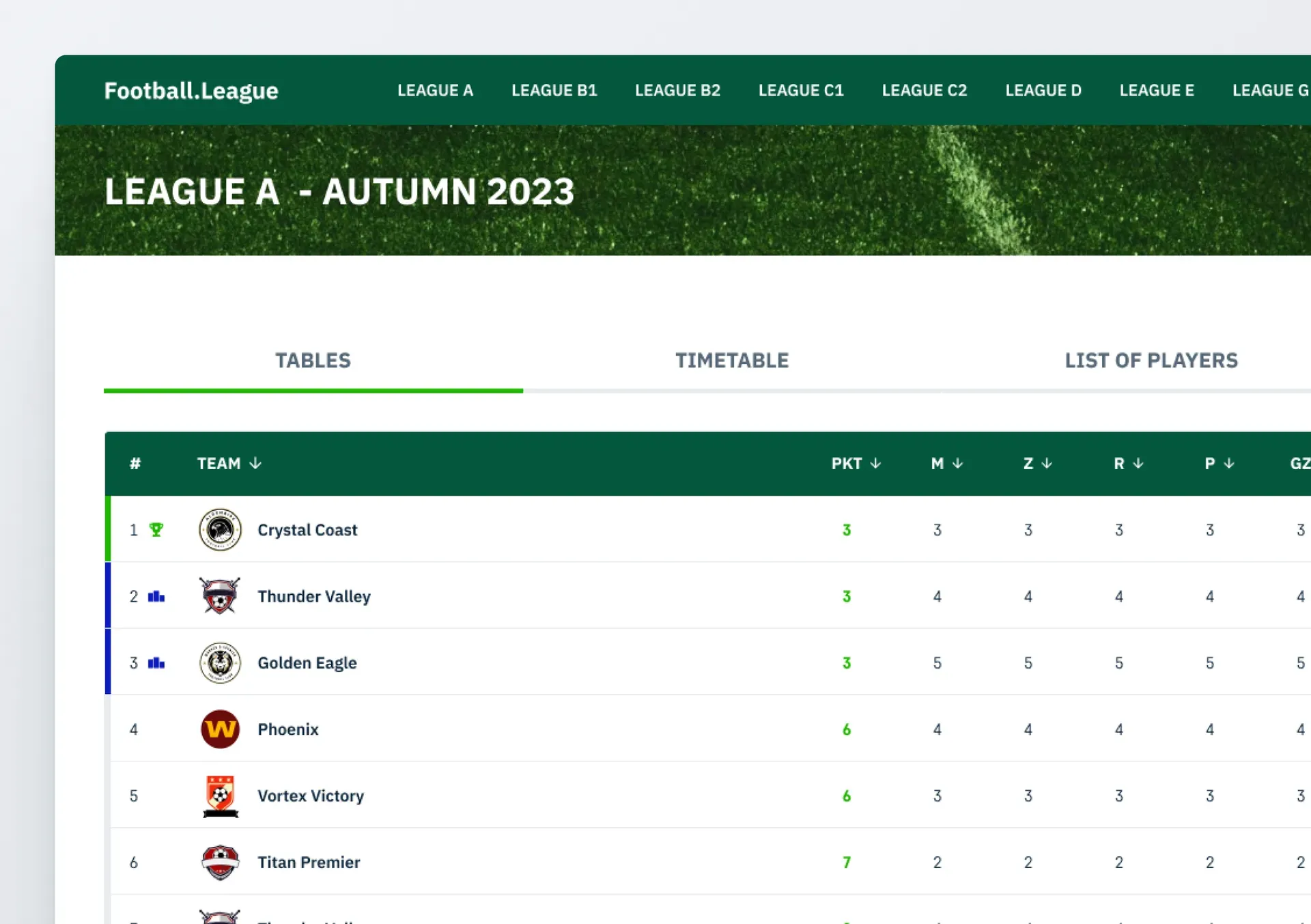
That weekly grind is exactly the problem FLM System solves. The platform generates the schedule, updates the table automatically as results come in, handles team fees, and gives every player a live view of fixtures and standings, so the questions stop landing in your inbox. The organiser sets it up once and the league runs itself week to week.
It is not theoretical. FLM already powers established corporate competitions, including Rekreacyjna Liga Biznesu, a business league running for dozens of seasons, and the company leagues operated by MSP Group in southern Poland. Both run exactly the cross-company, small-sided model this guide describes, and both use the platform to keep multi-team seasons organised without an army of volunteers. If you can run a recurring league this size on autopilot, you have removed the single reason most workplace competitions never reach a second season. Start your league here.
Keeping players engaged between games
The league is the product, but engagement lives in the details around it. Live scores update the moment a game ends. A public table gives bragging rights a home. Player profiles and top-scorer stats turn a casual league into something people follow, and a clean public page makes the whole thing feel legitimate to the wider company, which matters when you ask for next season's budget. For what that page should contain, see our breakdown of what a football league website should include.

FAQ
How many players do you need to start a corporate football league?
For a five-a-side format, you need at least four teams of around seven to eight players each, which covers a starting five plus substitutes. That is roughly 30 people total. If your company can't field four teams internally, invite nearby businesses to join, which also adds a networking angle.
What's the best format for a workplace football league?
Small-sided formats win for workplaces because they need fewer players and shorter time slots:
- Five-a-side – the lowest barrier, easy to field from a single department.
- Six-a-side – a popular middle ground with a bit more space and tactics.
- Futsal – ideal if you only have indoor court access.
Avoid full eleven-a-side unless you have a large, sporty workforce and an easy pitch booking.
How much does it cost to run a corporate football league?
The main costs are pitch hire, basic equipment, optional referees, and league software. The pitch is the largest, usually billed as a weekly hourly rate and often split across teams. Management software for amateur leagues starts at around $1 per team per month, far below what a single external team-building day costs per head.
Should companies charge employees to play?
A small per-team or per-player fee is healthy. It covers the pitch and equipment, and a paid spot is far more likely to be a used spot, which cuts down on no-shows. Many companies subsidise part of the cost as a wellbeing benefit and let teams cover the rest.
How long should a corporate football league season be?
For a first season, aim for eight to ten weeks. It is long enough to produce a real champion and clear standings, but short enough that players don't feel locked in. You can always run a second, longer season once you know the format sticks.
Can teams from different companies play in one league?
Yes, and it is one of the strongest models. Cross-company corporate football leagues, like those run by Rekreacyjna Liga Biznesu and MSP Group, double as business networking events. A league platform makes managing many teams from different organisations straightforward, since each team manages its own roster while you oversee the season.