
8 min• 30.06.2026
How to collect team fees for your soccer league without chasing payments
By Dawid Pątko

Across US youth and amateur sport, the average family spent $1,016 on a child's primary sport in 2024, up 46% since 2019, according to the Aspen Institute's Project Play survey. Registration and team fees are a leading driver of that climb. For the person running the league, the takeaway is simpler and more annoying: the pot of money you have to collect every season keeps growing, and most organizers still gather it by hand.
If you run a league, you know the routine. A handful of teams pay the day you ask. A few pay after a reminder. And two or three drag it out until week three, when they are already playing on a schedule they have not paid for. You do not end that chase by sending more reminders. You end it by removing every reason a team can delay – a deadline tied to something real, one record of who has paid, and a spot in the league that depends on it. This is how to collect team fees without spending your evenings chasing players, using a league management platform to carry the parts you should not have to track in your head.
What turns fee collection into a chase
Before fixing collection, it helps to see why it breaks. The problem is rarely a team that refuses to pay. It is a process with gaps, and teams settle into whatever the gaps allow.
Soft deadlines that nothing enforces
A deadline that is not tied to anything is a suggestion. If a team can still turn up for week one without having paid, then "fees due by Friday" carries no weight, and everyone learns that quickly. The captains who pay late are not difficult people. They are responding to a system that lets them.
The fix is to make the deadline matter. When paying late costs a team something concrete, like its place in the fixtures, the behavior changes on its own. You stop being the person nagging and start being the person who set a clear rule.
Payments and records living in separate places
The second problem is that the money and the record of it almost never sit together. Cash goes to one organizer's pocket, a couple of transfers land in a bank app, two captains promise to "sort it next week," and a spreadsheet gets updated whenever someone remembers. By week two you cannot answer a basic question without an investigation: who has actually paid?
Here is what slips through when payments and records are scattered:
- Partial payments that no one logged, so a team looks unpaid when it owes half
- Cash handed over at a game and never written down anywhere
- The team that swears it paid and might be right, because your record is three places at once
- Re-registrations from last season mixed up with this season's new teams
Most leagues outgrow the spreadsheet long before they admit it. If tracking who owes what already eats an evening a week, that is one of the clearest signs you've outgrown Excel.
A system for collecting team fees without chasing
Chasing is a symptom of a loose process. Tighten three things, and most of the chasing disappears before the season starts. The fix is not a clever trick; it is getting the fee, the deadline, and the record to point at the same thing.
Set one fee, one deadline, one payment method
Decide these three before you announce the season, and do not improvise after:
- One fee per team. Per-team billing is simpler to collect than per-player, because one captain owes one amount and chases their own squad for you. At roughly $1 per team per month for the software side, the admin tool costs a rounding error against what you collect.
- One deadline, before the schedule is published. Fees are due to confirm a spot, not after games begin. That single ordering change is what gives the deadline teeth.
- One payment method. Pick the channel that suits your league, whether that is bank transfer, Venmo, or cash to a named person, and refuse the rest. Three accepted methods means three places to reconcile.
Make registration the gate for a team's spot
This is the change that does the most work. Tie a team's place in the league to registration, so a team is not on the schedule until it has signed up and confirmed its fee. In FLM System, teams register, or re-register from last season, before they appear in the fixtures. No registration, no spot, no fixtures to play.
What changes is that a team's place in your league now depends on completing registration, so "I'll pay later" stops being compatible with "put us on the schedule." The gate does the asking for you, and a team that wants its spot in the fixtures has a reason to settle up before the deadline rather than after week one.
Track paid and unpaid teams in one view
Once registration is the gate, you need one place that shows where every team stands. Mark each team paid or unpaid and read the whole league at a glance, instead of cross-checking a bank app against a spreadsheet against your memory. The teams that still owe are the ones not marked paid, and a reminder becomes one message to one captain rather than a detective exercise.
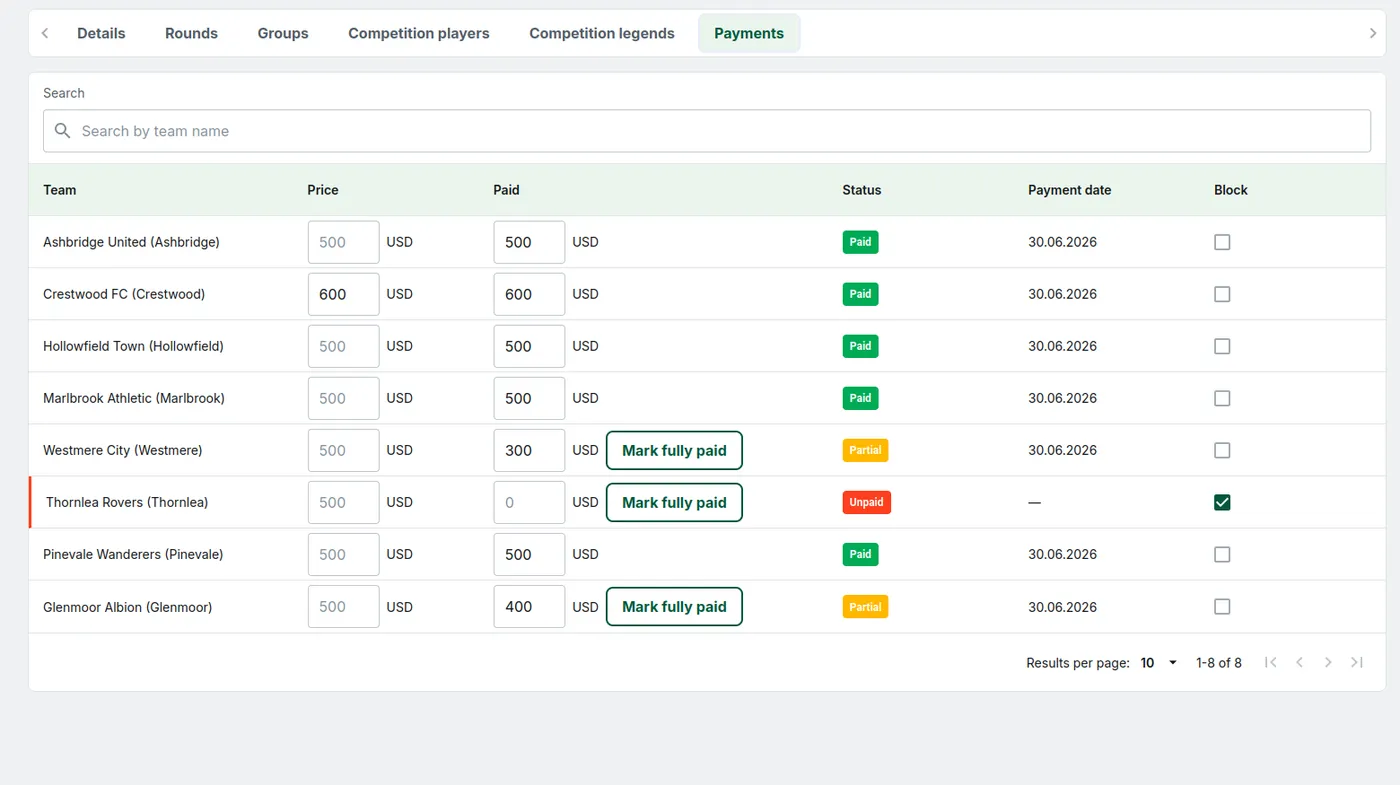
That single source of truth is also what protects the league's finances over a season. Unpaid fees that no one was tracking are a quiet way for an amateur league to run short of money, and they sit near the top of the mistakes that sink amateur leagues.
Give every team one accountable captain
You should never be chasing twelve individual players for one team's fee. Put one captain in charge of each squad and collect team fees at the team level. The team-manager module gives that captain their own access to manage their roster, which makes them the obvious person responsible for the team's payment too. You chase one person, who has every reason to chase the other eleven, because their team's spot rides on it.
Where FLM System takes the chasing off your plate
Pull the pieces together and the pattern is clear: you collect team fees faster when the league itself does the reminding. FLM System is built to remove the conditions that make you chase in the first place, so the work happens once at setup instead of every week of the season.
Visibility replaces reminders
Most chasing is a visibility problem in disguise. You send reminders because you are not sure who has paid, so you message everyone and hope. When registration gates the schedule and a paid or unpaid status sits next to every team, the uncertainty goes away, and so does the blanket reminder. You can see the three teams that still owe and contact only them. Set your league up in FLM System and the record keeps itself while you collect.

A league teams take seriously
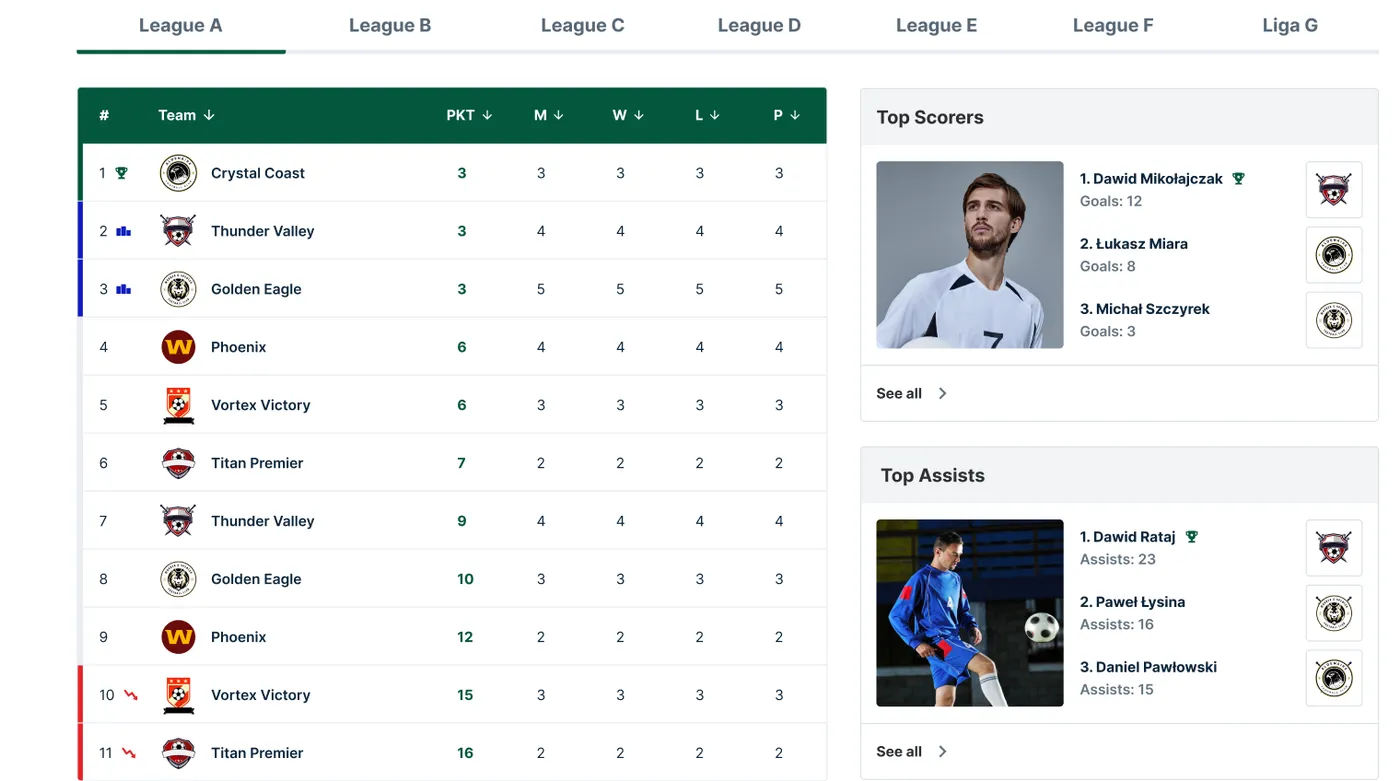
There is a softer reason teams pay on time: the league looks like it deserves to be paid. A public site with real fixtures, standings, and team pages signals that this is run properly, and people pay run-properly leagues faster than they pay a group chat. This matters most for corporate and workplace competitions, where a finance department wants something that looks legitimate before it releases a budget. If that is your audience, it is worth reading how to start a corporate soccer league that companies are happy to fund.
FAQ
How do I collect team fees without constantly chasing teams?
Stop relying on reminders and tie the fee to a deadline that means something. Set one due date that confirms a team's spot, keep a single record of who has paid, and make registration the condition for appearing on the schedule. When a team's place depends on paying, most of the chasing never starts, and you collect team fees on the timeline you set rather than the one teams drift into.
What's the best way to handle a team that hasn't paid?
Tie consequences to the schedule, not to a stern message. A team that has not registered and paid does not get added to the fixtures, so the conversation shifts from "please pay" to "you are not in the league yet." Handle it in three steps:
- Check the record, not your memory, to confirm the team is genuinely unpaid
- Message the one captain, since they are responsible for the team's fee
- Hold the spot, not the schedule – the season starts on time with the teams that paid
Should I charge per team or per player?
Per team is usually easier to collect for a league. One captain owes one amount and handles their own squad, which means you chase one person instead of a dozen. Per-player billing makes sense when there are no stable teams, but for most fixed-roster leagues, collecting team fees at the team level removes most of the work.
How do I keep track of which teams have paid?
Keep one record that the whole league reads from, rather than a spreadsheet, a bank app, and your memory all at once. In FLM System you mark each team paid or unpaid and see every team's status in a single view, so the teams that still owe are obvious at a glance. That one source of truth is what turns a reminder into a single message instead of a search.