
9 min• 18.06.2026
Running a soccer league: 8 mistakes that quietly kill amateur leagues
By Dawid Pątko

More American adults are playing organized soccer than they have in years. CivicScience reported in April 2026 that 10% of US adults now play in an adult recreational sports league, up from 6% a year earlier, with another 13% planning to join. For anyone running a soccer league, that is a tailwind: the players are out there, and more of them want a team every season.
Demand doesn't keep a league alive, though. Most amateur leagues that fold don't run out of players; they run out of organizer patience. A fixture clash here, a standings argument there, a season of fees half-collected, and by the next sign-up window the founder is quietly done. Running a soccer league is mostly admin, and the admin is where leagues break. This article walks through eight mistakes that sink amateur leagues and the fix for each. Whether you're starting an amateur soccer league or already three seasons in, FLM System exists to take that busywork off your plate. The difference between a league that grows and one that folds in a season is rarely the soccer – it's everything around it.

Setup mistakes that follow you all season
The decisions you make before the first whistle are the ones you can't easily undo mid-season. Get the foundation wrong and you spend the rest of the year patching it instead of running it.
Leaving fields and the calendar to the last minute
Field time is the hardest constraint in amateur soccer, and it's the one most organizers leave until last. By the time you've recruited eight teams, the good Saturday slots are gone and you're stuck with a 9 p.m. weeknight kickoff that half your players can't make. Lock the venue and a full-season calendar before you take a single registration, not after.
A workable calendar needs more than a list of dates:
- Field availability for the whole season, booked up front, not negotiated week to week
- Rest between games so no team plays twice in one night, especially across two venues
- A buffer for weather and the inevitable rescheduling that follows a rained-off weekend
A league that can't reliably tell teams where to be on Saturday loses them by week three.
Running without clear rules or a disciplinary process
Amateur does not mean improvised. Squad sizes, player eligibility, what counts as a forfeit, how many games a red card costs you, how ties are broken in the table: decide all of it before kickoff, write it down, and publish it where every captain can see it. The fastest way to lose half your teams is to settle one disputed result on gut feeling and have the losing side smell favoritism.
Think of it like house rules at a regular poker night. Nobody minds the rules being strict, as long as they're the same for everyone and they don't change halfway through the hand. Consistency is what makes players trust the competition enough to come back.
Forcing a pro-league format onto a casual league
Small-sided soccer now accounts for roughly 90% of all soccer participation in the US, according to FRANdata's 2025 industry analysis. The amateur game is 5-a-side, 6-a-side, futsal, and corporate leagues, not 38-week 11-a-side seasons with full promotion and relegation. Yet plenty of new organizers copy the structure they watch on TV onto a group of colleagues who wanted a Tuesday-night kickabout.
Match the format to the lives your players lead: shorter seasons, smaller squads, flexible enough that missing one week doesn't sink a team. Build the league your players have time for, not the one you see on the weekend broadcast.
Admin mistakes that eat your evenings
Once the season is live, the weekly grind of running a soccer league is where organizers burn out. Three recurring jobs cause most of that grind, and all three are fixable.
Building and reshuffling the schedule in spreadsheets
A spreadsheet fixture list works right up until the first team asks to move a game. Then you're rebuilding the grid by hand on a Sunday night, checking for double-bookings, and resending a PDF that's out of date before anyone opens it, which is one of the clearest signs you've outgrown spreadsheets and gets worse with every team you add.
A proper scheduler regenerates the fixtures when a game moves and flags the clash before you publish it. The job that used to cost you an evening drops to a couple of clicks.

Updating the league table and stats by hand
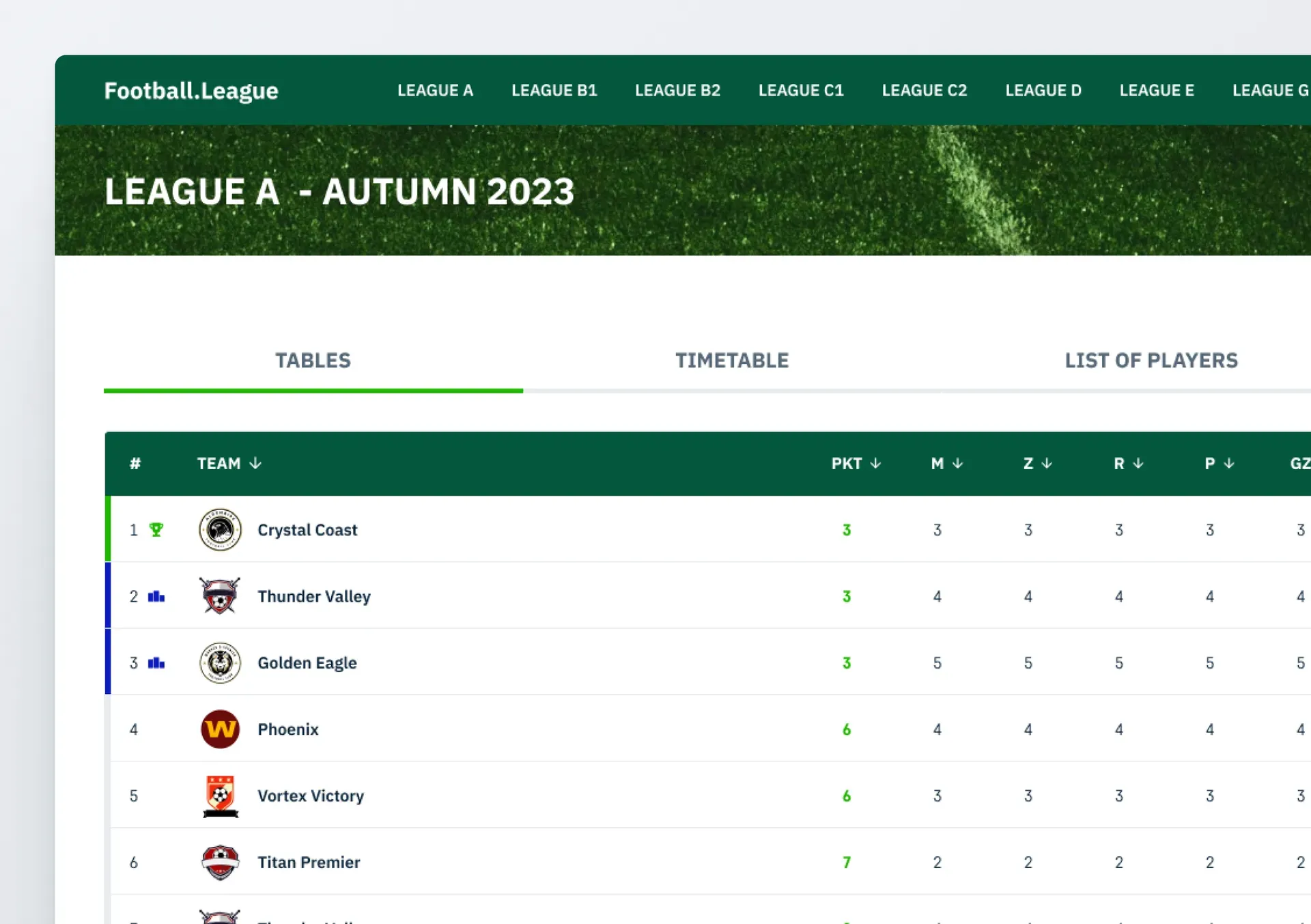
The standings table is the thing players check most, so it's the worst thing to get wrong. Manual tables drift: a late score correction doesn't propagate, a tiebreaker gets miscalculated, and by matchweek eight the published table quietly disagrees with reality. Once a captain catches the table out once, they stop trusting it, and a league nobody trusts is a league nobody renews.
Pulling standings straight from match results kills the drift entirely. A league table generator updates the table, the form guide, and the top-scorer chart the moment a result lands, with the tiebreakers applied the same way every time.
Chasing sign-ups and fees by hand
Collecting money is the least fun part of running a soccer league, and doing it manually is where leagues quietly lose income. A registration form in one place, payment screenshots in a group chat, a spreadsheet you update by memory: it adds up to real money left on the table.
- Fees you never collect – the one captain who always pays "next week" and somehow never does
- Hours reconciling – matching Venmo notes to a roster long after you've forgotten who's who
- No clean record – when a player disputes whether they paid, you have nothing to point to
Online registration with payment built in turns sign-up into a self-serve step. Teams register, pay, and land on your roster in one flow, and you stop being the league's debt collector.
Player-experience mistakes that quietly lose you teams
Players rarely announce that they're leaving. They just don't sign up next season, and you find out when you're two teams short in August. Two mistakes push them out without a word.
Letting communication scatter across group chats
When the schedule lives in one chat, results in another, and the table in a PDF someone emailed in March, every player is one missed message away from showing up at the wrong field. A group chat is fine for banter and useless as a system of record. Last week's result gets buried under 200 messages about whose turn it is to bring the ball.
A public league page fixes both problems at once, giving everyone a single source of truth for the schedule, results, and standings while making the league look like something worth joining. A league with a proper league website feels real in a way a group chat never will, and that impression matters when a captain is deciding whether to bring their team back.

Treating stats and retention as an afterthought
Players come back for reasons that have little to do with the trophy. CivicScience found that social interaction, enjoyment, and a sense of progress are the top motivations for adult league players, clustered around 40% each. A league that tracks every player's goals, keeps a live top-scorer race, and gives each player a profile feeds exactly those motivations. One that just records the score doesn't.
Retention is also the cheaper game to play. Finding a brand-new team every season costs you far more outreach than keeping the eight teams you already have happy. Keeping a team you already have beats recruiting a new one every time.
Running a soccer league without the weekly busywork
Every fix above points the same direction. Scheduling that reshuffles itself, standings that update from results, registration that collects its own fees, a public page that doubles as your league's home, and stats that keep players invested: that's one connected system rather than eight separate chores. Good soccer league management software pulls all of it into one place, which is exactly what a league management system is built to do. You can start a free trial of FLM System today, no card required, and have next season's schedule, table, and sign-up page ready before the weekend.
FAQ
How much does it cost to start an amateur soccer league?
The real costs are field hire, basic kit like balls and bibs, and referees if you use them. Field time is by far the biggest line. League software is optional and cheap relative to that: FLM System starts at $1 per team per month, which most organizers fold into team fees so the league pays for its own admin.
How many teams do you need to run a soccer league?
You can run a real season with as few as four, but the experience changes as you grow:
- 4 teams – the minimum for a competitive round-robin, though the schedule gets repetitive
- 6 to 8 teams – the sweet spot for most amateur leagues, enough variety without overloading the calendar
- 10 or more – usually the point to split into divisions and lean on software to keep it manageable
Start with what you can fill reliably. A full 6-team league beats a half-empty 12-team one.
How do you schedule an amateur soccer league fairly?
Use a round-robin so every team plays every other team, balance home and away slots as evenly as your venue allows, and build in rest so no team plays twice in a single night. The fairness usually breaks during rescheduling, so use a scheduler that regenerates the fixtures cleanly instead of patching the grid by hand.
Do you need software to run a soccer league?
Not always. It depends on size and ambition:
- One short season, four to six teams – a spreadsheet can hold together
- Multiple divisions, several seasons, or a public table – software pays for itself fast
- Online registration, payments, and player stats – hard to do credibly by hand at any size
Most organizers reach for dedicated soccer league management software the season after the spreadsheet first lets them down.
How do you keep players coming back each season?
Give them a competition they trust and an experience worth their Tuesday night: a standings table that's always right, communication they don't have to dig for, personal stats that make the games feel like they count, and a league that looks the part. Players renew for the feeling that the league is run well, and most of that feeling comes from the admin being invisible.