
12 min• 22.10.2026
How long is a football match? 6-a-side, 7-a-side, futsal and 11-a-side
By Dawid Pątko
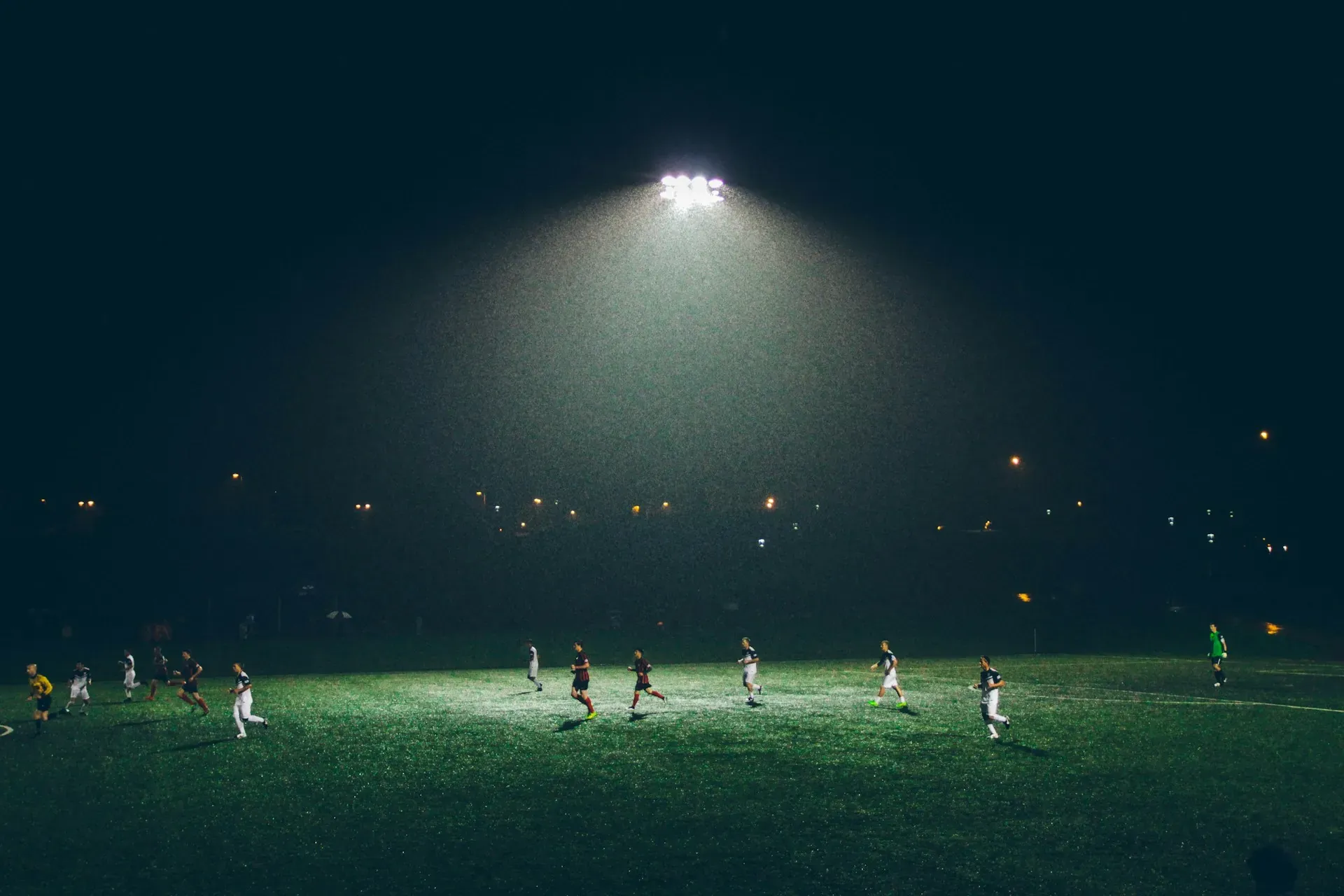
FIFA put a three-minute hydration break into every one of the 104 matches at the 2026 World Cup, around 22 minutes into each half and regardless of the temperature, even under a closed roof, as ESPN reported. A match that officially lasts 90 minutes was, in practice, played in quarters. In your Tuesday-night small-sided league, a different clock decides how long a football match lasts. At Powerleague, one of the UK's biggest small-sided operators, league games last 30, 40 or 50 minutes depending on the league, split into two equal halves, and the next two teams are already warming up by the gate.
So how long is a football match? It depends on the pitch. An 11-a-side match lasts 90 minutes: two 45-minute halves with a half-time break of up to 15 minutes. In amateur 6-a-side, 7-a-side and futsal leagues, the league's own rules set the match length, and the usual answer is two halves of 20 to 25 minutes that fit inside an hour of pitch hire. Below you'll find the typical match length for each format, the timing rules worth writing into your rulebook, and a short summary of the Laws of the Game for 11-a-side. In an amateur league, the pitch booking decides how long a match lasts and the rulebook writes it down: every matchday schedule and the whole season's fixtures follow from that one number. If you run your league on FLM System, it's also the number the system uses to fit matches into your pitch times.

How long is a football match in an amateur league?
Outside the 11-a-side game, only futsal and socca have worldwide rules on match length. Everything else is decided by the league, and almost always around the hours it hires, because pitches and sports halls are booked by the hour. That's why the answer to "how long is a football match?" changes from one amateur format to the next.
6-a-side and socca: two 20-minute halves
Socca is 6-a-side with its own federation and its own rules: a goalkeeper and five outfield players on a small pitch. Under the ISF's official rules for 2026, a standard match lasts 40 minutes, played as two 20-minute halves with a five-minute break. The referee is the only timekeeper, and a draw in a knockout round goes straight to penalties, with no extra time.
Most 6-a-side leagues stick to that measure, or stretch the halves to 25 minutes when the booking allows. A 2×20 match with its break takes 45 minutes of pitch time. Everything a league in this format needs week to week, from fixtures to the table, is on our 6-a-side football page.
7-a-side: two 25-minute halves
Two 25-minute halves with a five-minute break is the most common setup in 7-a-side leagues, although anything from 2×20 to 2×30 turns up. That works out at 55 minutes, which slots into an hourly booking once you allow for the changeover.
Leagues that prefer 2×30 either book 90 minutes or accept that the last game of the night finishes late. Pitch sizes, squad numbers and substitution rules are covered in our guide to 7-a-side football.

5-a-side and indoor football: under an hour
The FA's Law 7 for 5v5 football allows halves of up to 25 minutes, caps half-time at five minutes unless the referee agrees to more, and lets competitions drop the break altogether. In practice, most weeknight 5-a-side leagues play 40 to 50 minutes including the break. Indoors, the venue's timetable sets the clock: the hall is hired for fixed slots, and the next group walks in on the hour whatever the score.
Futsal: 40 minutes on a stopping clock
Futsal has its own Laws: two 20-minute halves of playing time, a half-time break of up to 15 minutes and one one-minute timeout per team in each half, under Law 7 of the futsal Laws. What decides the length, though, is Law 6. The timekeeper stops the clock every time the ball goes out of play, after a goal, when a free kick or penalty is awarded and when a player is injured, so a futsal match always takes noticeably longer than 40 minutes on the wall clock.
Amateur leagues rarely have a separate timekeeper, so most play a running clock, anywhere from 2×12 to 2×20, and a match fits into a 35- to 50-minute slot. The rest of the game, from the low-bounce ball to accumulated fouls, is in our guide to futsal rules.

Your league rulebook sets the match length
Nobody outside your league tells you how long a football match should last in it. The Laws let you shorten the halves, the pitch booking sets the limit, and your rulebook fixes the number for the season. Anything left unwritten gets settled on the pitch, usually at 2-2 with three minutes to go.
Law 7 lets you shorten the halves
Law 7 of the IFAB Laws of the Game says the two 45-minute halves can be shortened only if the referee and both teams agree before kick-off, and only where the competition rules allow it. The futsal Laws say the same about their 20 minutes.
In an amateur league, the competition rules are your rules. You set the match length once and it holds for every matchday, so nobody has to negotiate it with the captains before each game.
Seven timing rules for your rulebook
Seven points cover the clock. Whichever one you leave out, someone will raise it halfway through the season:
- Length of each half – one figure for the whole league, for example 2×25 in 7-a-side.
- Length of half-time – five minutes is plenty when the slot is an hour.
- Running or stopped clock, and who keeps time – in amateur football it's almost always a running clock kept by the referee. If someone else does it, name them.
- Added time – if you allow it, cap it. A minute or two is enough to give back time lost to an injury without eating into the next game's slot.
- Late teams – how long you wait for a short-handed side and what result goes in the table if they never turn up.
- A match that kicks off late – it still finishes at the scheduled time. This one rule prevents more arguments than any other, because the pitch booking ends when it ends, whether or not the match has.
- Draws in knockout rounds – straight to penalties, three each and then sudden death; an hour-long slot has no room for extra time.
The rest of the rulebook, from cards to the order of tiebreakers in the table, is in our piece on the 10 decisions to make before the season.
From match length to pitch slot
Knowing how long a football match lasts in your league is half the sum. The other half is the slot: the pitch time one match takes up, made of the match itself, the break and roughly five minutes for one pair of teams to leave and the next to come on. For the most common formats it looks like this:
- 7-a-side, 2×25 – 50 + 5 + 5, a 60-minute slot. One match an hour.
- 6-a-side, 2×20 – 40 + 5 + 5, a 50-minute slot. On a 90-minute booking, that's one match with a proper warm-up, or two shorter ones at 2×15 with no break.
- Futsal – a running-clock 2×15 gives 30 + 5 + 5, a 40-minute slot. With a stopping clock, allow at least 50 minutes per match and three matches in a three-hour block.
- 11-a-side – 90 + 15 + the changeover, a block of about two hours per match.
How many matches fit into your hours, and how many teams that serves over a season, we work out step by step in our guide to planning a league season.
In FLM System you set the match or slot length once. Enter when each pitch is available, and the league scheduling software gives every match a date, a kick-off time, a pitch and a referee. Two matches never land on the same pitch at the same time, even with several leagues sharing the same venue. It costs $1 per team per month, and you can build your first schedule before entering a card. A slot that's been worked out properly keeps the fixtures on time; one judged by eye ends every evening twenty minutes late.

How long is a football match under the Laws of the Game?
Ask anyone "how long is a football match?" and you'll hear "90 minutes". That figure comes from the Laws of the Game for 11-a-side, which the IFAB updates every year; the 2026/27 edition has applied since 1 July 2026. Even if your league plays on a small pitch, it's the benchmark every other format is measured against.
Two 45-minute halves and up to 15 minutes of half-time
How many minutes is a football match? Ninety minutes of play in two 45-minute halves, with a half-time break of up to 15 minutes. From the first whistle to the last, with half-time and added time, a professional match takes close to an hour and 55 minutes.
The Laws only set a ceiling on how long half time in a football match can last. The exact length is set by the competition rules, and it can only be changed with the referee's permission. In extra time there is no proper break between the two periods, just a short drinks pause of up to a minute.
Added time and effective playing time
The clock in 11-a-side keeps running while the ball is dead, and at the end of each half the referee adds back the time lost. Law 7 lists where it goes:
- substitutions,
- treating and removing injured players,
- deliberate time-wasting and disciplinary sanctions,
- medical breaks allowed by the competition rules: drinks breaks of up to a minute and cooling breaks of 90 seconds to three minutes,
- VAR checks and reviews,
- goal celebrations.
The 2026/27 Laws went after time-wasting from another angle. A referee can now show a visible five-second countdown when a team delays a throw-in or a goal kick. Run past it and the throw-in goes to the opponents, while a goal kick becomes a corner to them. A substituted player has ten seconds to leave the pitch, according to the IFAB's summary of the changes.
Even so, the ball is in play for little more than half the match. World Cup group games in 2026 averaged around 100 minutes of play, with the ball live for roughly 57% of it, according to DataFactory and Opta figures reported by Ecuador's Expreso. The question of how many minutes a football match lasts therefore has two answers: 90 in the Laws, and just under an hour with the ball moving. In amateur leagues hardly anyone adds time on, because the next two teams are already waiting.
Frequently asked questions
How long is half time in football?
Up to 15 minutes in the professional game, with the exact length set by the competition. In an amateur league every minute of half-time comes out of the slot, so it's better to start from the slot length and see how much break fits in. In formats of 2×20 or shorter, many leagues skip half-time altogether and just change ends, which on a four-match evening frees up about 20 minutes of pitch time.
How long is a futsal match?
That depends on who is keeping time:
- Under the Laws – two 20-minute halves of effective time, with the clock stopped every time the ball goes out. With half-time and timeouts, allow at least 50 minutes on the wall clock.
- On a running clock – the minutes in your league rules are the minutes on the clock, plus half-time.
- Timeouts – the Laws give each team one one-minute timeout per half. On a running clock each one costs a minute of play, so decide in your rulebook whether to keep them.
If you choose a stopping clock, appoint someone to keep time before the season starts, because it's hard for a referee to whistle and work a stopwatch at once.
How long is a 5-a-side match?
There's no single standard, because how long a 5-a-side football match lasts is up to the competition. Under The FA's 5v5 Law 7, halves can run up to 25 minutes with no more than five minutes of half-time, and commercial operators set their own lengths within that. Powerleague runs 30-, 40- and 50-minute games, for example. Check your league's rules or fixture details for the exact figure.
How long is a football match with extra time and penalties?
It depends whether you mean a professional cup tie or an amateur league:
- Professional match – 90 minutes plus added time and half-time, two 15-minute periods of extra time with a short drinks pause between them, then a penalty shootout. The whole thing, from kick-off to the last penalty, can take more than two and a half hours.
- Amateur leagues and socca – usually no extra time at all. The match goes straight to penalties at the final whistle, and the shootout adds 5–10 minutes to the slot.
If your knockout rounds run back to back, leave a free slot after each round to soak up those minutes.
Why is a football match 90 minutes?
One of the most cited origins dates back to 1866. The match between the London and Sheffield associations was agreed at 90 minutes, from 3pm to 4.30pm, because the rules of the time set neither the length of a game nor a half-time break, according to the account of that fixture. Over time, 90 minutes made it into the Laws, and today Law 7 splits it into two halves of 45.