
10 min• 02.07.2026
Best LeagueLobster alternative for running a soccer league
By Dawid Pątko

American soccer just had its biggest year in more than a decade. Outdoor participation reached 16.8 million players in 2025, a 15-year high and a 15.8% jump in a single year, while indoor soccer climbed to 6.6 million. Most of that growth isn't coming from professional academies. It's adults returning to the game and organizers spinning up six-a-side, indoor, and corporate leagues in cities across the country.
If you run one of those leagues, you have probably met LeagueLobster. Its free schedule generator is the tool many organizers reach for first, and for good reason. But building a schedule is one job, and running a league season after season is another. This is an honest LeagueLobster alternative comparison: where LeagueLobster is the right pick, where it runs out of room, and why organizers who want a modern public league site, live scores, and season-long stats move to FLM System. LeagueLobster is a scheduling tool with features bolted around it; FLM System is a platform built to run the entire competition.
LeagueLobster and FLM System at a glance
The two tools overlap on paper and split apart in practice. Before you settle on a LeagueLobster alternative, it helps to know where that split runs. One starts from the fixture list. The other starts from the league.
LeagueLobster – a scheduling-first tool for fixtures and brackets
LeagueLobster does one thing better than almost any tool out there: it turns a list of teams into a full season of fixtures. The round-robin generator handles single or multiple divisions, the bracket builder produces single and double-elimination knockouts with or without consolation games, and you can drag and drop games to reschedule them. It also copes with the messy parts of real scheduling, like travel time between venues, early or late start requests, and a coach who runs two teams at once.
Organizers can enter scores on a shareable page to build standings, and registration with electronic payment processing is available as an add-on. The free LITE version covers up to 50 games a month. For a one-off tournament or a small season, that combination is hard to beat.
FLM System – built for small-sided soccer leagues end to end
FLM System generates fixtures too, in round-robin, cup, group-stage, and combined league-and-cup formats, and lays out the dates and times. Then it keeps going. Standings and player stats update automatically, referees post results live from the sideline through a dedicated app, and every league gets a public website with team pages, player history, top-scorer tables, photo galleries, and sponsor slots you can sell.
The platform is built specifically for small-sided formats: six-a-side, indoor, socca, and corporate leagues run outside the official federation structure. The pricing is a flat $1 per team each month, with no free plan and no per-game meter. In short, LeagueLobster hands you a schedule, and FLM System runs the league that schedule belongs to.

Head-to-head: what matters when you run a soccer league
Four things separate a scheduling utility from a league platform once your competition is live and players are watching. If you are weighing a LeagueLobster alternative, these are the four areas where the choice gets made.

Scheduling and competition formats
On pure scheduling logistics, LeagueLobster is the deeper tool, and it would be dishonest to pretend otherwise. If your league spreads across several venues, reshuffles fixtures every week, and has to work around travel time and coaches with multiple teams, its generator is built for exactly that. Drag-and-drop rescheduling and the multi-division handling are genuinely strong.
FLM System takes a simpler path. You pick a format – round-robin, cup, groups plus a knockout, or a league-and-cup combination – and it produces the fixture list with dates and times, then feeds those matches straight into live scoring and the standings table. If you want to see how that works without a spreadsheet, we broke it down in our guide to building a season of fixtures without Excel. The trade-off is real and worth naming: LeagueLobster wins on scheduling depth, FLM wins on what happens after the schedule exists.
Live scoring and the referee app
This is where the two tools stop being comparable. FLM System gives referees an app to enter results live during the match. The score updates, the table recalculates, and the top-scorer list shifts, all while players are still at the field checking their phones. Nobody waits until Monday for someone to type results into a page.
LeagueLobster has no live match-day flow and no referee role. You enter scores yourself on a custom page after games finish, and that builds your standings. It works, but it is a manual, after-the-fact step rather than a real-time experience for the people playing in your league.
Public league site and standings
A schedule page and a league feel like two different products to the players looking at them. LeagueLobster gives you functional, shareable schedule and standings pages. They do the job, but they look like what they are: a utility.
FLM System gives every league a full public website that looks modern and professional out of the box, with automatically updating tables, individual team and player pages, historical records, photo galleries, and space for sponsor logos and banners. For an organizer trying to make an amateur league feel like a real competition, that presentation is not cosmetic; it is a big part of why players keep showing up and treat the league as something worth committing to. If a strong standings page is the one feature you care about most, our league table creator breaks down what a good one includes.

Registration, payments, and fee tracking
LeagueLobster can collect money. Its registration add-on includes electronic payment processing, so players can pay online through the same forms they sign up on. If taking card payments inside the tool is a hard requirement for you, that is a genuine advantage.
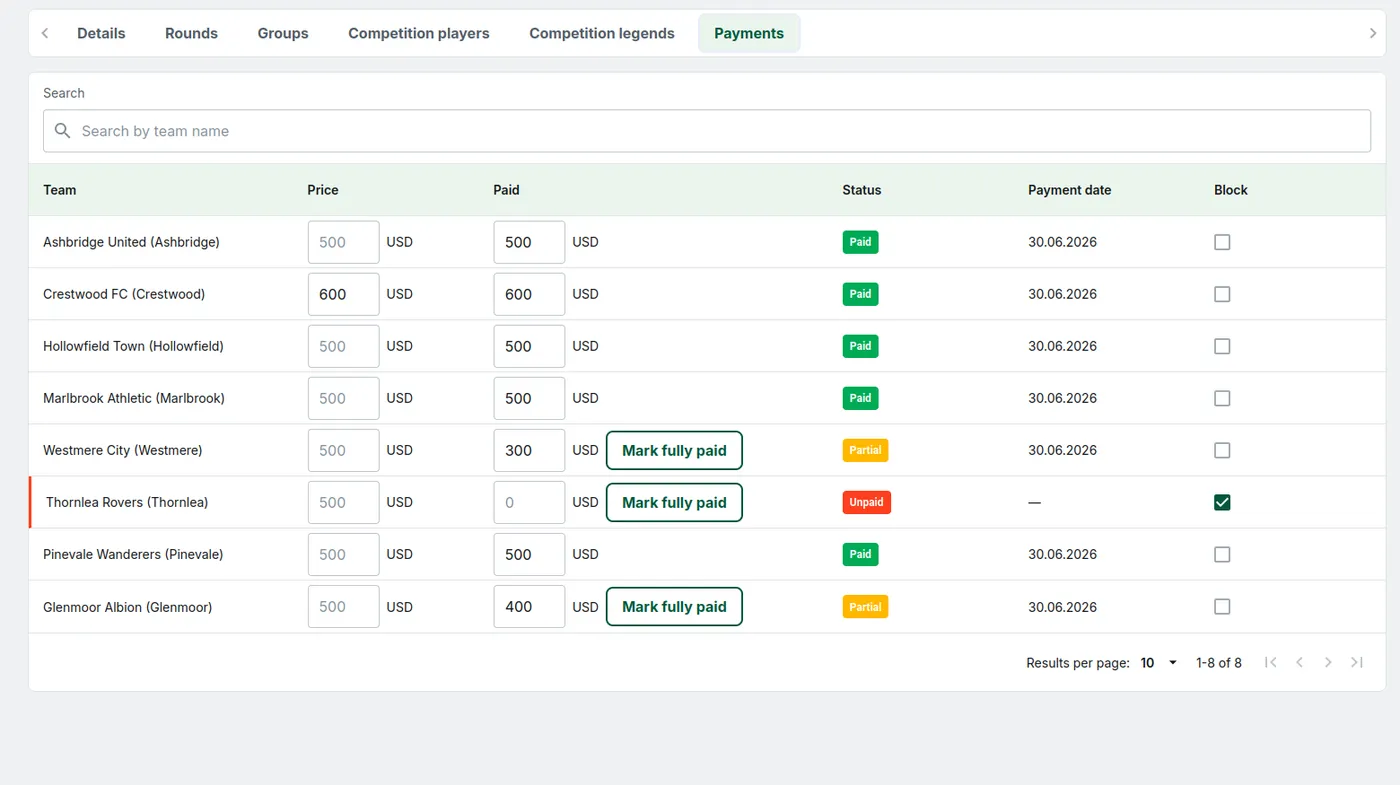
FLM System handles registration with an approval step, so you control who joins, and its payments section tracks who has paid their fees and who still owes across the whole season. You see the paid and unpaid status of every team at a glance instead of digging through a spreadsheet. The two tools solve the money problem from different ends: one focuses on the checkout, the other on keeping the season's books straight.
Pricing comparison
The two tools price on completely different logic, so a straight side-by-side needs a little translation. One charges for games, the other for teams.
How much does LeagueLobster cost?
LeagueLobster meters on games, not teams. The published pricing works like this:
- LITE (free) – up to 50 games per month, with ads, and a small charge to publish beyond the limit
- PRO – around $29.95 per month, covering up to 150 teams with the full feature set
- Overage – extra games cost $0.10 each on LITE and $0.25 each on PRO
- Registration and payments – a separate add-on on top of the scheduling subscription
For a tiny league or a single tournament under 50 games, you can run on the free tier. Scale up to a busy multi-division season and PRO lands near $360 a year before the registration add-on.
How much does FLM System cost?
FLM System charges $1 per team each month, and that is the whole price. A 12-team six-a-side league pays $12 a month. There is no free plan, no per-game meter, and no separate tier to unlock registration, live scoring, the public site, or sponsor tools, because all of it is included. The cost scales with the size of your league in a way that is easy to predict a season ahead, which matters when you are the one collecting fees and balancing the budget.
When LeagueLobster is the better choice
For some organizers, LeagueLobster is the right tool, and pushing them toward a bigger platform would be a disservice. Reach for it when:
- You are running a one-off tournament and mainly need clean brackets, not a season-long home
- Scheduling logistics are your hardest problem – many venues, constant reshuffles, travel-time constraints
- Your league is small enough to live under the free 50-game limit
- You already have a website and only need fixtures and a standings page to drop into it
If the schedule is the whole job, LeagueLobster's generator is one of the best around and the free tier is a gift. For anything past that, a LeagueLobster alternative built for full league management earns its place.
When FLM System is the better LeagueLobster alternative
FLM System is soccer league management software, not a scheduler with add-ons, and it becomes the better LeagueLobster alternative the moment your league turns into an ongoing thing that players, and eventually sponsors, care about. The platform fits leagues that run season after season, want a public site that looks the part, and would rather have live results, automatic stats, and player history working together than stitch a scheduler to three other tools.
That is the same reason organizers pick it over other platforms in the category. We laid out the full case against LeagueApps and League Republic elsewhere, and the pattern holds here: a scheduler covers the fixtures, a real platform covers the league. If you are earlier in the journey, our guide to starting and running an amateur soccer league is a good place to begin. When you want players to see a modern, professional league instead of a shared spreadsheet, that is when the switch pays for itself. You can register a league on FLM System and have your public site live before your next game.
FAQ
Is LeagueLobster free?
Yes, in part. The LITE version is free for up to 50 games per month and includes ads. Publishing beyond that limit and unlocking PRO features requires a paid subscription, and the registration and payments tools are a separate add-on.
How much does LeagueLobster cost for a small soccer league?
It depends on how many games you run:
- Under 50 games a month: free on the LITE tier
- PRO plan: about $29.95 per month, up to 150 teams
- Overage: $0.10 per extra game on LITE, $0.25 on PRO
- Registration and payments: priced separately on top
A busy multi-division league on PRO works out to roughly $360 a year before add-ons.
Can LeagueLobster run a whole league season, or just make the schedule?
It makes the schedule and builds standings from scores you enter, which covers the core of a season. What it does not include is live match-day scoring, a referee app, a full public league website with player history, or sponsor tools. Those gaps are exactly what a LeagueLobster alternative like FLM System is built to fill.
What is the best LeagueLobster alternative for running a soccer league?
For organizers who want everything in one place rather than a scheduler plus add-ons, FLM System is the strongest LeagueLobster alternative: it is soccer league management software that generates fixtures, scores matches live, updates tables and stats automatically, and gives each league a modern public site with sponsor slots, at $1 per team per month. If your only need is pure scheduling depth for complex, multi-venue logistics, LeagueLobster itself may still be the better fit.
Can I move from LeagueLobster to FLM System without losing my setup?
Yes. You recreate your teams and divisions in FLM System, set the competition format, and generate the rest of the fixtures from there, so a mid-season switch is realistic. Once your teams are in, live scoring, standings, and the public site come online without any extra configuration.
Want fixtures, tables and team payments in one place, without paying per game? Start your free trial of FLM System.