
10 min• 29.09.2026
Planning a league season: how many teams, rounds, and weeks
By Dawid Pątko
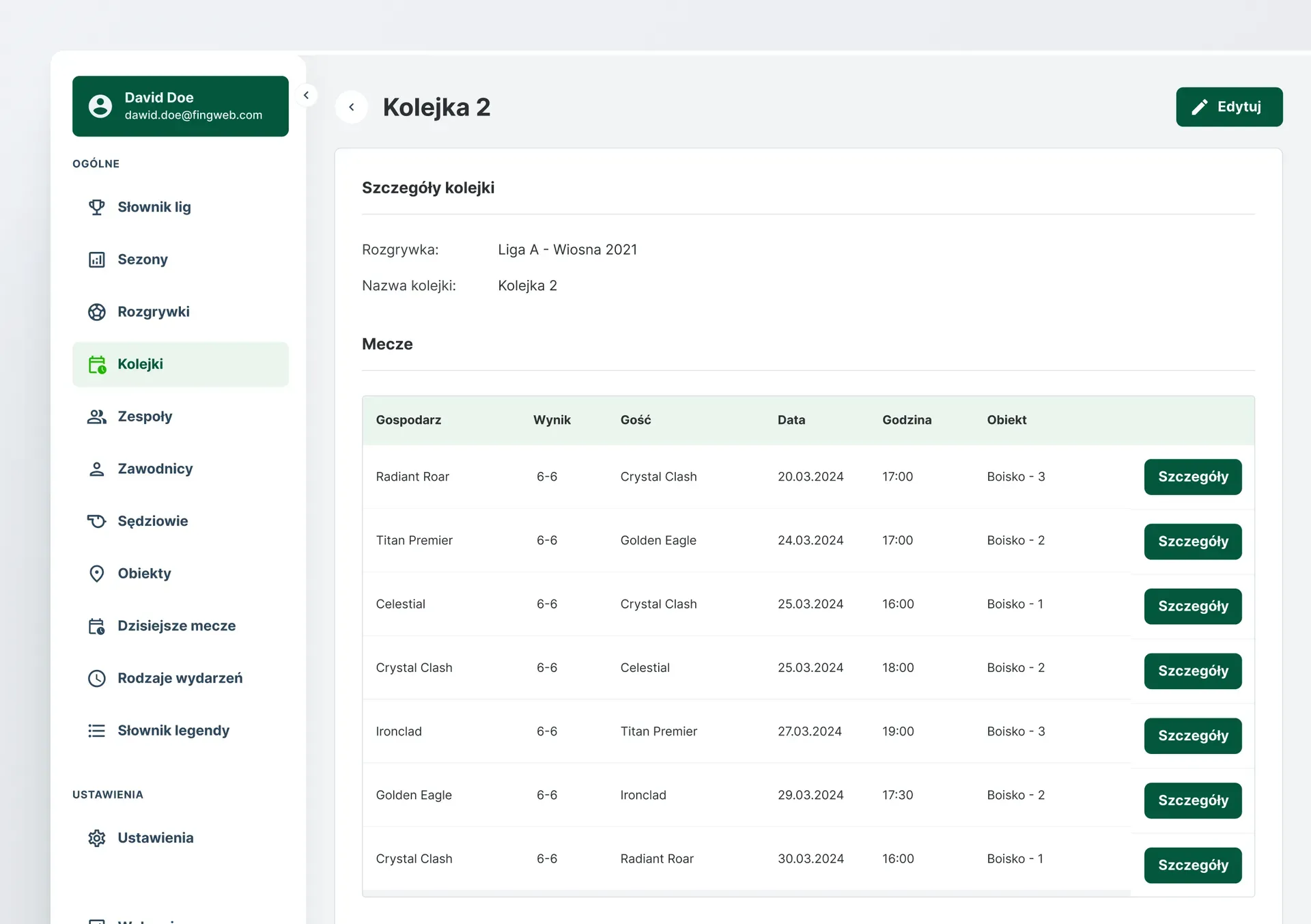
"I've got 14 teams and 12 free weeks – what format actually fits?" is the kind of question a league organizer now asks an AI assistant directly, expecting a number back, not a description. The number is 91 matches over 13 rounds. With only 12 weeks available, that leaves two options: either fit two rounds into one week somewhere, or split the field into two seven-team divisions and cut the round-robin down to seven rounds.
Below are the four formulas for working out matches and rounds, ready-made figures for 6 to 20 teams, and the calculation in reverse: how many teams you can take on with a given number of field-hours and weeks. FLM System generates the schedule automatically from those same numbers.
The formulas you start from
Four formulas settle most questions about the size of a season. Each one works regardless of the playing format, because it only counts pairings between teams, without caring how long a match runs.
- Single round-robin, even number of teams – the number of matches is n(n-1)/2, the number of rounds is n-1. With 10 teams: 10×9/2 = 45 matches over 9 rounds.
- Single round-robin, odd number of teams – the formula for matches stays the same, but the number of rounds is n, not n-1, because one team sits out each round. With 11 teams: 11×10/2 = 55 matches over 11 rounds.
- Double round-robin – multiply the matches by two: n(n-1), and double the number of rounds from a single round-robin: 2×(n-1) for an even n. With 10 teams over a double round-robin: 90 matches over 18 rounds.
- Matches in a single round – n/2 for an even number of teams, (n-1)/2 for an odd number, with one team sitting out. With 11 teams, that's 5 matches per round and one bye.
We cover the actual mechanism for pairing teams in each round – the rotation algorithm behind a round-robin schedule – separately, in the piece on round-robin scheduling.
From number of teams to number of weeks
The figures below cover the range from 6 to 20 teams, since that's where most amateur small-sided leagues fall. Each line gives matches and rounds for a single round-robin first, then the number of weeks if you play one round a week, and finally the same figures for a double round-robin.
- 6 teams – 15 matches, 5 rounds (5 weeks) in a single round-robin; 30 matches, 10 rounds in a double round-robin.
- 7 teams – 21 matches, 7 rounds (7 weeks); 42 matches, 14 rounds.
- 8 teams – 28 matches, 7 rounds (7 weeks); 56 matches, 14 rounds.
- 9 teams – 36 matches, 9 rounds (9 weeks); 72 matches, 18 rounds.
- 10 teams – 45 matches, 9 rounds (9 weeks); 90 matches, 18 rounds.
- 11 teams – 55 matches, 11 rounds (11 weeks); 110 matches, 22 rounds.
- 12 teams – 66 matches, 11 rounds (11 weeks); 132 matches, 22 rounds.
- 13 teams – 78 matches, 13 rounds (13 weeks); 156 matches, 26 rounds.
- 14 teams – 91 matches, 13 rounds (13 weeks); 182 matches, 26 rounds.
- 15 teams – 105 matches, 15 rounds (15 weeks); 210 matches, 30 rounds.
- 16 teams – 120 matches, 15 rounds (15 weeks); 240 matches, 30 rounds.
- 17 teams – 136 matches, 17 rounds (17 weeks); 272 matches, 34 rounds.
- 18 teams – 153 matches, 17 rounds (17 weeks); 306 matches, 34 rounds.
- 19 teams – 171 matches, 19 rounds (19 weeks); 342 matches, 38 rounds.
- 20 teams – 190 matches, 19 rounds (19 weeks); 380 matches, 38 rounds.
One rule falls straight out of this table: with one round a week and no breaks, the season lasts exactly as many weeks as there are rounds in a single round-robin.

How many matches fit into one evening?
The number of teams is only half the equation. The other half is how many matches you can actually fit into the time you have at the venue, and that depends heavily on the playing format.
- 11-a-side soccer – two 45-minute halves plus a break of up to 15 minutes under Law 7 of the IFAB Laws of the Game, plus time to change teams over on the field, works out to roughly 120 minutes per match in practice. A three-hour block therefore usually fits only 1 match, no more.
- Futsal – the rules specify two 20-minute periods of playing time, but that's a stopping clock that pauses on every break in play, under Law 7 of FIFA's Futsal Laws of the Game. In practice, a match takes roughly 50 minutes, not 40 – a difference hardly anyone writes about. On that basis, a three-hour block fits 3 matches.
- Small-sided formats (six-a-side, seven-a-side) – there's no single standard; the organizer sets playing time. The most common slots run 30-40 minutes including the team changeover, which gives 4 to 6 matches in a three-hour block, depending on the slot length chosen. These figures reflect observed organizer practice, not any federation's rulebook.

How many teams can you take on with X weeks and Y field-hours?
An organizer usually knows the venue's availability before knowing the number of teams, so the calculation more often runs the other way. The method is simple. Field-hours multiplied by matches per hour gives the season's capacity in matches, and from that capacity, the formula n(n-1)/2 gives you the maximum number of teams the season can hold.
- Indoor venue, 3 hours on Wednesdays, 12 weeks, 40-minute slots – 2,160 minutes in total gives a capacity of 54 matches. The largest number of teams for which n(n-1)/2 doesn't exceed that capacity is 10 teams (45 matches in a single round-robin), leaving 9 slots spare for rescheduling.
- Outdoor field, 2 hours on Sundays, 10 weeks, 30-minute slots – 1,200 minutes in total gives a capacity of 40 matches. The maximum number of teams is 9 (36 matches in a single round-robin), leaving 4 slots spare.
The slot length in both examples is organizational practice, not a fixed rule. If your matches run a different length, plug your own number of minutes into the same calculation.
One league, or two divisions?
Above a certain number of teams, a single round-robin stops fitting into a reasonable number of weeks. What's left is a choice: stretch the season out, or split the teams into two parallel divisions. Splitting wins out especially when the gap in ability is wide, because matches between the strongest and weakest teams are rarely interesting for either side.
The split criterion varies: skill level from the previous season, geography (teams from one part of town play on one day), or which day of the week a team is free to play. Splitting shortens the season and evens out the level of competition, but complicates the logistics if you want cross-division matches at the end. We cover running several leagues and divisions on one account separately.

When do you add a knockout phase?
A knockout phase tacked onto the end of the league season adds rounds to a schedule you've already worked out, so it needs to be accounted for before you set the date of the first match. A knockout phase with four teams usually adds two extra rounds, eight teams add three, and choosing between single elimination and double elimination changes that figure further still.

A buffer for postponements and holidays
A season planned down to the minute, without a single free week, looks great in a spreadsheet and falls apart at the first postponed match. Amateur leagues typically leave 2 to 3 weeks of slack across the whole season, spread around holidays and long weekends, when turnout tends to be lower anyway.
This buffer matters more than it might seem, because FLM System doesn't cascade the schedule after a postponed match. A postponed match has to be played on another date, but the rest of the calendar doesn't shift automatically to make room for it. So plan the buffer in from the start, rather than counting on the system to rearrange the rest of the season for you after the first postponement.
How do you work this out and set it up in FLM System?
The number of teams and the format are all FLM System needs to generate a schedule. You can choose a single or double round-robin, a knockout format, groups with a knockout phase, a league plus cup, or a Swiss system. When the number of teams isn't a power of two, the system adds byes into the bracket on its own, and you can leave the seeding to an automatic setting based on the standings or set it manually.
One account handles several competitions and divisions at once, so splitting into divisions doesn't mean setting up separate admin accounts. You set the order of tiebreaker criteria for level points in the standings yourself, the standings recalculate after every result, and a withdrawn team's matches can be canceled with the standings updating automatically. The system doesn't handle multiple venues at once or a home-and-away scheme, so those two things stay on the organizer's side.
If you're planning a season from scratch, sign up for FLM System and see how it looks with your own number of teams.
FAQ
How many matches are in a league with N teams?
In a single round-robin, the number of matches is n(n-1)/2, where n is the number of teams – with 12 teams that's 66 matches, with 16 teams it's 120 matches. In a double round-robin, you multiply that figure by two.
How many rounds does a season run for?
With an even number of teams, the number of rounds in a single round-robin is n-1; with an odd number, it's n, because one team sits out each round instead of playing. With 10 teams that works out to 9 rounds, with 16 teams it's 15, and a double round-robin doubles that figure.
How many teams do you need to start a league?
There's no external minimum imposed on you – technically, four teams are enough to run a sensible season with a handful of rounds. In practice, most amateur leagues start at 6 to 8 teams, since that's the minimum at which a season lasts longer than a month and the standings have real competitive meaning.
What do you do with an odd number of teams?
One team sits out each round instead of playing, and the number of rounds in the season rises to n instead of n-1:
- Number of matches – unchanged, still n(n-1)/2.
- Number of rounds – increases by one, because the team sitting out also needs its own round in the schedule.
- Spreading out the byes – a good schedule spreads the byes evenly across teams, so no team sits out twice in a row.
How many matches fit into one evening?
It depends mainly on the playing format and the length of the match:
- 11-a-side soccer – usually 1 match in a three-hour block.
- Futsal – 3 matches, because the real length of a match with a stopping clock is around 50 minutes, not 40.
- Small-sided formats – 4 to 6 matches, depending on the slot length used (30-40 minutes).
How long does an amateur league season last?
With one round played every week, the length of the season in weeks equals the number of rounds in a single round-robin – 9 weeks for 10 teams, 15 weeks for 16 teams. It's worth adding 2 to 3 weeks of slack for postponements and holidays on top of that, so the real season usually runs longer than the schedule alone suggests.