
8 min• 06.07.2026
Round robin scheduling explained: build fair soccer league fixtures
By Dawid Pątko

A 12-team league that plays everyone home and away is 132 separate fixtures to arrange, with each team playing 22 games across the season (the standard round-robin math). Add a thirteenth team and the fixture list jumps from 132 to 156. That is the quiet problem with the fairest format in sport: the games multiply faster than anyone expects, and the calendar fills up before you have finished counting.
Round robin is the format most amateur soccer leagues run on, because it is the fairest one going: everyone plays everyone, and the final table reflects a whole season rather than one bad afternoon. The catch is the scheduling. This guide explains what round robin scheduling is, the math behind the matches and rounds, how to build a schedule by hand with the circle method, and when another format fits better. Round robin scheduling is simple to understand and tedious to do by hand, which is exactly why most organizers stop doing it manually once their league grows.
What is round robin scheduling?
The term gets used loosely, so it is worth pinning down before the math.
Round robin scheduling, defined
Round robin scheduling is a way of organizing a competition so that every team plays every other team the same number of times. In a single round robin each team meets each opponent once; in a double round robin they meet twice, usually home and away. Final standings come from every result across the season, not from a single elimination game.
Single vs double round robin
The difference is how many times each pairing meets. A single round robin has every team play every other once, which suits short seasons or large fields where a full home-and-away slate would run too long. A double round robin, the model most weekend leagues use, plays each pairing twice so home advantage evens out and the league table is harder to argue with.
A few leagues go further, with triple or quadruple round robins, when they have only a handful of teams and a long calendar to fill. The principle never changes: every team gets the same schedule, just repeated.

The math: matches, rounds, and byes
Two formulas cover almost everything you need to plan a round robin, and you can run both on the back of a napkin.
Matches and games per team
For a single round robin, the total number of matches is n × (n − 1) ÷ 2, where n is the number of teams. Each team plays n − 1 games. Double both figures for a home-and-away season. The counts climb fast:
- 4 teams – 6 matches single, 12 double, 3 games per team
- 6 teams – 15 single, 30 double, 5 games each
- 8 teams – 28 single, 56 double, 7 games each
- 12 teams – 66 single, 132 double, 11 games each
That jump from 8 to 12 teams, 28 matches up to 66, is why scheduling stops being a five-minute job somewhere around ten teams.
Rounds and byes
A round is a set of matches in which every available team plays once. With an even number of teams you get n − 1 rounds, each of n ÷ 2 matches, so an 8-team league runs 7 rounds of 4 games. An odd number will not pair cleanly, so one team sits out each round on a bye, and you end up with n rounds instead. The common fix is to add a phantom "bye" team to make the count even, then give the week off to whichever team is drawn against it.

Building a round robin schedule by hand: the circle method
If you want to do it manually, the circle method is the standard trick, and it is worth understanding even when software ends up doing the work.
The circle method, step by step
- List your teams in two rows, paired top to bottom. With six teams that is 1–6, 2–5, 3–4, and each column is a match.
- Fix one team in place, usually the top-left, and rotate every other team one position clockwise.
- Read off the new column pairings. That is your next round.
- Repeat until the fixed team has played everyone, which takes n − 1 rounds.
- For a double round robin, run the whole cycle again with home and away reversed.
For an odd number of teams, put the bye marker in the fixed position, and whoever lines up against it that round has the week off.
The limits of manual scheduling
The circle method gives you fair pairings, but it knows nothing about your league. It will happily put two matches on a pitch you booked once, send a team away three weeks running, or ignore that half of one squad shares a Tuesday work shift. Real scheduling has constraints: venues, referees, blackout dates, and home-and-away balance. Every time a single game moves, the knock-on effects have to be checked by hand. That is the part that eats an evening, and it is why a schedule that looks fair on paper so often falls apart by week three.

Round robin vs knockout and other formats
Round robin is not the only option, and the right one depends on how much calendar you have and what you want the season to settle.
- Round robin – everyone plays everyone; the fairest format; the table reflects the whole season; needs the most fixtures and the longest calendar
- Knockout (single elimination) – lose and you are out; fast and dramatic, but one poor game ends your run; ideal for a one-day cup
- Groups plus playoffs – a short round robin to seed teams, then a knockout to decide it; the model most tournaments and many leagues use to get fairness early and drama at the end
For a competition that runs over weeks, round robin scheduling is almost always the base. Plenty of organizers then bolt on a cup or a playoff so the season has a fair league phase and a knockout finish, which is exactly the kind of multi-stage tournament that is a headache to draw up by hand.
From method to a real season: round robin scheduling in practice
Understanding the method is one thing. Producing a clean, dated fixture list for a live league, and keeping it intact when a game gets moved, is another. That is the point where round robin scheduling stops being a diagram and turns into a logistics problem.
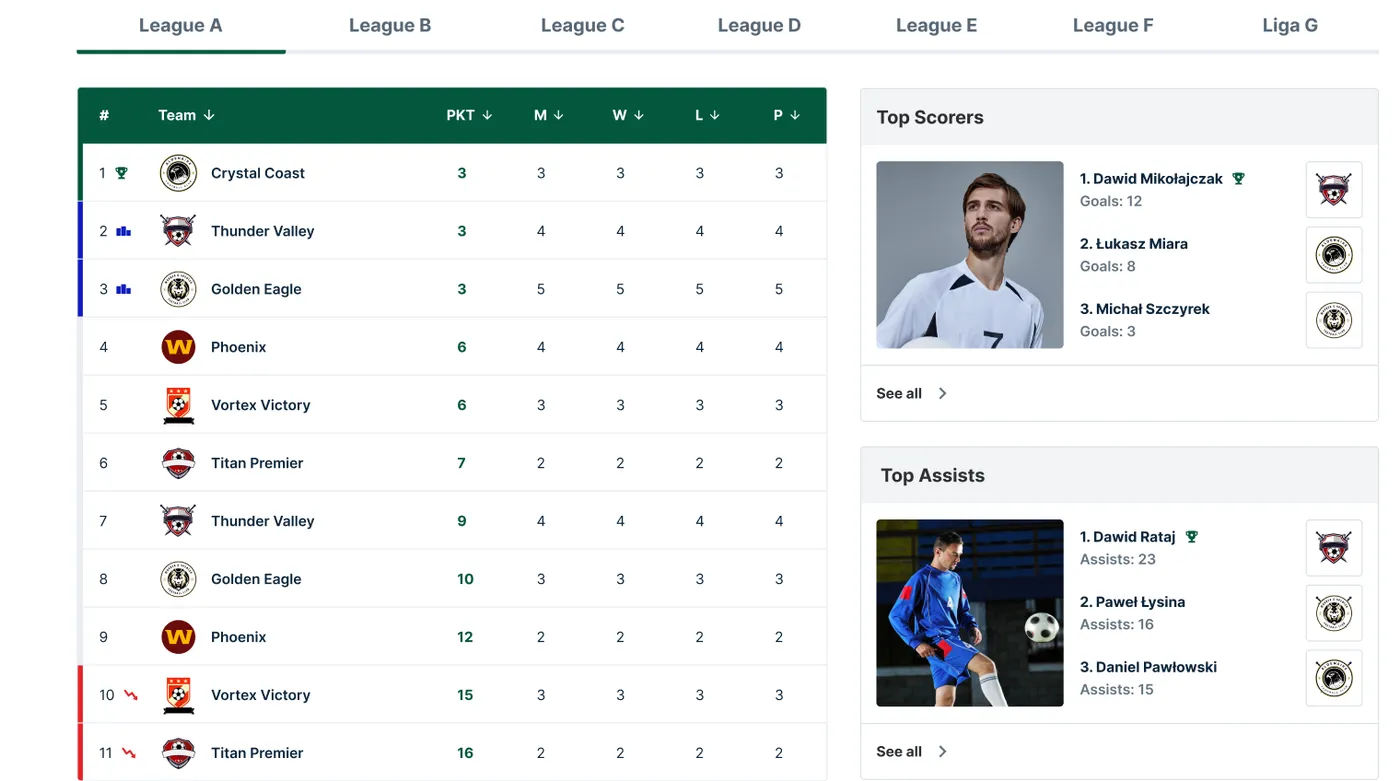
This is where most organizers stop working by hand. A round robin generator runs the circle method for you and assigns dates and times, so a 12-team season is a few clicks instead of an afternoon in a spreadsheet. FLM System generates fixtures for round robin, cup, group, and league-plus-cup formats, then feeds them straight into live scores and an automatically updating table, so your schedule and standings never drift apart. If you are setting up a competition from scratch, our guide to starting and running an amateur league covers the rest. Learn the method so you understand your fixtures, then let software build them so you get your evenings back.
FAQ
How many games are in a round robin tournament?
For a single round robin, use n × (n − 1) ÷ 2, where n is the number of teams. So:
- 4 teams – 6 games
- 6 teams – 15 games
- 8 teams – 28 games
Double those for a home-and-away season, and each team plays n − 1 games in a single round robin, or twice that in a double.
What is the difference between single and double round robin?
In a single round robin, each team plays every other team once. In a double round robin they play twice, normally home and away, which cancels out home advantage and doubles the total number of matches. Most league seasons use a double round robin, while short tournaments often use a single.
How do you schedule an odd number of teams?
With an odd number, you cannot pair everyone in a round, so one team sits out each round on a bye. The usual method is to add a phantom "bye" team to make the count even, run the normal schedule, and give the week off to whichever team draws the bye. Across the season, every team gets the same number of byes.
Is round robin better than a knockout format?
It depends on what the competition needs to prove. Round robin is fairer, because final position reflects a full season rather than one result, so it suits leagues. Knockout is faster and more dramatic but punishing, since a single loss ends your run, so it suits one-day cups. Many competitions use both: a round robin group stage, then a knockout finish.
How do you make a round robin schedule without a spreadsheet?
Manual round robin scheduling works fine for four or six teams, but past that, use a round robin generator built for leagues. You enter your teams, choose single or double, and it applies the circle method and assigns match dates for you. FLM System does this for round robin and mixed formats, then keeps the table and stats updated as results come in, so you never rebuild the schedule by hand.