
9 min• 13.07.2026
Running multiple soccer leagues in one system: an operator's guide
By Dawid Pątko

Demand for organized recreational sport keeps climbing. In a 2025 CivicScience survey, 24% of American adults said they were at least somewhat likely to join a recreational sports league that summer, up four percentage points on 2023, with millennials leading at 31%. For a league organizer, that demand rarely arrives as a bigger league. It arrives as another one: the Tuesday futsal crowd wants a Thursday night too, the sixes players ask about a summer 7v7 season, a local company wants a corporate competition.
Saying yes is how a hobby becomes an operation. It's also how one manageable spreadsheet becomes five unmanageable ones. Running multiple soccer leagues doesn't multiply the work by the number of leagues – it multiplies it by the number of leagues times every system you run them in. First, the real bill for that patchwork; then what moving everything into one platform like FLM System changes; finally, a playbook for adding league number four without adding a fourth job.

The real cost of running each league separately
Most multi-league operators didn't plan to be multi-league operators. Each new competition got whatever tool was closest: a spreadsheet here, a free generator there, a WhatsApp group everywhere. The costs of that patchwork stay invisible until you add them up.
Admin multiplies faster than revenue
Picture a realistic mid-size operation: a 10-team futsal league on Tuesdays, 12 teams of sixes on Thursdays, and a 14-team 7v7 league on Sundays. Three leagues, 36 teams, three match nights. Now count the weekly admin if each league lives in its own tool: three sets of results to enter, three tables to recalculate, three fixture lists to keep current, three places captains send their eternal "what time do we play?" messages.
None of those tasks is hard. All of them repeat, every week, per league. An operator who spends four hours a week on one league's admin doesn't spend twelve on three – it's more, because switching between systems has its own tax, and errors travel. Type Thursday's score into Tuesday's sheet once and you'll check both, twice, forever. The mistakes that quietly kill amateur leagues mostly come down to admin debt, and a multi-league operator carries it at compound interest.
Fragmentation costs you players and sponsors
The internal mess is only half the bill. From the outside, a fragmented operation looks fragmented: the futsal league lives on a shared PDF, the sixes have a free page with ads on it, the Sunday league's table is a screenshot in a group chat. Players who move between your leagues – and in small-sided soccer they do – meet a different system at every door.
Sponsors feel it even more. A local business backing your operation wants to point at something: one place where their logo sits over live tables and fixtures across your competitions. A patchwork of PDFs is a hard thing to sell, and that drag compounds every season you try to grow an amateur soccer league into a real business.
What running multiple soccer leagues in one system looks like
The fix isn't a better spreadsheet; it's putting all the leagues in one place. Here's what that structure looks like in practice, using FLM System as the working example. When you are ready to compare platforms, our ranking of the best soccer league management software is a good starting point.
Every league and season under one login
In FLM System, each competition is its own league with its own seasons, all managed from a single panel. The Tuesday futsal, the Thursday sixes, and the Sunday 7v7 sit side by side, each with its own format – straight round-robin, cup, groups feeding a knockout, or a league running alongside a cup. You set each league up once, generate its fixture list with dates and times, and the system carries every competition in parallel.
Formats matter more in a multi-league operation than in a single league, because the odds that everything you run is a flat round-robin shrink with every competition you add. A platform that treats a group stage plus playoffs as one competition, rather than three stitched-together events, removes a whole class of reconciliation work – the same logic covered in our guide to building a season of fixtures without a spreadsheet, multiplied across your portfolio.

Results, tables, and stats that run themselves in every league
Once fixtures exist, the weekly grind across leagues collapses into one flow. Referees enter goals, cards, and results live from a phone through the referee app; standings, top-scorer lists, and player stats recalculate on their own, in whichever league the match belongs to. The operator's role shifts from data-entry clerk to supervisor: you're not updating three tables on Sunday night, you're glancing at three tables that updated themselves.
That automation is what makes the third and fourth league possible at all. The marginal admin of an extra competition drops toward the effort of setting it up, instead of a permanent weekly cost added to your calendar.
One public home and a stronger sponsor story
Every league gets its own public page – fixtures, results, tables, team and player profiles – under your operation's umbrella. Players find every competition you run in the same familiar shape, and moving a team from your Thursday league into your Sunday league doesn't mean teaching anyone a new system.
For sponsors, the pitch changes category. Instead of "a banner on my league's PDF," you're offering presence across several live, regularly visited league sites with logo slots and banners – inventory you can price per league or bundle across the whole operation. Multi-league operators sit on more [sponsorship inventory](https://www.flmsystem.com/us/blog/soccer-league-sponsors) than most of them ever sell.

Money tracked across every competition
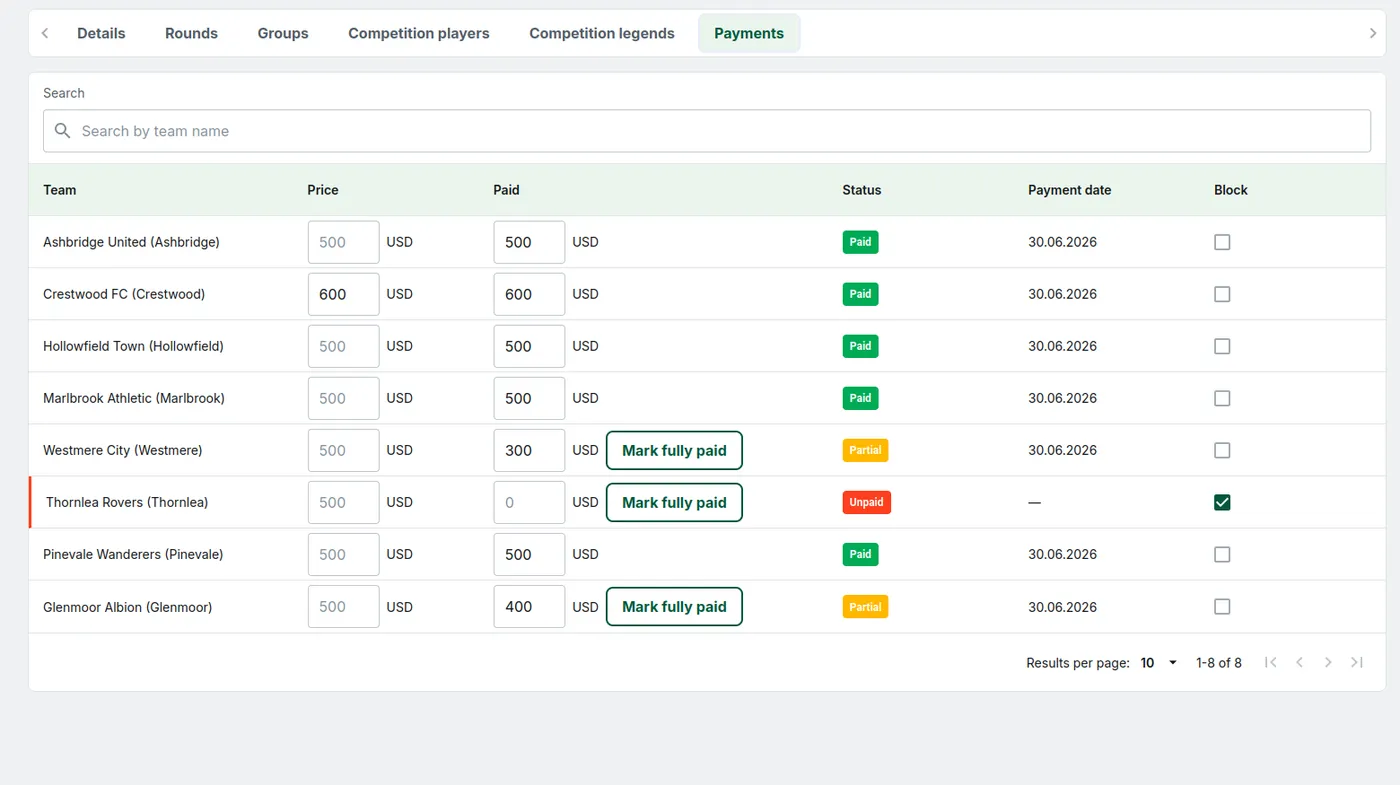
Fee collection is where multi-league chaos gets expensive rather than annoying. FLM System's payments view tracks which teams have paid and which still owe, per league, so "who hasn't paid?" stops being a cross-referencing project across three spreadsheets. Collect the money however you like – the system keeps the books straight across every competition, using the same workflow we describe in collecting team fees without chasing payments, just multiplied.
A scaling playbook for multi-league operators
Software removes the mechanical ceiling on running multiple soccer leagues, but the operators who scale smoothly follow a pattern beyond tooling. Three habits show up again and again.
Standardize before you multiply
Every rule that differs between your leagues is a thing you'll explain forever: different point systems, different card suspensions, different reschedule policies. Before adding a league, write down the rulebook you already run and reuse it wholesale, changing only what the format demands. Standardized rules also make your leagues feel like one brand – and they make every future competition faster to launch, because the decisions are already made.
Reuse seasons instead of rebuilding them
The second season of any league should cost a fraction of the first. In FLM System, a new season reuses the league's structure, and returning teams re-register rather than being re-entered; rosters carry forward under each captain's control through the team manager module. Starting a brand-new league is nearly as quick: teams and players can be imported from a CSV, so even the "enter forty rosters" job disappears. An operator's off-season should be spent selling and recruiting, not retyping.
Add the next league on signal, not on hope
The operators who scale sustainably launch a new league when the current ones push them to: a waitlist that won't fit the Thursday division, a facility offering a free night, ten teams asking for a summer season. Each of those signals comes with teams attached, which means the new league starts near breakeven. At $1 per team per month, the software cost of saying yes is exact before you say it – a 12-team addition costs $12 a month, and you can set the whole league up in an afternoon and see it running before the first ball is kicked. Start with the league you already have: put it in the system, run one matchday, and the second league will look a lot less frightening.
FAQ
Can I run several soccer leagues in one FLM System account?
Yes, that's the intended shape. Each league is a separate competition with its own format, fixtures, table, stats, and public page, and every league you operate is managed from the same panel. Seasons are handled per league, so your winter futsal and summer 7v7 can overlap without touching each other.
How does scheduling work across multiple leagues?
Each league generates its own fixture list – round-robin, cup, groups plus knockout, or league plus cup – with dates and times matched to that league's match night and venue. Since small-sided leagues typically each run at one facility on their own evening, the leagues don't collide: Tuesday's competition schedules Tuesdays, Sunday's schedules Sundays, and you keep the facility calendar in view when you set match nights.
Does every league get its own public website?
Yes. Each competition gets a public page with live fixtures, results, standings, and team and player profiles, updated automatically as referees enter results. Players see a consistent experience across your whole operation, and sponsors can be offered visibility on one league or across all of them.
How much does it cost to run multiple leagues in FLM System?
The flat rate is $1 per team per month, counted across everything you run. Three leagues with 36 teams total cost $36 a month; there's no extra fee per league, no per-game metering, and no percentage of the fees you collect. The number scales with teams and nothing else, which makes the cost of an additional league predictable before launch.
What's the fastest way to move several leagues off spreadsheets?
Between seasons, one league at a time:
- Recreate the league and its format in the system
- Import teams and players from CSV, or invite captains to register their squads
- Generate the new season's fixtures and publish the public page
- Run one full matchday with live results before you migrate the next league
Most operators find the first migration takes an afternoon and each following one takes less, because the rulebook and workflow are already settled.