
15 min• 21.07.2026
Best Soccer League Management Software in 2026 (Small-Sided & Amateur Leagues)
By Dawid Pątko

Indoor soccer alone had 6.6 million participants in the United States in 2025, according to the Sports & Fitness Industry Association, alongside 16.8 million outdoor players and 15.8% one-year growth on the outdoor side. Every one of those players turns up to a fixture that somebody scheduled, a table that somebody updated, and a results sheet that somebody typed up on a Sunday night. That somebody is usually one organizer with a spreadsheet, a group chat, and no budget.
This guide compares nine league management software platforms that take that work off your plate, with prices checked against each vendor's own published terms in August 2026. The audience is people running six-a-side, futsal, socca, indoor and corporate competitions rather than eleven-a-side clubs inside a national federation. The pricing model matters more than the feature list, because how a platform charges tells you exactly which kind of league it was designed to serve.
League management software and the work it covers
Before comparing vendors it helps to pin down the category, because half the tools marketed to sports organizers solve a different problem entirely.
League software compared with club and team apps
League management software runs a competition: it generates the schedule, keeps standings and scorer stats current as results come in, tracks team registration and fees, and publishes a public page where players check when they play and where they finished. One system covers the whole season.
Club and team apps solve the layer underneath. TeamSnap, Jersey Watch and similar products register players, collect dues from parents, and handle roster communication for a single club or academy. They do that well. Ask them to run a six-division small-sided league with promotion, relegation and a public table, and you hit their limits fast.
The distinction shows up in the buying decision more often than organizers expect. If your core job is collecting money from parents, a club app fits. If your core job is running a competition that teams register into, you want league software. Our buyer's guide walks through that shortlist in more detail.
The jobs a league platform has to cover
Good league software carries an organizer from sign-ups to the final standings without a spreadsheet in the middle. The specific jobs:
- Team registration with a record of who has paid and who has not
- Schedule generation for round robin, group stage, knockout, or a league-plus-cup format
- Schedule editing, because a field will fall through in week three
- Result entry that someone can do from a phone at the venue
- Automatic standings, including the tie-break order your own rules specify. Getting this wrong is how arguments start, and tie-breaks vary more than most organizers assume
- Player and scorer statistics that accumulate across a season
- A public league page teams can send to their players and sponsors
- Communication with team captains
- Season archiving, so year three can still look up year one
- Multi-division or multi-league support once you grow past a single table
Few platforms cover all ten. Most cover six or seven and expect you to live without the rest.

Choosing league management software for your competition
Two leagues of identical size can need completely different systems, so the useful question is which constraints bind hardest in your case.
Match the tool to the way your league runs
A Sunday six-a-side league with 12 teams, one venue and one referee has almost nothing in common with a city-wide corporate competition running four divisions across three sites. The first needs fast setup and a table that updates itself. The second needs divisions, multiple admins, and a way to see everything in one place.
Format matters as much as size. Plenty of platforms assume a straightforward round robin and struggle with a group stage feeding a knockout, or a league that also runs a cup. If your competition has any structure beyond one table, test that structure during the trial rather than after you have paid.
The costs hidden behind the price tag
Headline prices in this category are close to meaningless on their own, because vendors meter completely different things. Four models are in play:
- Per team, per month. Cost tracks the size of your competition. Predictable, and it stays small for a small league.
- A percentage of transactions. The platform takes a cut of registration money flowing through it. The subscription may be free or near-free, and the real cost scales with how much you collect.
- Per game. Cost tracks how busy your schedule is, which punishes multi-division seasons.
- Flat annual fee. Cost is fixed regardless of size, which favors large operations and penalizes small ones.
The percentage model deserves particular attention. A platform that funds itself from your registration revenue has a strong interest in that revenue running through it, and several do not publish the rate at all. We broke the four models down with worked season budgets if you want to run the numbers against your own team count.
Questions to ask before you commit
Three questions separate a good fit from an expensive mistake, and all three are answerable during a trial:
- Can it generate your actual competition format, including any cup or group stage?
- What happens to your league history if you leave, and what does it cost to bring history in?
- Who enters results on matchday, and how long does one match take them?
The second question is the one organizers skip and later regret. Season archives, scorer records and past tables are the thing that makes a league feel established, and moving them is the single biggest reason organizers stay on software they have outgrown. It is a solvable problem, but solve it before you sign rather than after.
The best league management software for soccer leagues in 2026
The nine platforms below all manage competitions, and they sort into three groups worth keeping straight. League-first tools (FLM System, League Republic, TeamSideline, Manage Your League) model a competition as the primary object. Club-first platforms (TeamLinkt, SportsEngine Motion, LeagueApps) model an organization and its members, with leagues layered on top. Scheduling utilities (LeagueLobster, Playpass) solve one slice well and leave the rest to you. Group one is where most small-sided organizers end up, and it is the group where league management software behaves the way you expect on matchday. Prices were taken from each vendor's published pricing in August 2026 and are noted as unpublished where the vendor keeps them behind a sales call.
1. FLM System

FLM System is built only for soccer, and specifically for small-sided and amateur competitions: six-a-side, futsal, socca, indoor and corporate leagues. The product ships as three connected tools instead of a single admin panel.
- Web CMS for seasons, divisions, teams, schedule generation and standings
- Referee app that lets the official post the result and match events from a phone at the field, so the public table updates while players are still walking off
- Branded public league website on your own domain, with fixtures, live scores, standings, scorer charts and team history
Pricing is Professional at $1 per team per month, with roughly 25% off on annual billing, and Enterprise on individual pricing for federations and larger operators. The entry point is a trial that does not ask for a card. Team fees are tracked as paid or unpaid inside the system while the money itself moves outside it.
Two things are worth knowing before you shortlist it. The sponsor inventory is unusually complete for this price bracket: logo slots, a homepage banner, sponsored articles and team history pages give a league something concrete to sell. And the scheduler covers round robin, cup, groups plus cup and league plus cup formats for a single venue and referee, but it will not rebalance a season after you move a fixture, so a multi-venue operation with frequent changes will still do some work by hand.
Around 15 organizations across four countries run on it, and it is backed by Fingoweb, a software house of about 50 people. The referee app is the piece worth testing first.
Best for: small-sided and amateur soccer leagues that want live results and a professional public face without a per-registration cut.
2. League Republic

Long-running and UK-based, League Republic is the closest thing this category has to a default for grassroots competitions, and its free tier is genuinely usable, well beyond a demo.
The free plan covers the scheduler, results, player statistics, online registration and payments, and a mobile-friendly league website, funded by ads on your pages. Gold removes the ads and adds your own domain, priced by team count: €16.50 per month up to 25 teams, €27.80 up to 100, €55.50 up to 300, and €81.40 above that. Registrations carry a 1% League Republic fee on top of Stripe's charges. Their team count is specific: teams in round-robin divisions in one season, with knockout entries excluded.
League Republic is deliberately league-first, supports referee assignment and player suspensions, and has been doing it for years. The interface shows its age, and the multi-sport breadth means nothing in it is tuned specifically for small-sided soccer. We compared it against FLM System in detail.
Best for: grassroots leagues that want a proven, low-cost system and can live with ads or a modest monthly fee.
3. LeagueLobster
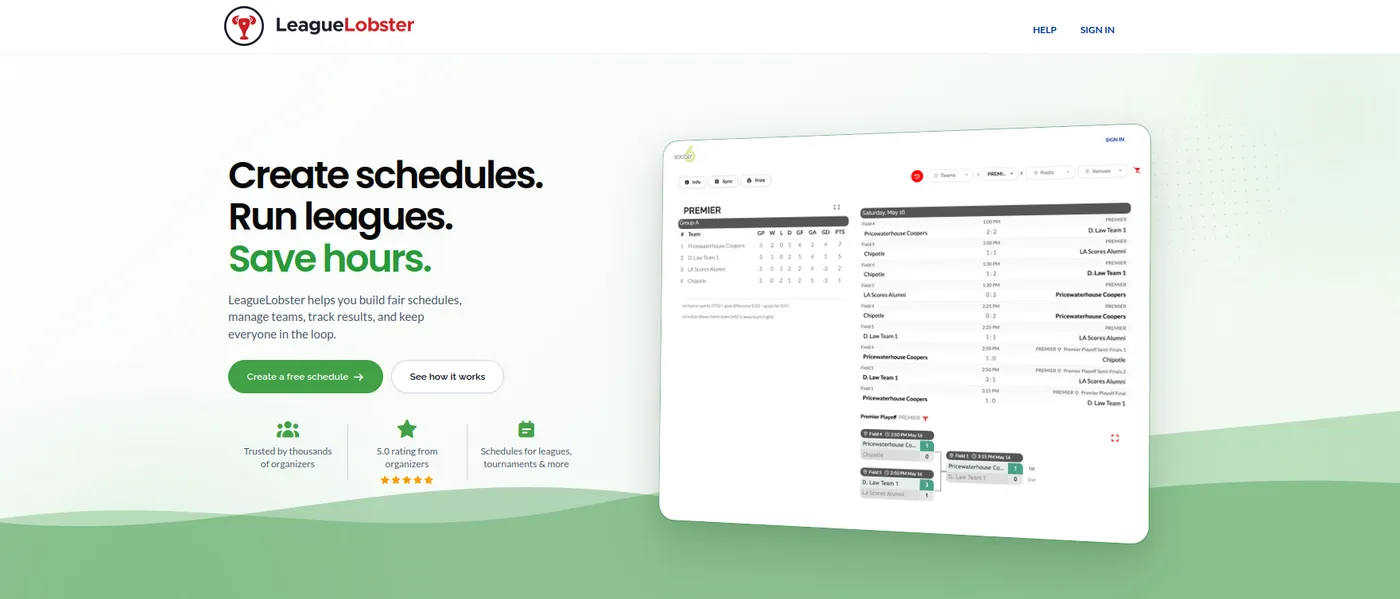
LeagueLobster does one job better than anyone else here: it turns a list of teams, venues and dates into a schedule, fast. Most organizers in this space have tried it at least once.
The meter is games played. The free LITE tier covers up to 50 games per month with ads, extra games run $0.10 each on LITE and $0.25 on PRO, and one subscription covers all your schedules. A busy multi-division season is where this bites: the cost tracks fixture volume, so the same 20 teams cost more in a season with a cup than without one.
Treat it as a scheduling utility with league features attached rather than a full league platform. If your standings, stats and public page requirements are light, it will serve you for years. Here is how it stacks up against a full league system.
Best for: organizers whose entire problem is building the fixture list.
4. LeagueApps

LeagueApps is one of the largest platforms in US youth and amateur sports, covering registration, payments, memberships, scheduling and communications across leagues, camps and clinics.
Pricing is not published. The model is a one-time setup fee plus a percentage of your online transactions, with no charge on payments taken offline, and annual fees for add-ons like a branded mobile app or custom site design. Volume and non-profit discounts exist. You get a number by requesting a quote.
The platform is capable and the support is real. For a single small-sided soccer league it is usually more system, and more sales process, than the situation calls for.
Best for: multi-program sports organizations with meaningful registration revenue.
5. TeamLinkt
-1-1400x606.webp?2026-07-08T14%3A18%3A47.942Z)
TeamLinkt offers the most aggressive free tier in the category. TeamLinkt Core is free for an entire organization, including registration and payments, communication, scheduling, rosters, live scoring, a team app, a website builder and reporting.
The funding model is where to look closely. Core is paid for through the processing fees on the payments you already collect, and TeamLinkt does not publish that rate, stating that rates vary by size and volume and directing you to sales. Several capabilities that a league organizer would consider core sit in paid annual add-ons: Operations at $425 per year covers tournament management, officials assigning and advanced scheduling, Revenue at $425 per year covers fundraising, sponsorship and merchandise, and the Full Platform bundle is $795 per year.
TeamLinkt leans club-and-roster-first, which shows in how competitions are modeled. For a Canadian or US organization running both a club and a league, the free tier is hard to argue with. We put the two side by side here.
Best for: organizations that collect registration money online and want one free app across club and league.
6. Playpass

Playpass is a lightweight option for organizers who want a schedule, a registration form and a simple public page without a procurement process.
The free plan allows one live schedule, one manager, one waiver and one website page, with a 3% Playpass fee on online payments in addition to Stripe's charges. Paid tiers raise those limits and step the fee down through 2.5%, 2% and 1%, and non-profits get 50% off paid plans. Regional pricing applies, so check the figure shown in your own currency. The fee ladder is the thing to model here: if you collect meaningful money online, the percentage will dominate the subscription line.
Best for: a single small league that wants essentials running this week.
7. SportsEngine Motion
SportsEngine is one of the largest platforms in US youth sports administration, and Motion is its offering for smaller organizations.
It costs $295 to get started with no monthly subscription, then a 1% technology fee plus 2.9% and $0.30 per online transaction. Access depends on using the payment processing, which the terms require within 90 days. That structure tells you plainly who it is for: organizations whose money runs through the platform. The ecosystem around it is large and well supported, and firmly oriented toward clubs and youth programs, which puts small-sided adult leagues outside its center of gravity.
Best for: youth clubs already inside the SportsEngine ecosystem.
8. TeamSideline
TeamSideline is the option built for parks, recreation departments and facility operators, and it prices accordingly: flat and annual, with no per-player charge.
Pricing is published in full, which is rare in this group:
- Core – $599 per year
- Enhanced – from $899 per year
- Elite – from $1,499 per year
- Enterprise – quoted
- Add-on modules – $199 to $499 each
The company makes a point of no contracts, no player fees and no ads, and the flat structure means a large program pays the same as a small one.
For a rec department running many programs that is a genuinely good deal. For a twelve-team six-a-side league, where a per-team platform runs about $144 a year, it is roughly four times the cost.
Best for: municipal recreation departments and multi-program facility operators.
9. Manage Your League

Manage Your League is a registration-and-administration system aimed at larger organizations with complex structures, and its strongest area is officials: referee assignment, volunteer scheduling, and coach and team manager portals.
Pricing is quote-based and nothing is published publicly. Expect a sales conversation, and expect the system to reward organizations that need deep administrative control rather than a quick season setup.
Best for: organizations where referee and volunteer assignment is the hardest weekly problem.
The platform that fits your league
Feature checklists rarely separate these platforms, because most of them tick the same boxes on paper. Sorting by situation gets you to a shortlist faster, and it keeps the choice of league management software anchored to how your season runs:
- A small-sided soccer league that wants live results and a public brand. FLM System, with League Republic Gold as the budget alternative.
- A league on almost no budget. League Republic's free tier, or TeamLinkt Core if you collect registrations online and accept an unpublished processing rate.
- Scheduling is the only real problem. LeagueLobster.
- A club and a league in one organization. TeamLinkt or SportsEngine Motion.
- A parks department or facility running many programs. TeamSideline.
- A large organization with real registration revenue. LeagueApps.
- Referee and volunteer assignment at scale. Manage Your League.
If you take one thing from this comparison, take the question to put to every vendor: what does this cost me across a full season at my team count, once transaction fees are included. The subscription line is rarely the number that decides it.
Most of these platforms let you try before paying. FLM System's trial does not ask for a card, so you can set up a season and run one matchday before deciding whether live results from the field change how your league feels.
FAQ
A handful of questions come up in nearly every conversation with organizers choosing a system.
What is league management software?
League management software runs a competition end to end: it generates the schedule, records results, calculates standings and statistics automatically, tracks team registration and payment status, and publishes a public page for players and sponsors. It differs from a club or team app, which is built to register individual players and collect dues rather than run a competition with a table.
How much does league management software cost?
Costs range from free to several thousand dollars a year, depending entirely on the metering model:
- Per team: around $1 per team per month, so roughly $240 a year for a 20-team league
- Per team tiered: from about €16.50 a month for 25 teams
- Flat annual: $599 and up, regardless of league size
- Percentage of transactions: 1% to 3% of what you collect, plus card processing
A small-sided league of 12 to 30 teams lands between roughly $145 and $360 a year on a per-team platform.
How much does LeagueApps cost?
LeagueApps does not publish prices. The structure is a one-time setup fee plus a percentage of online transactions, with no charge on payments collected offline, plus optional annual fees for add-ons such as a branded app. Volume and non-profit discounts are available, and you get an actual figure by requesting a quote.
Is free league management software enough for an amateur league?
Sometimes, and League Republic's free tier is the strongest evidence for that. The trade-offs are consistent though: ads on your pages, no custom domain, hard caps on schedules or admins, or a processing percentage that quietly exceeds what a paid subscription would have cost once your registrations grow. Model the percentage against your real registration volume before assuming free is cheaper.
What is the best league management software for a six-a-side league?
For six-a-side specifically, prioritize three things: fast season setup, a scheduler that handles a cup alongside the league, and a public table that updates on matchday without you touching it. FLM System and League Republic both fit that profile, with FLM System adding referee-app live scoring and a branded site, and League Republic offering the lower entry cost.
Can I move my league history to a new system mid-season?
Switching between seasons is far easier than switching mid-season, and it is what most vendors recommend. Teams and players usually import by CSV; past seasons, tables and scorer records vary by platform and are often quoted as a separate migration job. Ask what leaving costs as well as what joining costs, because export rights differ sharply across these nine.