
8 min• 10.07.2026
Soccer league software pricing: what it should cost in 2026
By Dawid Pątko

Software vendors hate publishing prices. In a March 2025 audit of its own marketplace, G2 found that only 4% of its product profiles list prices explicitly – and even that slice is more than 9,300 profiles – while the rest hide the number behind "contact us" buttons and demo calls. Sports software is no exception, which leaves an amateur league organizer trying to budget a season with almost nothing to go on.
Consider this the missing price sheet for one category. Soccer league software pricing follows four models, and the model matters more than the sticker price, because each one behaves differently as your league grows. Below you'll find all four models with real 2026 numbers, worked budgets for a 12-, 20-, and 40-team league, the hidden costs that don't appear on pricing pages, and the questions to answer before you pay anyone – including why FLM System prices the way it does.

Soccer league software pricing models: the four you'll meet
Nearly every tool in this market charges one of four ways. Once you can name the model, a vague pricing page becomes readable, and quotes stop being surprises.
Flat per-team pricing
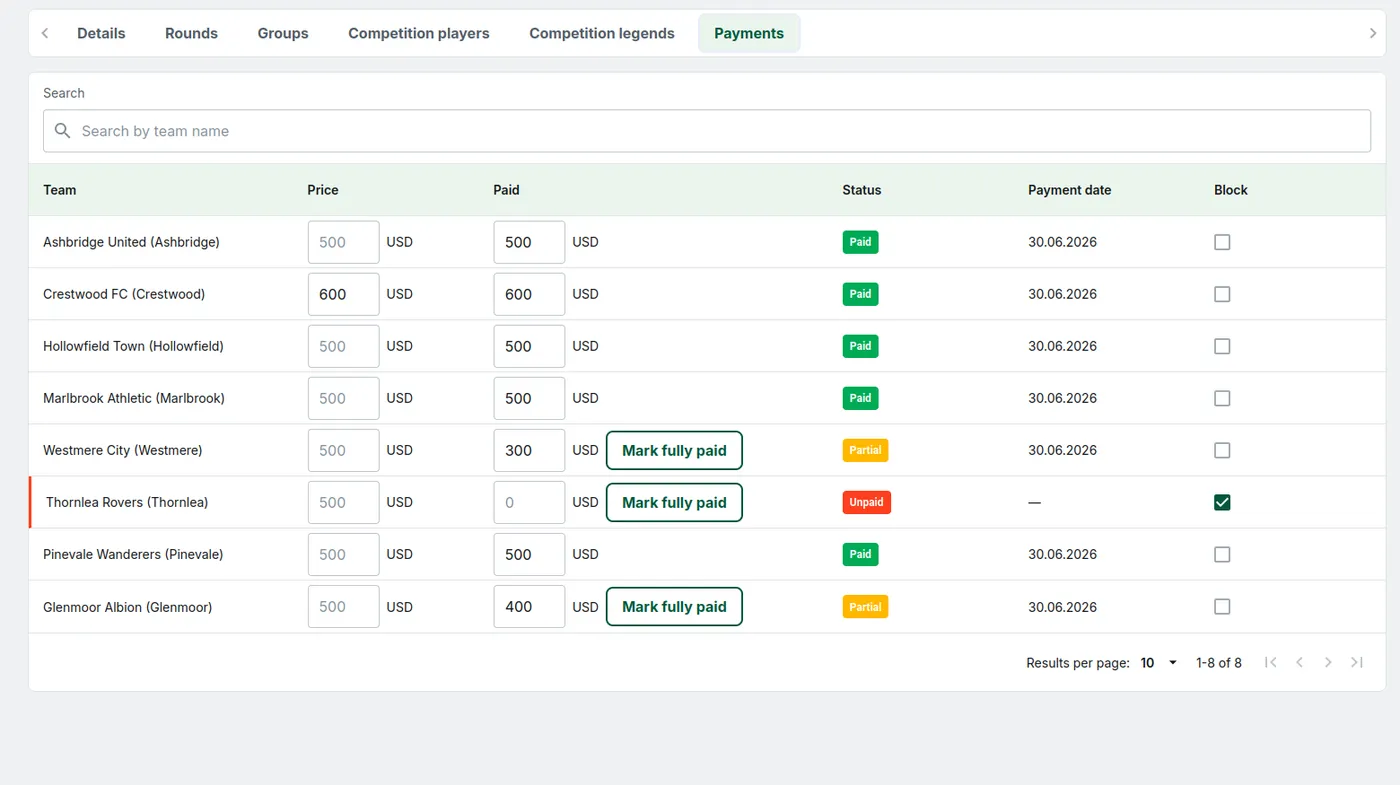
The simplest model: a fixed price per team per month, published openly. FLM System charges $1 per team per month on its Professional plan, so a 16-team league pays $16 a month and can predict a whole season's software budget in one multiplication. Everything is included at that rate – fixture generation, the referee app with live scoring, automatic tables and stats, fee tracking, and the public league site.
The strength of this model is that cost tracks league size and nothing else. It doesn't care how much money you collect from teams or how many games you play. The weakness, if you want to call it that: there's no free tier to camp on, though FLM System lets you set up and test a full season without a credit card before paying anything.
Percentage of registration payments
Youth-oriented platforms such as LeagueApps typically skip the subscription and instead take a percentage of every payment processed through the platform, with rates scaled to the organization's size and type and a quote required for real numbers. Optional services stack on top – LeagueApps bills its custom website design at $400 per month, for example.
For a league that collects little money through the platform, this can feel nearly free. The catch shows up as you grow: the platform's cut rises with your revenue, so your most successful season is also your most expensive one. We ran the full breakdown in our LeagueApps comparison; the short version is that percentage pricing suits organizations processing complex registrations, not leagues collecting a flat fee per team.
Per-game metering
Scheduling-first tools often meter usage by games. LeagueLobster is the clearest example: the LITE tier is free up to 50 games a month (with ads), the PRO plan runs about $29.95 per month for up to 150 teams, and extra games cost $0.10 each on LITE and $0.25 on PRO. Registration and payments are a separate add-on on either tier.
A metered model rewards small, quiet leagues and taxes busy ones. A single division playing a short season may never leave the free tier. A multi-division league with playoffs and a parallel cup burns through the meter, and the "free" tool turns into $360 or more a year before anyone noticed a price – covered in detail in our LeagueLobster comparison.
Quote-based enterprise pricing
At the top of the market sit platforms priced by sales conversation: multi-venue federations, national associations, facility chains. There is no public number at all; cost depends on modules, seats, and negotiation. If you run one league at one facility, finding yourself on a quote call is a strong sign you've wandered into the wrong product tier, and the implementation timeline will confirm it.
What a season costs in 2026: worked budgets
Models are abstract until you put your own team count into them. Here are the annual numbers for three typical league sizes, using published 2026 prices and a season running year-round.
- 12-team league – FLM System: $144 a year. LeagueLobster PRO: about $360 plus the registration add-on, though a league this size might squeeze into the free tier during quiet months. Percentage-based platforms: a quote, but on $100-per-team seasonal fees the cut typically lands in the low hundreds.
- 20-team league – FLM System: $240. LeagueLobster PRO: about $360 plus add-ons, with overage risk in playoff months. Percentage-based: the cut grows with your gross, and $2,000+ of collected fees starts producing a real number.
- 40-team, multi-division operation – FLM System: $480. Metered tools: PRO pricing plus consistent overage. Percentage-based or enterprise: expect four figures once website services and processing cuts are counted.
Two things stand out from the math. Across all of soccer league software pricing, flat per-team billing is the only model where the 40-team budget is just the 12-team budget scaled, with no cliff and no surprise line items. And no honest budget stops at the subscription – which brings us to the costs that never appear on the pricing page.

The hidden costs beyond the subscription
Four line items routinely surprise organizers in their first paid season:
- Add-ons that should be core. Registration, payments, or a decent-looking public page priced separately can double a "cheap" subscription.
- Transaction cuts on your own fees. If the platform processes your team payments and takes a percentage, your software cost is hiding inside your revenue. Track it – it's often the biggest single item. Collecting fees outside the platform, then just tracking who has paid, avoids the cut entirely.
- Your own admin hours. A tool that leaves score entry, table updates, and roster chasing on your desk charges you in evenings, every single week. Price your time at anything above zero and the cheapest tool is rarely the cheapest tool.
- Switching late. Migrating mid-season costs more attention than migrating between seasons. Budget the move for the off-season and it's an afternoon.
Matching a pricing model to your league
Price lists don't make decisions; league profiles do. The right model falls out of three questions, and most organizers can answer them in a minute.
Three questions before you pay
- How does money enter your league? Teams paying you a flat seasonal fee point to flat per-team software. Hundreds of individual player registrations with payment plans point to a percentage-based registration platform, and you should treat the cut as a real cost.
- How busy is your calendar? Count your games per month, including cups and playoffs. Under 50, a metered free tier may hold. Over it, metering works against you every week.
- Where will you be in two seasons? Every model looks fine at your current size. Recalculate each one at double the teams; the model that stays boring is the right one. If you're still comparing specific products at this point, our ranking of the best soccer league management software does the side-by-side work.
Why FLM System prices flat
FLM System publishes one number – $1 per team per month – because the leagues it serves budget in team counts, not transaction volumes. There is no free plan; a platform that runs your referee app, live scores, standings, and public site has real costs per league, and a paid-only model keeps the product funded without taking a cut of your fees or metering your matchdays. The trial costs nothing and needs no card: set up your league, generate a season of fixtures, and see the number you'd pay before you pay it. For a small-sided league, software should be one boring, predictable line in the budget – and everything else in the spreadsheet should stay yours.
FAQ
How much does soccer league software cost in 2026?
For a typical small league, soccer league software pricing in 2026 spans $12 to $50 a month, depending on the model. Flat per-team pricing (FLM System) puts a 12-team league at $12 a month with all features. Metered tools like LeagueLobster run free to $29.95+ a month depending on game volume. Percentage-based platforms cost a share of the money you process, so their price is a function of your revenue rather than your size.
Is there completely free soccer league software?
Free tiers exist, but they're almost always schedule generators, not league platforms: you get a fixture grid, while standings, live scores, and a public league page stay manual or absent. LeagueLobster's LITE tier (up to 50 games a month, with ads) is the most generous. For a season-long league, count the admin hours the free tool hands back to you before calling it free.
How much does LeagueApps cost?
LeagueApps doesn't publish a flat price. It charges a percentage of each payment processed through the platform, scaled to your organization's size and type, so real numbers require a quote. Its custom website design service is billed separately at $400 per month. For a small adult league, that model usually costs more than a flat per-team subscription once registration money starts flowing.
How much does LeagueLobster cost?
LeagueLobster prices by games, not teams:
- LITE – free up to 50 games a month, ad-supported
- PRO – about $29.95 per month, up to 150 teams
- Overage – $0.10 per extra game on LITE, $0.25 on PRO
- Registration and payments – a separate paid add-on
A busy multi-division season on PRO works out to roughly $360 a year before add-ons.
What should a small amateur league budget for software?
Plan on $150–$400 a year all-in for a 12-to-20-team league, and treat anything above that as a signal to re-check the model. On flat per-team pricing the number sits at the low end ($144–$240 with FLM System) and stays put; on metered or percentage models, budget the top end and watch the add-ons. Whichever tool you pick, the budget line worth protecting is your own admin time.