
9 min• 07.07.2026
League scheduling software for soccer: a buyer's guide
By Dawid Pątko

The global market for sports management software was worth $4.26 billion in 2025 and is on track to reach $14.79 billion by 2033, growing about 17% a year. That is a lot of tools chasing a lot of organizers. Most of them are built for big clubs, national governing bodies, and multi-sport complexes with paid staff. At the other end sit the free schedule generators, which produce a grid of fixtures and then leave you to do everything else by hand.
If you run a five-a-side or amateur soccer league, neither end fits you. You need the middle: a way to generate fixtures and then actually run the season around them. The right league scheduling software is not the one with the longest feature list, it is the one where the schedule lives inside the system that runs your league – the standings, the results, the public page your players check on Monday morning. This guide covers what league scheduling software does, the features that matter for a small-sided league, and how to tell a schedule generator apart from a platform built to run the whole league.
League scheduling software in plain terms
Before comparing tools, it helps to pin down what this category covers, because the same phrase gets stretched across very different products. Some of them stop at making a grid. Others carry the whole season.
League scheduling software, defined
League scheduling software is a tool that generates a season's fixture list – who plays whom, and when – and manages it from there. For soccer that means building a round-robin or cup format, assigning each match a date and time, and keeping the schedule tied to results and standings as games are played.
That last part is what separates real league scheduling software from a generic sports league scheduling software widget or a one-off team sports scheduling system. A widget answers a single question: what is the fixture list? A platform answers the question you live with all season: where does the league stand right now? Both call themselves scheduling tools. Only one saves you work after week one.
A free schedule generator only solves half the problem
Generating fixtures looks like the hard part. It is not. A single round-robin with 8 teams produces 28 matches across 7 rounds; play it home and away and you get 56. The math is `n(n-1)/2`, and it climbs quickly. Past roughly 20 teams, building a genuinely fair schedule becomes an optimization problem that academics study in their own right. A free generator handles the arithmetic in a second and hands you a clean grid.
Then it stops. You still copy that grid into a spreadsheet, retype every score after each round, recompute the table by hand, and message the standings to twelve captains who will ask again next week. The generator solved the easy half and left you the tedious half, the half that repeats every seven days.
A fixture list is only useful for as long as it stays in sync with what happened on the field. A static grid starts drifting out of date the moment the first final whistle blows. If you want to understand the mechanics behind the grid itself, how round-robin scheduling works is worth a read, but the mechanics are not where your Sunday nights go.

League scheduling software: the features that matter
With that distinction in mind, here is what to weigh when you compare options. For a small-sided soccer league, four things carry more weight than anything on an enterprise checklist.
Fixture generation that fits your format
Start with formats, because a tool that only does straight round-robin will fail you the first time you run a cup. Good league scheduling software should build the shapes amateur soccer actually uses:
- Round-robin – every team plays every other team, the backbone of most recreational leagues.
- Cup or knockout – single-elimination brackets for a season-ending trophy.
- Groups plus cup – a group stage that feeds a knockout, the format most five-a-side tournaments run.
- League plus cup – a full season table running alongside a parallel cup competition.
Once you have picked a format, the tool should turn it into dated, timed fixtures, not just an abstract pairing list. If you want to see how that looks step by step, here is how to build a season's fixtures without touching a spreadsheet.

Tables, results, and stats that update themselves
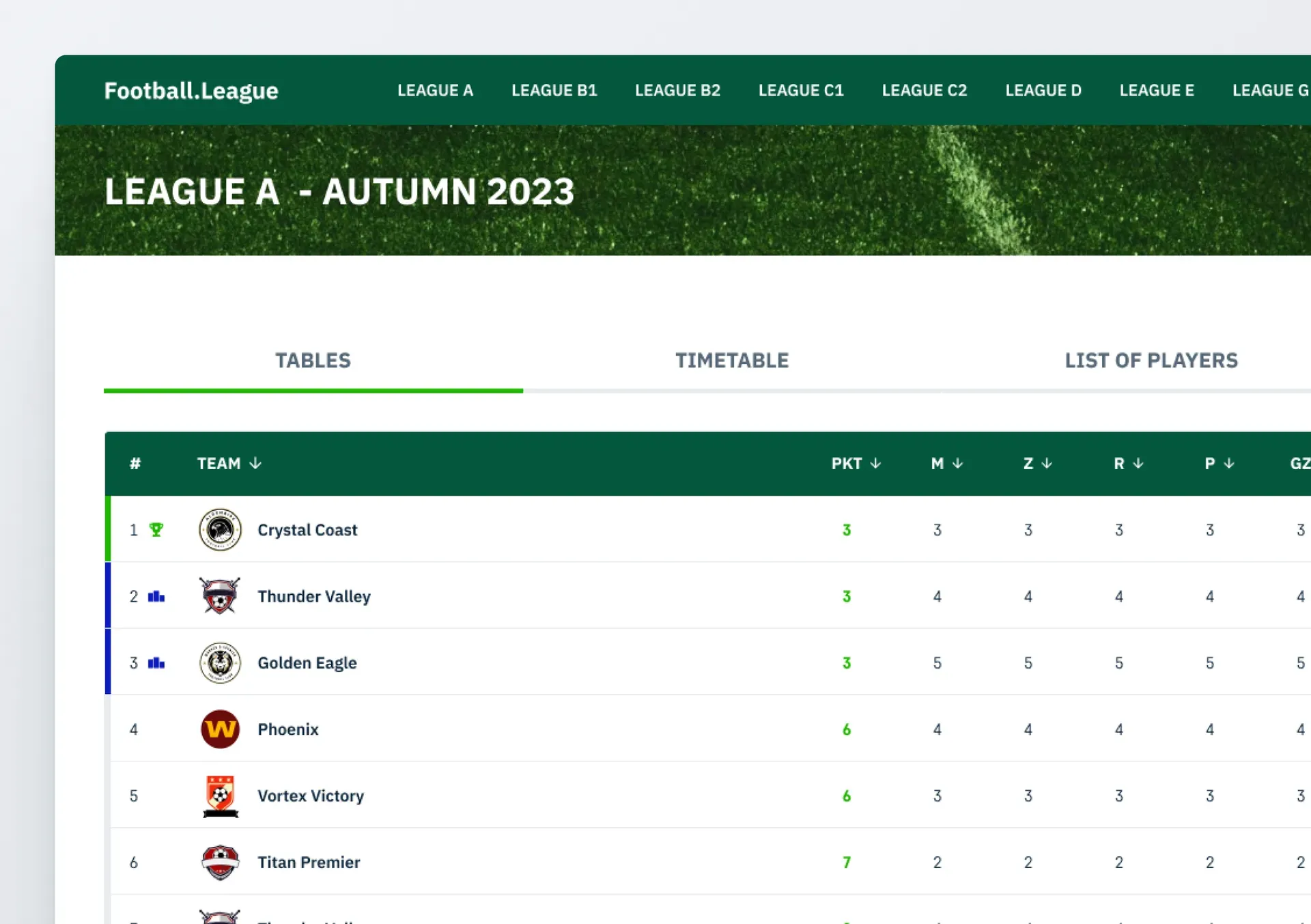
Nothing on this list pays for itself faster. Scores go in once, from the field, and the league table, top-scorer list, and team records recalculate on their own. No second data entry, no Sunday-night spreadsheet session, no arithmetic mistakes that a captain spots before you do.
Automatic standings are also what turn a schedule into a story. Players check the table because it moved; they care about the golden boot race because it is live. When you evaluate a tool, look past the fixture generator and ask what happens after a result is entered. That is also the core of what a full league management system should include, and scheduling is only the front door to it.
A live public league page, not a static file
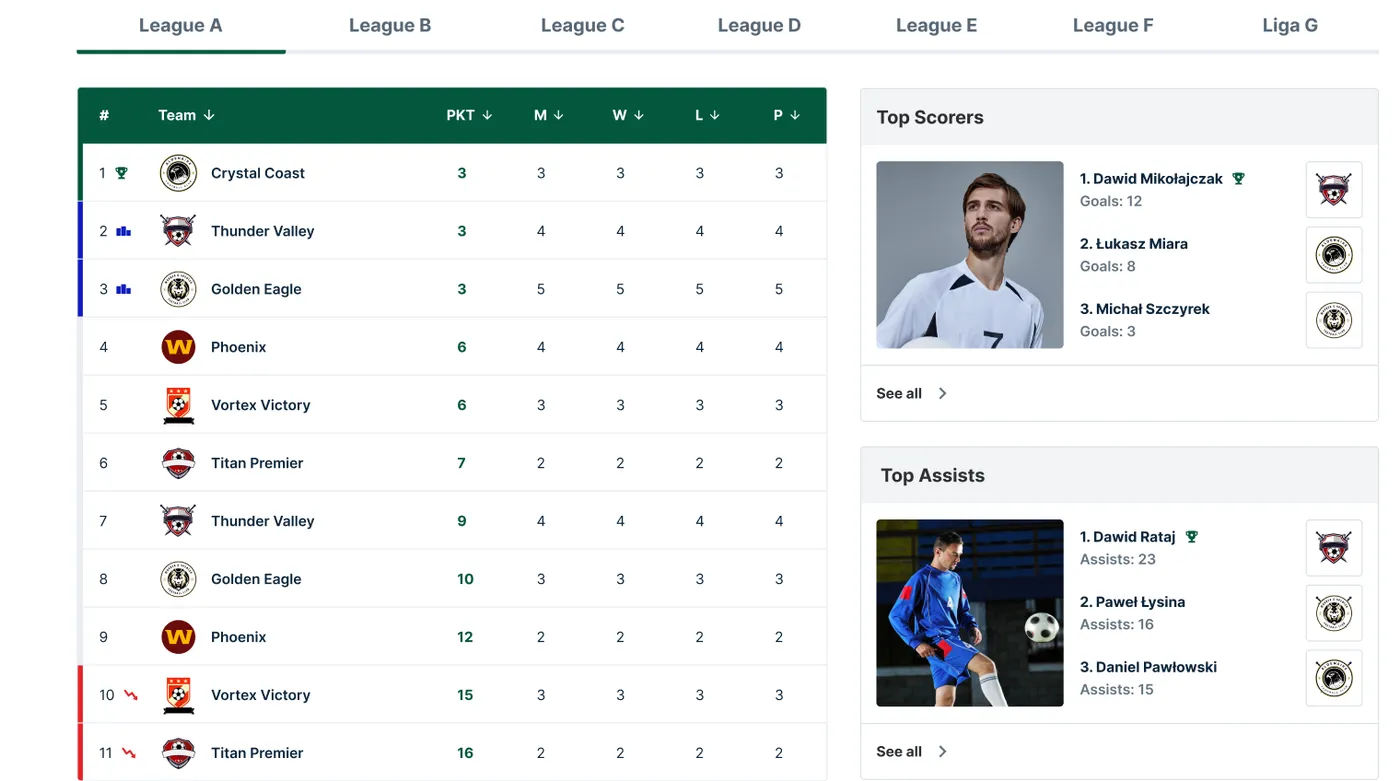
Here is the thing a generator structurally cannot give you: a place your league lives in public. A PDF grid sits on your laptop. A live league page sits on a link you drop in the team WhatsApp group, and it updates itself.
For an amateur organizer that page does a lot of quiet work. Players see the next fixture and the current table without messaging you. Live scores tick over during game night. A referee enters results from a phone at the field, and the public page reflects them minutes later. The schedule stops being a document you maintain and becomes a service your league runs on.
Fast setup instead of enterprise complexity
Now the honest part, the one most buyer's guides skip. Enterprise scheduling tools sell on constraint solving: multi-venue optimization, blackout dates, weather contingencies, home-and-away balancing across dozens of fields. If you run a regional federation across twenty sites, you need that. If you run one league that plays at one hall on Tuesday nights, you are being sold a solution to a problem you do not have.
Most small-sided and amateur soccer leagues share a shape: one venue, one referee, games back to back across a single evening. Within that shape, generating a correct round-robin and dropping it onto dates is quick, and the enterprise complexity is dead weight you still pay for and still have to learn. Match the tool to the league, not to the demo. FLM System was built for exactly this setup, which is why setting up a season takes minutes rather than a training course.
Fitting the software to your league
The choice usually comes down to two shapes of product. Knowing which one you are looking at makes the decision easy.
Standalone generator vs. all-in-one platform
The two options solve different amounts of your job:
- A standalone schedule generator – produces fixtures and exports a grid or PDF. Free or cheap, fine for a one-time tournament bracket. Everything after the fixtures, results, tables, communication, is back on you and your spreadsheet.
- An all-in-one platform like FLM System – generates the fixtures inside the same system that records results, keeps the table, runs live scores, powers a referee app, and publishes a public league page. You set the season up once and the platform carries it.
The trade is convenience against control of your own time. A generator is faster to open and slower to live with. A platform asks for a short setup and then hands the week-to-week admin back to itself. If you would rather compare specific products than categories, our roundup of the best soccer league management software lines them up side by side.
Simple is often the right call
Do not overbuy. The most common mistake I see amateur organizers make is picking the tool with the most features and using four of them, then quietly drifting back to a spreadsheet because the software felt like a second job. Power you never touch is not power, it is friction.
Pick league scheduling software that matches how your league already runs and that you can set up in an afternoon. If you have been holding a season together with tabs and group chats, these are the signs your league has outgrown Excel. You can generate your fixtures, publish the table, and run your first season in FLM System without a credit card – the fastest way to judge scheduling software is to schedule a real season in it.
FAQ
What is league scheduling software?
League scheduling software generates a season's fixtures for a sports league and helps manage them once games begin. For soccer it builds a round-robin or cup format, assigns dates and times, and, in a full platform, keeps the schedule connected to results and standings so the table updates as matches are played.
Is there free league scheduling software?
Yes, but read the fine print on what "free" covers. Free tools are almost always fixture generators, not league platforms:
- What you get – a round-robin or bracket grid you can export or print.
- What you do not get – automatic standings, live scores, a public league page, or results entry from the field.
- The real cost – the weekly admin the generator hands back to you.
For a single tournament a free generator is plenty. For a season that runs for months, the time it costs usually outweighs the license you saved.
Can you make a soccer league schedule in Excel?
You can, and plenty of organizers start there. Excel handles the fixture grid and a basic table without much trouble for a small league. The strain shows up in the upkeep: retyping scores, recalculating standings, sharing an updated file every week, and catching the errors those steps introduce. It works until the league grows past the point where the manual work is worth it.
How does round-robin scheduling work?
Round-robin scheduling pairs every team against every other team once (or twice, for a home-and-away season). With an even number of teams, one team stays fixed while the rest rotate around it each round, which guarantees a balanced fixture list where everyone plays the same number of games. Most league scheduling software generates this automatically in seconds.
What scheduling software is best for a small soccer league?
The best fit for a small league is rarely the most powerful tool. Weigh these instead:
- Format support – round-robin plus cup and group formats.
- Automatic tables and stats – results in, standings out, no re-entry.
- A public page and live scores – so players self-serve instead of messaging you.
- Fast, simple setup – a season live in an afternoon, no training required.
FLM System is soccer league scheduling software built around this exact profile for small-sided and amateur leagues, but whichever tool you choose, judge it on how little admin it leaves you, not on how long its feature list runs.