
15 min• 01.10.2026
Amateur league budget: what it costs and what to charge teams
By Dawid Pątko

In Poland, the Ministry of Sport and Tourism set aside 10 million zł (about £2 million) in 2026 for a scheme called "Active Amateur Leagues", with grants of up to 100,000 zł (about £20,000) per league per discipline. The costs the scheme actually covers are the same ones every unfunded organiser pays out of their own pocket every week: venue hire, referees, kit, and prizes. The government has already done the maths, and it comes to tens of thousands of zł a year for a single league.
Most organisers never see that kind of funding and have to work out an amateur league budget from scratch on their own, usually in a rush before the first season. The mistake almost always runs the same way: they charge teams too little, because the first budget leaves out costs that only show up once the season is under way. Below is the full list of those costs with price ranges, three ways to collect fees from teams, and a worked example for a ten-team league. If you're still putting together the basics for your own league, FLM System handles the fixture list, the table, and a page where teams can see everything in one place.

What goes into a league budget?
A league budget splits into a handful of recurring costs, paid every round, and a few one-off costs, paid once a season. Below is each one, with a price range and a note on whether it's a per-round cost or a one-off.
- Hall hire – usually £20–£80 an hour, depending on location and the standard of the venue. Council-run centres are the cheapest option, while commercial venues in bigger cities can charge two or three times as much. A per-round cost.
- Artificial turf pitch hire – £10–£40 an hour, cheaper for teams booking a whole evening than for a single hour on its own. A per-round cost.
- Referees – the second of the two biggest line items, alongside venue hire. Rates are set locally and depend on the city, the format, and the referee's experience, so there's no single figure you can drop into every budget without checking your own market first. A per-round cost, worked out below.
- Balls and kit – cones and bibs run £2–£8 each, match balls roughly £15–£40 each. A one-off or periodic cost, since kit gets replaced every season or less often.
- Prizes and medals – trophies £5–£15, medals £2–£5 each, paid once at the end of the season.
- The league's software and website – FLM System charges $1 per team a month, billed in US dollars wherever you're based. It's the smallest line item on this list, and we come back to it below with an actual figure.
- Optional: insurance, or a photographer and match stats. Both depend so heavily on your local market and the exact scope of the service that a single figure would just be a guess. Budget a line for them anyway, even without a number attached at the start.
Some of these costs are one-off and easy to forget after the first season, once the kit's already bought. That's why a second season is often cheaper than the first – as long as the organiser remembers this when setting the new entry fee.

The two costs that eat up most of the budget
Venue hire and referees together account for most of the cost of every round. Both scale with the number of matches and rounds in the season, while kit and prizes are a one-off purchase.
The venue sum is simple: the hourly rate, times the number of hours needed for every match in a round, times the number of rounds in the season. How many hours and rounds fit into a season for a given number of teams is something we break down in the piece on planning a league season.
The referee sum works the same way: the rate per match, times the number of matches per round, times the number of rounds. The difference is that you have to check the rate itself with two or three referees in your area first, since there's no national price list. Where to find them and how to arrive at a realistic rate is covered in the piece on referees in an amateur league. Work out both costs for the whole season before setting the entry fee, not round by round.

What does that come to per team, per season?
To turn those ranges into something concrete, here's a worked example: a ten-team league, a double round-robin, nine rounds each way (eighteen in total), one hall, five matches played in each round.
The assumptions are stated up front, so any organiser can swap in their own numbers instead of these:
- Hall hire: 4 hours a round × £40 an hour (a middling rate within the £20–£80 range) = £160 a round × 18 rounds = £2,880 a season.
- Kit: a one-off £200 or so (midway through a £150–£250 range).
- Prizes: a one-off £150 or so (midway through a £100–£200 range).
- FLM System: $1 × 10 teams = $10 a month, or roughly $80 across an eight-month season – billed in US dollars, on top of everything above.
The three pounds-sterling items above add up to £3,230 a season, or £323 per team, or roughly £40 per team a month. On top of that comes the cost of referees, worked out the same way, with a rate checked locally. Every pound spent on referees grows the total budget, so the higher the going rate in your city, the smaller a share the software fee ends up being.
FLM System's fee doesn't move that total in any meaningful way, in either currency – ten teams paying $10 a month comes nowhere close to shifting a budget already measured in thousands of pounds. It's one of the few line items on this list you can settle with a single, fixed figure from day one.
Three ways to collect fees
How you collect money from teams affects the league budget just as much as the size of the fee itself, because it decides when the money actually lands in your account and what happens when a team drops out mid-season.
A season entry fee
The simplest to administer: one payment before the season starts, one line in the budget, no chasing deadlines for months afterwards. The downside is the barrier to entry – a new team that doesn't yet know the standard of competition finds it harder to commit to a single sum in the hundreds of pounds than to smaller instalments. This model works best in leagues with a settled group of teams that comes back season after season.
A per-match fee
The easiest for a new team to accept, because psychologically it looks like a small amount rather than one big outlay. The problem sits with the organiser instead: collecting money after every match is more admin than a single payment, and the league budget is harder to plan, because income now depends on turnout and the number of matches actually played, rather than a fixed sum agreed in advance.
In practice, a mixed model is more common. Liga6.org, near Bydgoszcz in Poland, charges 500 zł as a season entry fee plus 60 zł per team per match as a referee fee, which the team settles directly with the referee. The fixed part covers the running of the league, the variable part tracks how many matches actually get played, and none of the referee money ever passes through the organiser's own account.
A monthly fee
A compromise between the two: smaller instalments than a season fee, but a more predictable cash flow than a per-match charge. It does need regular chasing, though – unlike a one-off season fee, an unpaid monthly instalment builds up slowly and is easy to miss until it's grown into several months of arrears at once.
The model you pick also shapes how you treat a team that withdraws mid-season, and how much you actually lose when it happens – a topic we cover separately in the piece on walkovers in amateur football.

How much should you charge a team?
Working out your own rate is simpler than choosing a fee model: divide the season's total cost by the number of teams, add a margin for anything unplanned, and, if the league is meant to leave a surplus for next season, add that on top too.
Five Polish leagues show where these rates actually land in practice (figures gathered in September 2026, each one tied to a specific season):
- Podkarpacka Liga Szóstek Seniorów – 450 zł for the 2026/2027 season, the same as the entry fee for Poland's Class B, and the only fee the league charges.
- Liga6.org, near Bydgoszcz – 500 zł as a season entry fee, plus a separate 60 zł per match, per team, as a referee fee settled directly with the referee. The season runs 22 rounds with twelve teams.
- Liga Amatorska w Kórniku – 780 zł for teams from the local municipality and 1,400 zł for teams from outside it (2025 season).
- Pszczyńska Amatorska Liga Piłkarska – 1,400 zł for the 2026/2027 season, after running the competition for more than twenty years.
- Futbolowa Liga Szóstek – 4,200 zł including tax, for the Spring 2024 season, paid in one instalment with no option to split it.
The tenfold spread here has nothing to do with anyone being better or worse at maths. Leagues run by a municipal sports centre or a football association tend to land between 450 and 1,400 zł, because they already have a venue on hand and don't need the competition to turn a profit. A commercially run league starts roughly where those leave off. Before comparing your own rate to someone else's, check who runs that league and whose venue they're paying for.
It's also worth watching how a rate moves over time. Pszczyna has published its entry fee at every sign-up for years: 1,000 zł in the 2022/2023 season, 1,200 zł by 2024/2025, and 1,400 zł now. That's a 40% rise across four years, or 200 zł every two seasons. If you're setting a fee for the next few years, plan for a similar climb instead of freezing the rate and covering the difference out of your own pocket.
What do you do about teams that pay late?
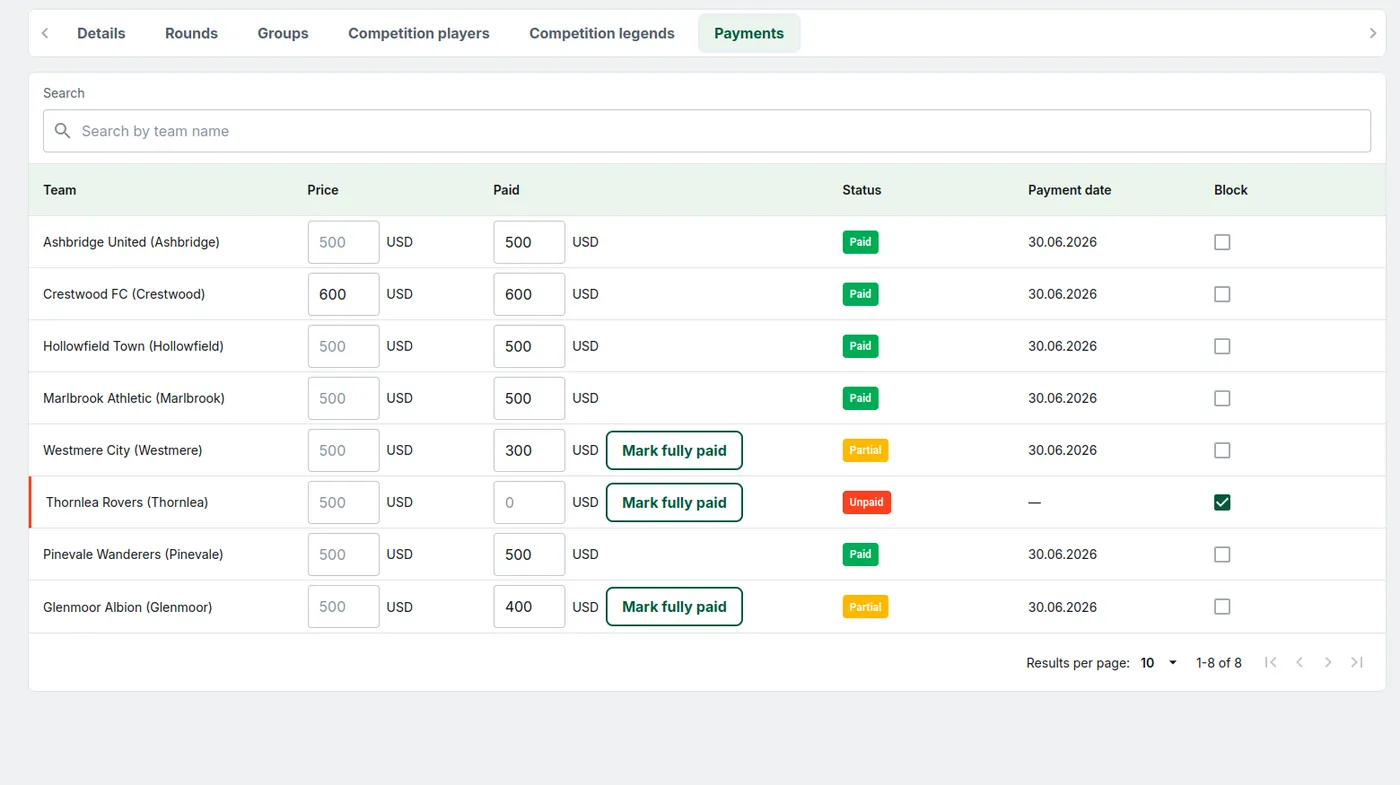
Late payment turns up sooner or later in every league. It's easier to have a procedure ready before the first missed deadline than to invent one under pressure mid-season.
Give teams a specific payment deadline – by the fifth round, say, or by the end of a given month – and a clear consequence for missing it, instead of judging every case on its own. A refundable deposit collected at sign-up works as security you can draw on to cover an unpaid balance, instead of chasing a bank transfer week after week. The hardest consequence is suspending a team's right to play until the debt is settled. A team that knows an unpaid round means no match in the next one pays faster than a team that only gets a reminder in the group chat.
FLM System tracks which teams have paid for the season and which are behind, so you can see it all at a glance instead of asking each one individually. We cover more ways to collect fees from teams separately, and what to write about deadlines and consequences in the piece on the amateur league rulebook.
Income beyond team fees
Team fees don't have to be the only source of funding for a league budget, even though in practice they remain the backbone of most amateur competitions.
A local sponsor covering part of the cost of prizes or the venue, an entry fee from a one-off tournament run alongside the season finale, or selling match photos or branded kit – these are the three most common extra sources of income, and each one takes a different amount of work. The first takes by far the most, which is why finding sponsors for a football league gets a piece of its own.
Should an amateur league turn a profit?
The honest answer: most amateur leagues run close to break-even rather than a clear profit, and that's normal – not a sign of poor management.
Any surplus, when it appears, usually goes back into the league itself – better prizes, new kit, or a lower entry fee next season – rather than into the organiser's own pocket. At some point, once a league grows and starts generating real, repeatable income, the question of formalising it as a business comes up. That's a tax and legal question that depends on scale and local rules, so we'll point you to an accountant here rather than guess at a one-size-fits-all answer.
What does the software actually cost, and what do you get for it?
The league's software and website is the smallest line item on this list, but not one you can skip. All the more reason to know exactly what you're paying for.
FLM System charges $1 per team a month, billed in US dollars wherever your league is based – on the ten-team example above, that works out to roughly 2% of the season's total cost. There's no free plan. Free league management software usually recoups the cost somewhere else – TeamLinkt funds its free tier with ads shown to teams – and here there are no ads and no features locked behind a higher tier.

For that fee, the system shows which teams have paid for the season and which are behind. It's a record, not a till: FLM System doesn't collect payments online, so the bank transfer or cash itself happens outside the system, and all you see is who's already settled up. On top of that comes the fixture list, a table that recalculates after every result, and a public page where teams can check results without asking the organiser. We go into more detail in the pieces on what a league management system costs and how to choose a league management system.
If your league budget already adds up and you're after a tool for the fixture list, the table, and a page for your teams, sign up for FLM System and see how it works in practice.
FAQ
How much does it cost to run an amateur league?
For a ten-team league playing a double round-robin, the venue, kit, prizes, and software come to £3,230 a season between them, plus referees at whatever the local rate per match comes to. The real figure for your own league moves with the number of teams, rounds, and local hire rates – hall hire alone accounts for £2,880 of that total, nearly 90% of the season's cost, which is exactly where to start looking for savings.
How much should you charge a team for a season?
The rate hinges mainly on who runs the league. Among the Polish municipal and football-association leagues checked in September 2026, entry fees range from 450 to 1,400 zł per team a season, from the Podkarpacka Liga Szóstek Seniorów to the Pszczyńska Amatorska Liga Piłkarska. A commercially run league charges several times more – Warsaw's Futbolowa Liga Szóstek asks 4,200 zł including tax for a season. Work out your own rate by dividing the full season cost by the number of teams and adding a margin for the unexpected. Compare yourself with leagues nearby rather than a national average: the entry fee tracks local venue rates, not a countrywide one.
What's the most expensive part of running an amateur league?
Two costs usually account for most of the budget:
- Venue hire – rises in a straight line with the number of rounds and hours needed for every match.
- Referees – the second-biggest cost, priced locally, with no national rate card.
Everything else – kit, prizes, software – is usually a fraction of what those two absorb.
Season entry fee or per-match fee?
The right choice comes down to what matters more to you: a predictable budget, or making it easy for a new team to say yes. A season fee gives the organiser one known sum up front and no deadlines to chase, but can be a harder sell to a team that doesn't yet know the standard of competition. A per-match fee is an easier psychological sell, at the cost of more admin and a less predictable cash flow.
What do you do when a team doesn't pay?
Three mechanisms work best in practice:
- A clear payment deadline set before the season, not "as soon as possible".
- A refundable deposit collected at sign-up, which you draw on to cover a shortfall instead of chasing a bank transfer.
- Suspending the right to play until payment is settled – it links a missed payment directly to a missed match on the very next round.
That last step tends to work best precisely because the team feels the consequence right away, rather than only at the end of the season.
Does an amateur league have to be a registered business?
There's no single answer here – it hinges on the scale of the income, how regular it is, and local tax rules. If a league starts generating repeatable income beyond covering its own costs, it's worth checking the right structure with an accountant rather than basing the decision on advice found online.