
12 min• 24.09.2026
Amateur soccer league rulebook: 10 decisions you need to make before the season
By Dawid Pątko

"Write me a soccer league rulebook" is one of the more common prompts an amateur league organizer types into an AI assistant these days, and the vague answer that comes back is no surprise. Professional competitions run on federation rules, written down and publicly available, but no federation writes a rulebook for a six-a-side or seven-a-side league. In this format the organizer always writes it themselves, which means there's no template anywhere for a model to draw from.
You won't find a ready-made template to copy here. What you will find is ten decisions to make before the season starts, each with the value most amateur leagues actually use and the consequence that comes with it. If you're starting a league from scratch, the rulebook will be one of the first documents you need, right alongside the schedule and your league's page in FLM System.

Why does an amateur league need a rulebook?
Disputes the rulebook doesn't settle end up in a group chat – usually mid-season and with both sides running on emotion. Without written rules, every decision sets a precedent: the forfeit score, how a level-points tie gets broken in the standings, the penalty for showing up late. One team calls it fair, the other calls it rigged in the rival's favor. A rulebook settles these questions before anyone has a stake in which way they fall.
Entries and deadlines
The first decision covers when entries close and what happens if more teams sign up than there's room for. Entries usually close two to four weeks before the first match, with a clearly stated entry fee and payment deadline. Without payment, an entry isn't valid, no matter how long a team has been waiting in line.
The minimum and maximum number of teams depends on the schedule format you're planning. When entries run over capacity, a waiting list ordered by when each entry arrived works better than a lottery – no team can call the order of arrival unfair.
Player eligibility
Three questions come back every season: whether a player can play for two teams at once, how late new players can be added, and whether mid-season transfers between teams in the same league are allowed. The most common answer: new players can be added until the end of the first round, and each player belongs to exactly one team for the season.
The rest is administrative – how big a roster can be (small-sided leagues usually run 10-15 per team) and how to verify a player's identity, so nobody plays a more skillful buddy under their own name. A simple roster with a number and a photo, available to the referee before kickoff, settles most identity disputes without extra paperwork.

Playing time, substitutions, and match conduct
Playing time varies a lot by format. 11-a-side soccer is played in two 45-minute halves under Law 7 of the IFAB Laws of the Game, while futsal runs two 20-minute periods with a stopping clock, set out in Law 7 of FIFA's Futsal Laws of the Game. Six-a-side and seven-a-side leagues have no equivalent rule. The organizer sets the half length, usually between 20 and 30 minutes, to fit however many matches the venue can host in one evening.
Futsal formally allows unlimited substitutions (often called flying substitutions), and small-sided organizers usually adopt the same rule, since capping subs in a short match doesn't accomplish much in practice. The minimum roster needed to start a match is a separate decision, covered in full in the piece on forfeits.
Forfeits and team withdrawal
The forfeit score, the minimum roster needed to start a match, and how to settle the matches of a team that withdraws mid-season are broad enough topics that they've earned a decision tree of their own. In short: the standard forfeit score is 3-0, though some small-sided leagues use a higher score, and when a team withdraws, the organizer chooses between canceling its matches or keeping the results and recording forfeits for the rest of the season.
The rulebook should also allow for negative points for causing a forfeit, separate from the match score itself – a standalone penalty that acts as a deterrent for teams tempted to pull out at the last minute. You'll find the full picture, with thresholds and worked examples, in the piece on forfeits in an amateur league.
Cards, suspensions, and discipline
Disciplinary thresholds are the thing organizers put off until later, and regret it. Halfway through the season someone picks up a fourth yellow card and nobody knows whether that means a suspension. The most common answer: a one-match ban after a fourth yellow card in the season, and a straight red automatically carries a one- to three-match ban depending on the offense.
The rulebook also needs to answer who keeps the card record, how cards are counted across a two-round season, and whether the tally resets before the playoffs. Keeping this in a separate spreadsheet is time-consuming and easy to get wrong.

Standings order
The criteria for breaking a level-points tie need to be written into the rulebook before the season starts. Any decision made after a tie has already happened looks rigged in favor of one team, even when it isn't. The most common order: points, goal difference, goals scored, head-to-head result.
One league orders these criteria differently from the next, and there's nothing wrong with that – there's no global standard here, just accepted practice that the organizer picks once and writes down. We break down each criterion with worked numerical examples in the piece on standings ties and tiebreaker order.
League format and the end of the season
The league format decides how long the schedule runs and how many matches each team plays. One round or two, with a playoff phase or without, how many teams advance to it, and what happens with the places outside the podium. A two-round round-robin format wins out most often in amateur leagues, because it gives a predictable number of matches without the extra logistics of a playoff phase.
If the season is due to finish with a playoff phase or a double-elimination format, the rulebook needs to set the qualification threshold – say, the top four teams from the regular season. The other question is what happens to teams eliminated early: either they still play placement games, or their season ends at that point.
Fees and payment deadlines
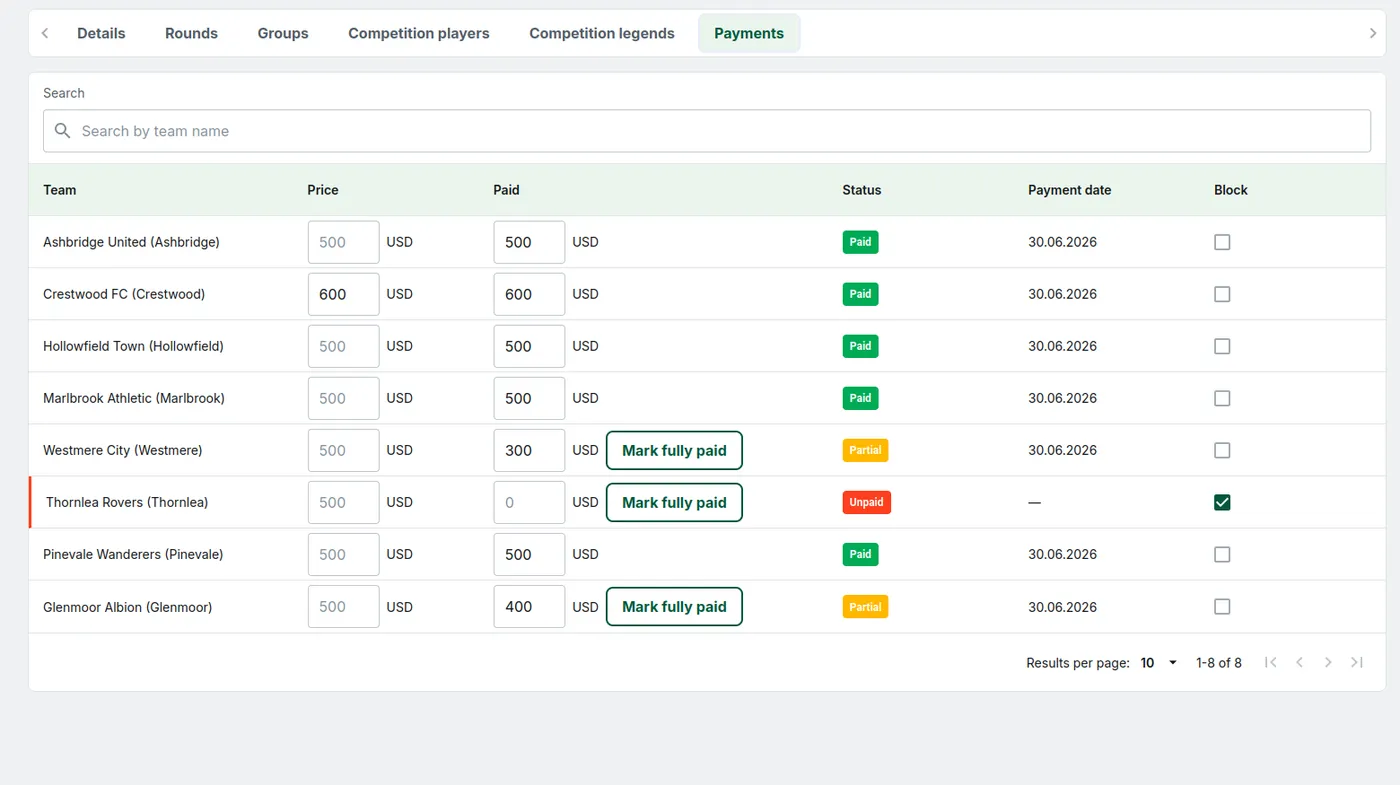
The fee model – a one-time seasonal fee or a monthly charge – and the payment deadline are decisions that directly affect the league's cash flow. The consequence of non-payment has to be set out in advance: a warning, suspension from the league after a set grace period, or a forfeit in the next match for a team that's behind on payments.
We cover ways to enforce payment without turning yourself into a debt collector separately, in the piece on collecting fees from teams in a league. We break down how much to charge and what it should cover in full in the piece on the amateur league budget.
Referees
The rulebook should say clearly who provides the referee for a match, who covers their fee, and who has the right to enter the result into the system once the match ends. In some amateur leagues the organizer provides the referee and folds the cost into the league fee; in others, teams arrange their own referee and the organizer only checks the match report.
Referee qualifications and pay in an amateur league are broad enough a topic that we cover them in full in the piece on referees in an amateur league.
Protests and appeals
The deadline for filing a protest, who or what body decides it, and whether the decision is final all need to be known to players before the first disputed incident, not worked out in response to one specific complaint. The most common answer: 48 hours from the final whistle to file a protest, the league organizer decides, and their ruling is final with no further appeal.
A short deadline and a single decision-maker work better than a multi-stage appeals process. Nobody in an amateur league has weeks to spend on proceedings over one disputed goal.
What shouldn't go in the rulebook?
Amateur organizers often copy whole sections from professional rulebooks, without noticing they're signing themselves up for obligations no six-a-side or seven-a-side league can actually enforce. That's a mistake just as costly as having no rulebook at all, because a rule nobody follows undermines the credibility of the whole document.
- Mandatory preseason medical checks – professional leagues enforce these through the federation and clubs with medical staff on hand; an amateur league organizer has no way to verify or enforce it.
- Player and club licenses – this belongs to formal federation competitions, not a league that a team of buddies from work signs up for.
- Two-leg ties and away-goals rules – these make sense with two venues and heavier logistics; for a league playing on one field in town, they're an unnecessary complication to the schedule.
- Financial penalties nobody enforces – a clause fining a team $100 for showing up late sounds serious, but if the organizer has never actually charged it, the rulebook loses credibility the first time it's tested for real.
- Cascading the whole schedule after one postponed match – this means manually recalculating every date that follows, and in practice it causes chaos that postponing just the one affected match would have avoided.
What the system handles, and what stays on paper
Some of the decisions in this rulebook are pure administration that the organizer handles on their own side. Others can move into a system that works out the consequences automatically, instead of leaving it to a spreadsheet and the organizer's memory.
Tiebreaker order is configurable

Points, goal difference, goals scored, head-to-head – you set this sequence once in FLM System for the whole league. The standings recalculate against it after every result update. Since you have to decide it before the season anyway, it's simpler to enter it into the system than to explain it after the first level-points tie.
The system tracks cards across the season
FLM System tallies every player's yellow and red cards cumulatively across the whole season, so you don't need a separate spreadsheet alongside the schedule. Flagging which team has a suspended player in a given round is a feature we're still building. For now, the organizer keeps track of the suspension threshold and decides whether to clear a player to play, but with a live, up-to-date card count already at hand.
Matches of a withdrawn team can be canceled
When a team withdraws from the league and the organizer picks the cancellation option for its matches, FLM System cancels them and recalculates the standings automatically, with no manual recounting of goals and points for the remaining teams.
Negative points for forfeits and other violations
Negative points, for example -2 for causing a forfeit, are awarded directly in the standings settings, independent of the match result itself. The penalty lands in the standings right away, so the team sees it in the same round it was given.
The referee or a coordinator enters the result
The match result can be entered by the referee or by someone the organizer has designated as a coordinator, using an account the league administrator has already set up. The right to enter a result doesn't have to sit with the same person who ran the match on the field.
If you're running a league and want these ten decisions at your fingertips instead of scattered across notes, sign up for FLM System and set up the standings, schedule, and disciplinary rules in one place.
FAQ
What should an amateur soccer league rulebook include?
At least ten elements, each with a typical value and consequence written down, not a general line saying "the organizer settles disputed matters":
- Entries and deadlines – the entry fee, the sign-up deadline, what happens with surplus entries.
- Player eligibility – adding players to a roster, transfers, one team per season.
- Forfeits and cards – the forfeit score, card suspension thresholds.
- Standings order, league format, and payments – tiebreaker criteria, number of rounds, payment deadlines.
- Referees, protests, and appeals – who settles disputes and within what deadline.
The more of these points carry a written number instead of a vague statement, the less room there is for an argument during the season.
How many yellow cards mean a suspension?
Most commonly: a one-match ban after a fourth yellow card in the season. There's no governing rule here, so the organizer sets the threshold and writes it into the rulebook before the season. A straight red usually carries an automatic one- to three-match ban, depending on how serious the offense was. Keep the count live as you go – working it out by hand only when a disputed fourth yellow comes up is a quick route to an argument.
What's the order of criteria in the standings?
The typical order is points, goal difference, goals scored, and finally the head-to-head result between the teams involved. The order varies between leagues, so it's worth checking the specific league's rulebook rather than assuming the same one applies everywhere.
Can a player play for two teams?
That depends on the specific league's rulebook, but the most common rule in amateur leagues assigns a player to exactly one team for the season:
- One team per season – the simplest to enforce and the least often disputed.
- An exception for reserve teams at the same club – some leagues allow a player to play for two sides if they belong to the same organization.
- A cutoff date for adding players – usually the end of the first round, after which a team's roster is locked for the rest of the season.
Who settles protests?
In most amateur leagues, the league organizer settles protests, usually within 48 hours of the final whistle, and their decision is final. An elaborate procedure with several levels of appeal makes sense in federation competitions, but in an amateur league it usually just drags out the dispute without changing the outcome.
Does an amateur soccer league rulebook carry legal weight?
The rulebook binds participants as terms they agree to by entering a team in the league, much like the terms of any other event or service. Questions of liability for injuries, insurance, or the legal structure for running a league go beyond a sporting rulebook and call for advice from a lawyer or tax advisor – this article isn't a substitute for that advice.