
19 min• 19.10.2026
How to run a one-day soccer tournament: schedule, rules, and entry fees
By Dawid Pątko
Outdoor soccer participation in the US reached a record 16.8 million people in 2025, up 15.8% in a single year, and indoor soccer grew to 6.6 million, according to the Sports & Fitness Industry Association. Most of those games never get near a TV camera. They happen on a Saturday at the local rec complex, in a one-day soccer tournament run by a league, a company, a church, or a parent group raising money for new uniforms: twelve teams, two rented fields, and a champion by mid-afternoon.
That short format is unforgiving. One team showing up 20 minutes late, or one tie with no written rule, pushes back every game that follows, and the field permit ends at the time on the paperwork whether or not the final has been played. This guide walks you through what makes a one-day soccer tournament different, what goes on the flyer, how to price the entry fee, a one-page rulebook, and the full soccer tournament schedule for a 12-team event, from 10:00 a.m. to the trophies. A one-day tournament works when the schedule is decided before the format: first you count how many field slots you have, then you choose how many teams get in, how long each game lasts, and how a tie is broken. You can run the schedule, the bracket, and live results in FLM System, and we'll get to that further down.

What is a one-day soccer tournament?
The name sounds self-explanatory, but a tournament squeezed into one day runs on its own set of rules. It's worth knowing them before you promise twelve teams an event that ends on time.
A full tournament in a single day
A one-day soccer tournament is a competition that starts and ends on the same day. Games are short, usually around 20 minutes, knockout ties go straight to penalty kicks, and the champion is crowned before the field reservation runs out. Leagues, clubs, companies, schools, and fundraising committees run them, almost always with a paid entry fee and prizes.
The shapes vary. A 3v3 event can host dozens of teams on small fields, a 5v5 indoor tournament fits a single arena, and a 7v7 rec tournament on two turf fields is the version this guide plans in detail. The Philadelphia Union Regional 3v3 Tournament on July 11, 2026, is a good example of how a professional club runs one: two 10-minute halves, at least four guaranteed games per team, and a $300 registration fee per team.
How is it different from a weekend tournament?
A two- or three-day tournament can afford to move a game to Sunday. A one-day event has no Sunday, and almost all of its rules come from that lack of slack:
- Short games – two 10-minute halves or a single 20-minute running clock, while a multi-day tournament usually plays 2×20 or longer.
- Straight to penalty kicks – knockout games have no regular overtime, or at most a few minutes of golden goal.
- Minimal grace period – five or ten minutes for the first game of the day. After that, the team that isn't on the field forfeits.
- Capped entry – the number of teams comes from field capacity, and team thirteen goes on the waiting list even if it's ready to pay.
- One venue – everything happens in one place, and if the weather turns, games get shortened.
What a one-day tournament shares with any other tournament (budget, referees, promotion) we cover in the step-by-step guide to organizing a tournament. Here we stick to what changes when everything has to fit into a single day.
How many teams fit in a one-day tournament?
The math starts with the field. Take the minutes on your permit, subtract half an hour for check-in and awards, and divide the rest by the length of a slot, meaning the game plus five minutes for one pair of teams to leave and the next to come on. Multiply by the number of fields and you have the maximum number of games for the day. With 2×10 games, a slot lasts 25 minutes and the numbers look like this:
- One field, about four and a half hours – up to 6 teams, in two groups of three with semifinals, a third-place game, and a final (10 games).
- Two fields, about five hours – 12 teams. That's the example we lay out hour by hour below, with 20 games.
- Three fields, about five hours – 16 teams in four groups of four with quarterfinals, 32 games in total.
If you have a different number of teams, the guide to tournament format by number of teams has the recommended format for 4 to 16, with total games and field time. Its times assume 20-minute slots; for 2×10 with a changeover, add a quarter. And when the slots don't add up, cut teams before you cut minutes. A 12-minute game feels like a formality, and nobody pays an entry fee for a formality.
Tournament flyer, permit, and registration
Most one-day tournaments are announced with a flyer and a registration link that travel through Facebook groups, league group chats, and the bulletin board at the rec center. Treat that flyer as your contract with the teams: anything that isn't written there, you'll end up arguing about on game day, next to the field, with the clock running.
Ten things your tournament flyer needs
A complete flyer for a one-day soccer tournament answers, in this order, what any captain asks before paying:
- Tournament name and contact – who's organizing and a phone number or email for questions.
- Date, venue, and times – the field address, check-in time (9:30 a.m.), and first kickoff (10:00 a.m.).
- Format and division – 7v7, men's, women's, or coed, plus the age floor for an over-30 or over-35 division.
- Spots – 12 teams, first paid, first in.
- Entry fee – cost, deadline, and payment method, with an early-bird price if you want registrations to come in early.
- Roster – minimum and maximum players, the ID players must bring, and the rule that nobody plays for two teams.
- Competition format – four groups of three; the top two in each group advance to the quarterfinals.
- Games and tiebreaks – 2×10 minutes; in knockout games, three penalty kicks each and then sudden death.
- Grace period – ten minutes, only for the first game of the day.
- Prizes – trophies and medals for the top places, a top-scorer award, and, if there's a cash prize, the exact amount and the condition for paying it.
Close with one line on who settles protests. At a one-day event, the tournament director's call is final and gets made on the spot.
Field permit and insurance
Book the fields before you print anything. Most parks and recreation departments issue tournament permits only after you send a certificate of insurance that names the city as an additional insured. The City of Las Vegas, for example, requires insurance for any tournament on its fields, with at least $1 million per occurrence and $2 million in aggregate, and wants the certificate no later than 30 days before the permit is issued. If your league already has liability coverage, ask your broker for a certificate for that date and field. If it doesn't, one-day event policies exist, and their cost belongs in the budget below.
Entry fee: the math so you don't lose money
The entry fee is calculated backward. You add up what the day costs, divide it by the number of teams, and add a margin for whatever goes wrong. For the 12-team tournament in this guide, the math looks like this:
- Fields – six hours on field 1 and four and a half on field 2, which is released after the semifinals. That's 10.5 hours at $50 an hour: $525.
- Referees – 20 games. At a hypothetical $20 per game that's $400, but you'll only know the real number after getting quotes from two or three referees in your area.
- Prizes – $156 for three team trophies and a top-scorer trophy at $15 each, plus 24 medals at $4 for the champion and runner-up.
- Balls, pinnies, and first-aid kit – about $100, which you can reuse at the next event.
- FLM System – $12, at $1 per team.
The total is $1,193, almost $100 per team. With a 20% margin for an extra referee, a flat ball, or a trophy that arrives broken, the fee lands at $120, plus whatever the insurance certificate costs you. If you want to announce a cash prize for the champion, charge it separately, say $30 more per team, and print it with its condition: a $360 prize with full registration. If only nine teams sign up, the prize shrinks proportionally and nobody can say you misled them. Never promise a prize that depends on teams that haven't paid yet.
Rosters, registration, and paying up front
A spot in the tournament is reserved by paying. A "we're in" in the group chat doesn't count, and the team that pays on Thursday goes ahead of the one promising to pay at the field on Saturday.
In 7v7, a roster of 10 to 12 players can handle five games in one day if substitutions are unlimited. Collect the list with full names before the deadline, freeze it at check-in the way the Philadelphia Union event does, and have every player bring ID. The one-player-one-team rule saves you the argument about the ringer who played for one team in the morning and shows up in another team's jersey for the semifinals.
One-day soccer tournament rules
The rulebook for a one-day soccer tournament fits on one page, and it should, because captains go over it at the 9:45 meeting and nobody has time to read through sections between games. Three topics cause almost all of the day's arguments.
Game length
The most common length in a 7v7 one-day tournament is two 10-minute halves with an immediate switch of sides, or a single 20-minute running clock. The Philadelphia Union 3v3 plays two 10-minute halves with a two-minute halftime, and also ends a game early once one team leads by 10 goals, which keeps a mismatch from eating the schedule.
The slot is always longer than the game. To 20 minutes of play add 5 for one pair of teams to leave, the next to come on, and the referee to check IDs, and you have the 25-minute slots used to build the schedule below. With a running clock, it stops only for an injury. Give the final 2×12 and a three-minute halftime, because it's the game everyone stays to watch.
Ties: straight to penalty kicks and sudden death
In group play, a tie is worth a point and stays that way. In knockout games, the most practical rule for a one-day event is to skip overtime: the game ends at minute 20 and goes straight to penalty kicks, three per team, then sudden death, one kick each until someone misses. The Philadelphia Union event allows three minutes of golden goal before its shootout, and gives the final ten. Either way, write it down before the day.
American soccer has tried faster ways to settle a tie. In its first seasons in the late 1990s, MLS decided drawn games with a 35-yard shootout: the shooter started 35 yards out and had five seconds to beat the goalkeeper. Some 3v3 events still take their kicks from the halfway line. It's fun, it's quick, and it's worth a try at a youth or fundraiser event, as long as it's printed on the flyer before anyone reaches the quarterfinals.
In FLM System's referee app, when a knockout game ends tied, the referee moves to the shootout and enters its result, which shows up on the tournament's public page.
Grace period, forfeits, and cards
The grace period is given once. Ten minutes for the first game of the day, and from then on every game starts at its scheduled time. A team that doesn't show up forfeits with the score the rulebook sets; the Philadelphia Union event records every forfeit as 5–0. At a one-day tournament, the healthiest option is for that team to be out of the event, so no opponent gets a free win from a game that wasn't played. If a team walks out halfway through the day, the guide to forfeits in an amateur soccer league explains how to handle its games and the standings.
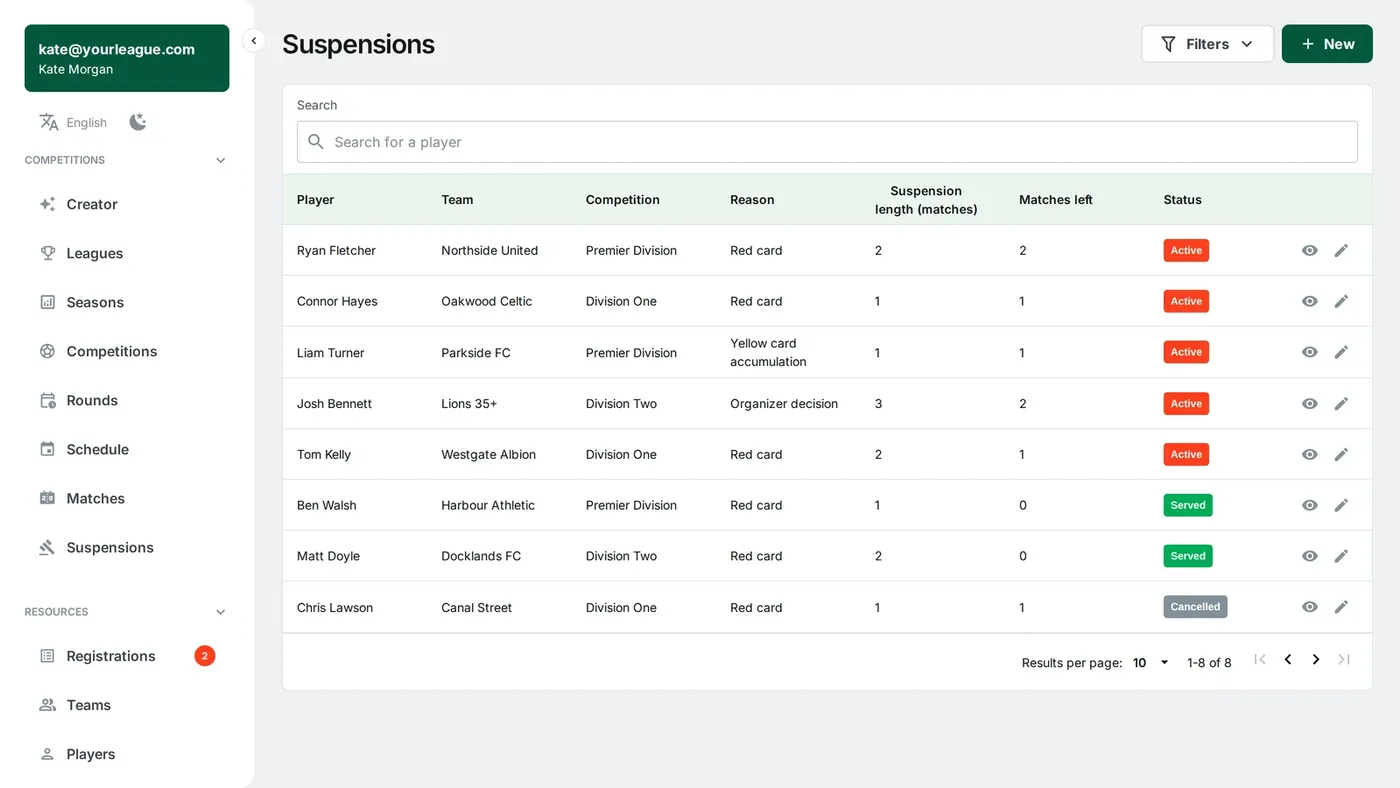
Keep cards simple. A straight red keeps the player out of their team's next game, two yellows in the same game count as a red, and yellows don't carry over from game to game, because in a single day there's no time for them to matter. In FLM System, a red card automatically suspends the player for the number of games you set, and the system won't let them into the next lineup, so nobody at the check-in table has to track it in a notebook.
One-day soccer tournament schedule for 12 teams, hour by hour
Here's the full example: 12 teams of 7v7 soccer, two fields, 25-minute slots (2×10 plus five for the changeover), and first kickoff at 10:00 a.m. Swap A1, B2, and the rest for your teams' names and it works almost as is.
The format: four groups of three and quarterfinals
The 12 teams are split into four groups of three: A, B, C, and D. Each group plays a three-game round robin and the top two advance, eight teams that meet in the quarterfinals, the winner of one group against the runner-up of another. Then come the semifinals, the third-place game, and the final.
That's 20 games in total: 12 in the groups, 4 quarterfinals, 2 semifinals, the third-place game, and the final. Every team is guaranteed two games and the finalists play five, a little over 100 minutes of soccer in one day. The format has an advantage you can feel at the field: at midday there are still eight teams alive, and people stick around. If you'd rather everyone play three games, the alternative is three groups of four with semifinals, 22 games in about the same time, at the cost of comparing runners-up from different groups. The format guide linked above lays it out.

The schedule from 10:00 a.m. to 3:30 p.m.
The order alternates the groups. While A and B play, C and D rest, so no team plays two slots in a row during group play. Numbers 1, 2, and 3 are the teams in each group according to the draw.
- 9:30 – team check-in: IDs, pinnies, and balls.
- 9:45 – 10-minute meeting with captains and referees.
- 10:00 – A1 vs. A2 on field 1 and B1 vs. B2 on field 2.
- 10:25 – C1 vs. C2 and D1 vs. D2.
- 10:50 – A1 vs. A3 and B1 vs. B3.
- 11:15 – C1 vs. C3 and D1 vs. D3.
- 11:40 – A2 vs. A3 and B2 vs. B3.
- 12:05 – C2 vs. C3 and D2 vs. D3.
- 12:30 – quarterfinals 1 and 2: 1st A vs. 2nd B and 1st B vs. 2nd A.
- 12:55 – quarterfinals 3 and 4: 1st C vs. 2nd D and 1st D vs. 2nd C.
- 1:20 – 15-minute break: water, shade, and the semifinal bracket already filled in.
- 1:35 – semifinals: winner of QF1 vs. winner of QF3 and winner of QF2 vs. winner of QF4.
- 2:00 – field 2 goes back to the parks department.
- 2:10 – third-place game on field 1.
- 2:40 – final on field 1, 2×12 minutes.
- 3:15 – awards.
Notice two details. Teams in A and B finish group play at 12:05 and play quarterfinals at 12:30, with one free slot in between; teams in C and D finish at 12:30 and play quarterfinals at 12:55, also with a slot of rest. And the winner and runner-up of the same group land in different semifinals, so two teams from the same group can only meet again in the final.
The buffers that save the day
No one-day tournament goes exactly as it does on paper. That's why the schedule above has two buffers. The 1:20 break is the first: if the quarterfinals run late, the delay eats the break and the semifinals start on time. The second is the 40 minutes between the end of the semifinals and the final, which also give the finalists a real rest.
For everything else, there's one rule worth printing on the flyer. If a slot starts late, that game gets shortened and the next one starts on time. It sounds harsh, but it's the only way to keep the last game from ending half an hour after your permit ran out.
And plan for the heat. With a 10:00 start, group play runs into midday, so put water next to each field and let resting teams wait in the shade. The 1:20 break falls in one of the hottest parts of the day, and that's on purpose.
Tournament day: the check-in table and live results
With the schedule printed and the teams registered, the tournament comes down to a folding table next to the fields. That's where teams check in, results get recorded, and disputes get settled, and whether the 25-minute slots hold depends on that table.
The check-in table
The check-in table needs one fixed person who doesn't play or referee, and ideally a helper to run between the two fields. On the table go the team rosters, game cards for the referees, spare balls, pinnies for when two teams show up in similar colors, the first-aid kit, and the printed schedule, with a second copy taped where everyone can see it. With FLM System you can give admin access to whoever is helping you, and both of you see the same tournament on your phones.
Live results instead of a whiteboard
At a one-day tournament, the question you hear most is "how's group C looking?", and it almost always comes while whoever keeps the whiteboard is at the other field.
In FLM System you set up the tournament with group play and a knockout round, add the 12 teams, and the system generates the schedule across both fields. The referee, or a coordinator on the sideline, enters goals and cards from a phone, and each group table updates as soon as the game ends. When group play finishes, the quarterfinals are built automatically from the standings, or you set them by hand, as we explain on the page about cup brackets, groups, and league phase. Teams and parents follow everything on the tournament's public page: you send the link to the group chat and nobody crowds around the table. The referee app runs in the phone's browser and needs mobile data or Wi-Fi, so check the signal when you walk the fields before the event.
A tournament costs $1 per team, $12 in this example, the smallest line in the budget above. For $12, all 12 teams see their standings on their phones instead of asking you every 25 minutes.

Awards and what comes next
Hand out the awards right after the final, with both teams still on the field. Besides the team trophies, individual awards cost little and keep players from eliminated teams around until the end. If the referee entered goals and each goalkeeper's goals allowed in the app, you already have the data for the top scorer and the goalkeeper who allowed the fewest goals, without anyone counting by hand.
A one-day tournament is also the best test run for a league. If all 12 teams showed up, paid, and stayed until the final, you have the base for a season, and the guide to starting an amateur soccer league explains the next step.
FAQ about one-day soccer tournaments
Most questions before a one-day soccer tournament come down to three things: how much time you have, how many teams fit, and what happens when a game ends tied.
How do you run a soccer tournament fundraiser?
Set the entry fee to cover the cost of the day, then raise the money for the cause on top of it. Local businesses can sponsor a field or the trophies in exchange for a banner, and a concession stand and a raffle during the awards add more. Tell teams in advance where the money goes, and post the total on the tournament page afterward, because next year's teams will ask.
How many teams do you need for a one-day tournament?
Four is the minimum: a round robin of six games, then a final between the top two. Five also works, with one team resting each round. The ceiling is set by the fields, because each extra field adds four to six teams to a one-day event.
How long are games in a one-day tournament?
It depends on the format. As a reference for a one-day event:
- 3v3 and 5v5 – two halves of 8 to 10 minutes.
- 7v7 – two 10-minute halves, or 2×12 in the final.
- 11v11 – two halves of 15 to 20 minutes; on a full-size field fewer teams fit, because each slot takes 40 to 50 minutes.
When building the schedule, always add five minutes per game for the changeover.
Can you run a tournament on just one field?
Yes, with six teams at most if you want group play: two groups of three that alternate (A, B, A, B), crossover semifinals, a third-place game, and a final. Before you settle for six, ask the parks department whether the full-size field can be split. Small-sided formats are often played across a full field, so one permit can give you two or three 7v7 or 3v3 fields, and the 12-team schedule above fits again. With eight teams on a single undivided field, the option that finishes on time is single elimination, and half the teams go home after their first game.
How do you break ties in group play?
In a group of three, ties on points are common, so print the tiebreak order on the flyer. A practical order:
- points,
- goal difference,
- goals scored,
- result of the game between the two tied teams,
- a three-kick shootout between them, or a coin flip if there's no time.
If all three teams in the group finish level on points and goals, the result between them adds nothing, because the three group games are exactly the games between them, and the tiebreak goes to the shootout or the coin flip. In FLM System the order of tiebreak criteria is configurable, so the table ranks teams by the rules you published.
What prizes should you give?
At minimum, a trophy for the champion and medals for the champion and runner-up. Buy medals for the full roster, 12 per team, because nobody wants to be the sub without a medal in the photo. For individual awards (top scorer, goalkeeper with the fewest goals allowed, best player of the final), write on the flyer what happens if two players tie, for example whether the award is shared, and hand out any cash prize at the awards, in front of everyone.