
19 min• 19.10.2026
How to organise a one-day football tournament: schedule, rules and entry fees
By Dawid Pątko

Half of UK adults (50%) gave money to charity in the past year, down from 58% in 2019, even though total giving reached a record £15.5 billion, according to the Charities Aid Foundation's UK Giving Report 2025 as summarised by the Chartered Institute of Fundraising. When fewer people give, fundraisers lean on events that give people a reason to turn up, and in grassroots football the classic one is the one-day football tournament: a charity day on the local 3G, a club fun day, a works 6-a-side between departments. Twelve teams, two pitches and a winner by mid-afternoon.
That short format is unforgiving. One team turning up 20 minutes late, or one draw with no written rule, pushes back every match that follows, and the pitch booking ends at the agreed time whether or not the final has been played. This guide covers what makes a one-day tournament different, when you need a County FA sanction, how to price the entry fee, a one-page rulebook and the full schedule of a 12-team event, from 10:00 to the presentations. A one-day tournament works when the schedule is decided before the format: first you count how many pitch slots you have, then you choose how many teams get in, how long each match lasts and how a draw is settled. You can run the fixtures, the bracket and live results in FLM System, and we'll come to that further down.

What is a one-day football tournament?
The name sounds self-explanatory, but a tournament squeezed into one day runs on its own rules. It's worth knowing them before you promise twelve teams an event that finishes on time.
A full tournament in a single day
A one-day football tournament is a competition that starts and finishes on the same day. Matches are short, usually around 20 minutes, drawn knockout matches go straight to penalties and the winners lift the trophy before the pitch booking runs out. Clubs, leagues, charities, schools and workplaces run them, almost always with an entry fee and prizes.
Bath City FC's partner 6-a-side tournament is a good example of how lean the rulebook can be: six players a side with unlimited squads, no half-time, three subs per match, a 1–0 win for the team that's waiting if the other hasn't reported to the pitch by kick-off, and penalties, three each and then sudden death, for any drawn knockout match.
How is it different from a weekend tournament?
A tournament that runs over a weekend can push a match to Sunday. A one-day event has no Sunday, and almost all of its rules come from that lack of slack:
- Short matches – two halves of 10 minutes or a single 20-minute period, where a longer tournament usually plays 2×20 or more.
- Straight to penalties – no knockout match has extra time.
- Minimal grace period – five or ten minutes for the first match of the day. After that, the team that isn't on the pitch loses.
- Capped entry – the number of teams comes from pitch capacity, and team thirteen goes on the reserve list even if it's keen to pay.
- One venue – everything happens in one place, and if the weather turns, matches get shorter.
What a one-day tournament shares with any other tournament (budget, referees, promotion) we cover in the step-by-step guide to organising a football tournament. Here we stick to what changes when everything has to fit into a single day.
How many teams fit in a one-day tournament?
The maths starts with the pitch. Take the minutes you've booked, knock off half an hour for registration and presentations, and divide the rest by the length of a slot, meaning the match plus five minutes for one pair of teams to come off and the next to go on. Multiply by the number of pitches and you have the most matches the day can hold. With 2×10 matches a slot lasts 25 minutes, and the numbers look like this:
- One pitch, about four and a half hours – up to 6 teams, in two groups of three with semi-finals, a third-place match and a final (10 matches).
- Two pitches, about five hours – 12 teams. That's the example we lay out hour by hour below, with 20 matches.
- Three pitches, about five hours – 16 teams in four groups of four with quarter-finals, 32 matches in total.
For other numbers of teams, the guide to football tournament format by number of teams has the recommended format for 4 to 16, with total matches and pitch time. Its times assume 20-minute slots; for 2×10 with a changeover, add a quarter. And when the slots don't add up, cut teams before you cut minutes. A 12-minute match feels like a formality, and nobody pays an entry fee for a formality.
Sanction, info pack and entry fees
Most one-day tournaments are announced with an info pack (a poster, a PDF or a page with the rules) that goes round club WhatsApp groups and local Facebook pages. Treat it as your contract with the teams: anything that isn't written there, you'll end up arguing about on the day, next to the pitch, with the clock running.
County FA sanction for one-off tournaments
If any affiliated club or registered referee is involved, the tournament needs a sanction from your County FA before it goes ahead. Sheffield & Hallamshire FA is blunt about why: an unaffiliated tournament renders a club's insurance invalid, and registered referees aren't allowed to officiate in unaffiliated football. Sheffield charges £30 and wants the paperwork at least 28 days before the event. Northumberland FA charges £25, accepts forms 14 days ahead (and recommends 28), and asks the lead organiser for evidence of at least £10 million of public liability insurance. Fees and deadlines vary by county, so check yours before you print anything. A works tournament between colleagues who don't play for affiliated clubs, refereed by someone who isn't registered, sits outside this system, though your venue will still want to see your insurance.
Ten things your tournament info pack needs
A complete info pack for a one-day football tournament answers, in this order, what any captain asks before paying:
- Tournament name and contact – who's organising and a number or email for questions.
- Date, venue and times – the venue address, registration time (09:30) and first kick-off (10:00).
- Format and category – 7-a-side, men's, women's or mixed, plus the age floor for a veterans' section.
- Places – 12 teams, allocated in order of payment.
- Entry fee – amount, deadline and how to pay.
- Squads – minimum and maximum players, the ID they need to bring and the rule that nobody plays for two teams.
- Competition format – four groups of three; the top two in each group go through to the quarter-finals.
- Matches and penalties – 2×10 minutes; drawn knockout matches go to three penalties each, then sudden death.
- Grace period – ten minutes, only for the first match of the day.
- Prizes – trophies and medals for the top places, a top scorer award and, if there's cash prize money or a charity total, the exact amount and the condition attached.
Add one line on who settles disputes and the sanction reference if you have one. On a one-day event, the organising committee's decision is final and is made on the spot.
Entry fee: the maths so you don't lose money
The entry fee is worked out backwards. You add up what the day costs, divide it by the number of teams and add a margin for whatever goes wrong. For the 12-team tournament in this guide, the sums look like this:
- Pitches – six hours on pitch 1 and four and a half on pitch 2, which is released after the semi-finals. That's 10.5 hours of 3G at £30 an hour: £315.
- Referees – 20 matches. At a hypothetical £15 a match that's £300, but you'll only know the real figure after asking two or three referees in your area.
- Prizes – £112 for three team trophies and a top scorer trophy at £10 each, plus 24 medals at £3 for the winners and runners-up.
- Balls, bibs and first-aid kit – about £70, which you'll use again next time.
- County FA sanction – £30 if affiliated clubs or registered referees are involved.
- FLM System – $12 in total, at $1 per team.
The pounds-sterling items come to £827, roughly £69 per team, plus FLM's $1 per team. With a 20% margin for an extra referee, a punctured ball or a trophy that arrives broken, the entry fee lands at £85. If you want to promise cash prize money, charge it separately, say £25 more per team, and put it in the info pack with its condition: £300 for the winners if all 12 places are filled. If only nine teams enter, the prize shrinks in proportion and nobody can say they were misled. Never promise prize money that depends on teams that haven't paid yet.
For a charity football tournament, the logic is the same, with one tax rule worth knowing. Under HMRC's Gift Aid rules, a charity can't claim Gift Aid on payments made in return for something, and a fee to take part is exactly that. Keep the entry fee at the level that covers the day, and raise the money for the cause separately, through sponsorship and donations, which can carry Gift Aid when they come from UK taxpayers.
Squads, registration and paying up front
A place in the tournament is secured by paying. A "we're in" in the group chat doesn't count, and the team that pays on Thursday goes ahead of the one promising to pay at the pitch on Saturday.
In 7-a-side, a squad of 10 to 12 players can handle five matches in a day with rolling substitutions. Bath City's rules allow unlimited squads with three subs per match, a tighter model that suits 6-a-side. Collect the names before the deadline, check ID at registration and enforce the one-player-one-team rule, which saves you the argument about the ringer who played for one team in the morning and turns up for another in the semi-finals.
One-day football tournament rules
The rulebook for a one-day football tournament fits on one page, and it should, because captains go through it at the 09:45 briefing and nobody has time to read clauses between matches. Three topics cause almost all of the day's arguments.
Match length
The most common length in a 7-a-side one-day tournament is two halves of 10 minutes with an immediate change of ends, or a single 20-minute period on a running clock. Bath City's 6-a-side event drops half-time altogether, which is how a short tournament claws back minutes.
The slot is always longer than the match. To 20 minutes of football add 5 for one pair of teams to come off, the next to go on and the referee to check the team sheets, and you have the 25-minute slots the schedule below is built on. With a running clock, it stops only for an injury. Give the final 2×12 and a three-minute half-time, because it's the match everyone stays to watch.
Draws: straight to penalties and sudden death
In the group stage, a draw is worth a point and stays that way. In knockout matches there's no extra time: the match ends on 20 minutes and goes straight to penalties. Three per team is the most practical number for a one-day event, then sudden death, one each until somebody misses, exactly as Bath City's rules set it out. Five each is fine if your schedule has slack, but every long shoot-out eats into the next slot.
In FLM System's referee app, when a knockout match ends level, the referee moves to the shoot-out and enters its result, which appears on the tournament's public page.
Late arrivals, walkovers and cards
The grace period is given once. Ten minutes for the first match of the day, and from then on every match kicks off at its scheduled time. A team that doesn't turn up concedes a walkover with the score your rules set; Bath City gives the waiting team a 1–0 win. On a one-day event, the healthiest option is for that team to be out of the tournament, so no opponent gets a free win from a match that wasn't played. If a team pulls out halfway through the day, the guide to walkovers in amateur football explains how to handle its matches and the table.
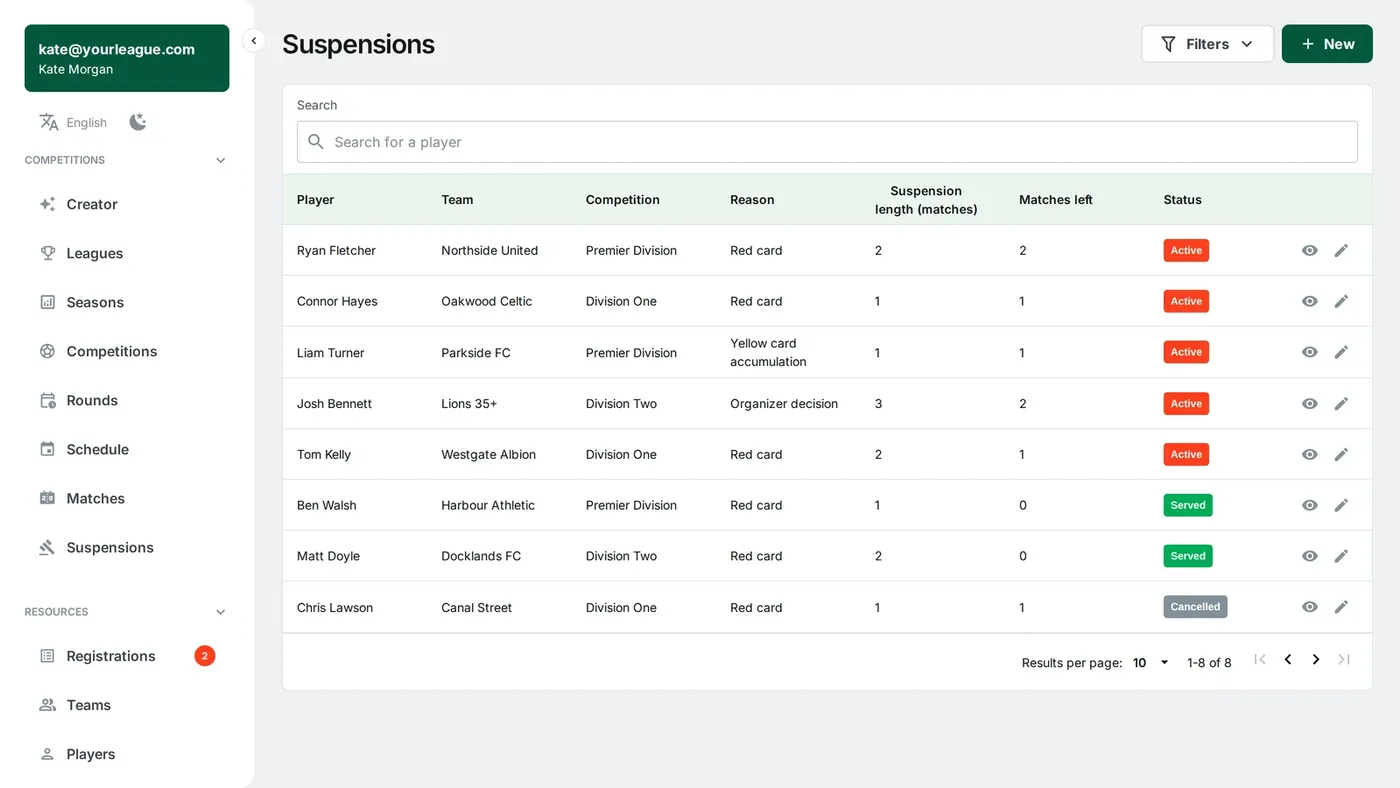
Keep cards simple. A straight red rules the player out of their team's next match, two yellows in the same match count as a red, and yellows don't carry over from match to match, because in a single day there's no time for them to matter. In FLM System, a red card automatically suspends the player for the number of matches you set, and the system won't let them into the next line-up, so nobody at the tournament desk has to keep count in a notebook.
One-day football tournament schedule for 12 teams, hour by hour
Here's the full example: 12 teams of 7-a-side football, two pitches, 25-minute slots (2×10 plus five for the changeover) and the first kick-off at 10:00. Swap A1, B2 and the rest for your teams' names and it works almost as it is.
The format: four groups of three and quarter-finals
The 12 teams are split into four groups of three: A, B, C and D. Each group plays a three-match round robin and the top two go through, eight teams that meet in the quarter-finals, the winners of one group against the runners-up of another. Then come the semi-finals, the third-place match and the final.
That's 20 matches in total: 12 in the groups, 4 quarter-finals, 2 semi-finals, the third-place match and the final. Every team is guaranteed two matches and the finalists play five, a little over 100 minutes of football in one day. The format has an advantage you can feel on the touchline: at midday there are still eight teams alive, and people stay. If you'd rather everyone played three matches, the alternative is three groups of four with semi-finals, 22 matches in about the same time, at the cost of comparing runners-up from different groups. The format guide linked above sets it out.

The schedule from 10:00 to 15:30
The order alternates the groups. While A and B play, C and D rest, so no team plays two slots in a row during the group stage. The numbers 1, 2 and 3 are the teams in each group according to the draw.
- 09:30 – registration at the tournament desk: ID, bibs and balls.
- 09:45 – 10-minute briefing with captains and referees.
- 10:00 – A1 v A2 on pitch 1 and B1 v B2 on pitch 2.
- 10:25 – C1 v C2 and D1 v D2.
- 10:50 – A1 v A3 and B1 v B3.
- 11:15 – C1 v C3 and D1 v D3.
- 11:40 – A2 v A3 and B2 v B3.
- 12:05 – C2 v C3 and D2 v D3.
- 12:30 – quarter-finals 1 and 2: 1st A v 2nd B and 1st B v 2nd A.
- 12:55 – quarter-finals 3 and 4: 1st C v 2nd D and 1st D v 2nd C.
- 13:20 – 15-minute break: water, shelter and the semi-final draw already filled in.
- 13:35 – semi-finals: winners of QF1 v winners of QF3 and winners of QF2 v winners of QF4.
- 14:00 – pitch 2 goes back to the venue.
- 14:10 – third-place match on pitch 1.
- 14:40 – final on pitch 1, 2×12 minutes.
- 15:15 – presentations.
Notice two details. Teams in A and B finish the group stage at 12:05 and play quarter-finals at 12:30, with one free slot in between; teams in C and D finish at 12:30 and play quarter-finals at 12:55, also with a slot of rest. And the winners and runners-up of the same group land in different semi-finals, so two teams from one group can only meet again in the final.
The buffers that save the day
No one-day tournament goes exactly as it does on paper. That's why the schedule above has two buffers. The 13:20 break is the first: if the quarter-finals run late, the delay eats the break and the semi-finals still kick off on time. The second is the 40 minutes between the end of the semi-finals and the final, which also give the finalists a proper rest.
For everything else, there's one rule worth putting in the info pack. If a slot starts late, that match is shortened and the next one starts on time. It sounds harsh, but it's the only way to stop the last match finishing half an hour after your booking ran out.
And plan for rain. A 3G pitch copes with a downpour, a grass pitch often doesn't, so agree with the venue in advance what happens if the pitches are waterlogged, and keep a shortened version of the day ready: a single 15-minute period instead of 2×10, or straight knockout after the groups. Put a gazebo next to the tournament desk, because the team sheets and your phone need to stay dry too.
On the day: the tournament desk and live results
With the schedule printed and the teams registered, the day comes down to a folding table by the pitches. That's where teams register, results get recorded and disputes get settled, and whether the 25-minute slots hold depends on that table.
The tournament desk
The tournament desk needs one person who neither plays nor referees, and ideally a helper to run between the two pitches. On the desk go the squad lists, team sheets for the referees, spare balls, bibs for when two teams turn up in similar colours, the first-aid kit and the printed schedule, with a second copy pinned up where everyone can see it. With FLM System you can give admin access to whoever is helping you, and both of you see the same tournament on your phones.
Live results instead of a whiteboard
At a one-day tournament, the question you hear most is "how's group C looking?", and it almost always comes while whoever keeps the whiteboard is over at the other pitch.
In FLM System you set up the tournament with a group stage and a knockout round, add the 12 teams, and the system generates the fixtures across both pitches. The referee, or a coordinator on the touchline, enters goals and cards from a phone, and each group table updates as soon as the match ends. When the groups finish, the quarter-finals are drawn automatically from the standings, or you set them by hand, as we explain on the page about cup brackets, groups and league phase. Teams and supporters follow everything on the tournament's public page: you post the link in the WhatsApp group and nobody crowds round the desk. The referee app runs in the phone's browser and needs mobile data or Wi-Fi, so check the signal when you visit the venue beforehand.
A tournament costs $1 per team, $12 in this example, the smallest line in the budget above. For $12, all 12 teams see their table on their phones instead of asking you every 25 minutes.

Presentations and what comes next
Do the presentations straight after the final, with both teams still on the pitch. Besides the team trophies, individual awards cost little and keep players from knocked-out teams around until the end. If the referee entered goals and each goalkeeper's goals conceded in the app, you already have the data for the top scorer and the goalkeeper who conceded fewest, without anyone counting by hand.
A one-day tournament is also the best trial run for a league. If all 12 teams turned up, paid and stayed for the final, you have the core of a season, and the guide to starting an amateur football league explains the next step.
FAQ about one-day football tournaments
Most questions before a one-day football tournament come down to three things: how much time you have, how many teams fit and what happens when a match ends level.
How do you organise a charity football tournament?
Run it like any one-day tournament, then add three charity-specific steps. Ask your County FA whether it reduces or waives the sanction fee for charity events, as some counties do. Set the entry fee to cover the day and raise the money for the cause through sponsorship and donations, which can be Gift Aided when they come from UK taxpayers. And publish the total afterwards, with the charity's name and how the money was passed on, because next year's teams will ask.
How many teams do you need for a one-day tournament?
Four is the minimum: a round robin of six matches, then a final between the top two. Five also works, with one team resting each round. The ceiling is set by the pitches, because each extra pitch adds four to six teams to a one-day event.
How long are matches in a one-day tournament?
It depends on the format. As a guide for a one-day event:
- 5-a-side and 6-a-side – two halves of 8 to 10 minutes, or a single 15-minute period.
- 7-a-side – two halves of 10 minutes, or 2×12 in the final.
- 11-a-side – two halves of 15 to 20 minutes; on a full-size pitch fewer teams fit, because each slot takes 40 to 50 minutes.
When you build the schedule, always add five minutes per match for the changeover.
Can you run a tournament on one pitch?
Yes, with six teams at most if you want a group stage: two groups of three that alternate (A, B, A, B), crossover semi-finals, a third-place match and a final. Before you settle for six, ask the venue whether its full-size 3G can be split. Plenty of venues already divide the big pitch for 5-a-side and 7-a-side bookings, so one booking can give you two or three tournament pitches, and the 12-team schedule above fits again. With eight teams on a single undivided pitch, the format that finishes on time is a straight knockout, and half the teams go home after their first match.
How do you separate teams level on points in a group?
In a group of three, teams level on points are common, so put the order in the info pack. A practical order:
- points,
- goal difference,
- goals scored,
- result of the match between the two level teams,
- a three-penalty shoot-out between them, or a coin toss if there's no time.
If all three teams in the group finish level on points and goals, the result between them adds nothing, because the three group matches are exactly the matches between them, and it goes to penalties or the coin toss. In FLM System the order of tiebreakers is configurable, so the table ranks teams by the rules you published.
What prizes should you give?
At a minimum, a trophy for the winners and medals for the winners and runners-up. Buy medals for the whole squad, 12 per team, because nobody wants to be the sub without a medal in the photo. For individual awards (top scorer, goalkeeper who conceded fewest, player of the final), say in the info pack what happens if two players are level, for example whether the award is shared, and hand over any prize money at the presentations, in front of everyone.